Ellie helps GLP-1 users keep weight off after stopping Ozempic, Wegovy, or Zepbound with a structured taper and maintenance plan.
What is Ellie?
Ellie is a mobile application designed for individuals who are coming off GLP-1 medications such as Ozempic, Wegovy, Zepbound, and Mounjaro, or who are reducing their dose. The app provides a week-by-week plan for maintaining weight loss after the medication ends, a period when research shows that up to two-thirds of lost weight returns within a year without structured intervention. The clinical reality is that most prescribers offer limited guidance for the discontinuation phase, and the appetite-suppressing effects of these drugs fade on a predictable schedule, leading to what many users describe as "rebound hunger." Ellie steps into this gap with a structured, science-informed maintenance protocol that goes beyond simple calorie counting. It is built for a specific population: people who have already achieved meaningful results on GLP-1 therapy and want to protect that investment, regardless of whether they are on a standard weekly dose, a stretched or reduced regimen, or completely off the medication. The app's positioning is distinct from general weight-loss apps like MyFitnessPal or Noom, as it acknowledges the biological reality of GLP-1 discontinuation and builds its features around that timeline. The tagline, "You did the hard part. Keep it," encapsulates the mission: the hard part is losing the weight, and the app is there to make sure that effort is not undone.
The website also hosts a substantial library of educational content, with 26 guides covering topics like tapering off Ozempic, food noise, regain research, and muscle loss. These guides are written in a clear, non-promotional tone, and each one includes a grade of the evidence behind the claims.
Key Features
Ellie bundles a range of features that work together to create a comprehensive post-GLP-1 maintenance system. Each feature is designed to solve a specific failure point that users commonly encounter when trying to hold their weight after stopping these medications.
The After Plan is the core timeline that maps out what happens after the last dose, breaking the process into week-by-week phases. It warns of the expected water-weight jump in week one, which the app reassures is not fat and should not trigger panic. It then flags week three to four as the period when appetite returns in earnest, and lists the statistical high-risk windows, including months two through six after discontinuation. For each phase, the app provides specific actions, such as locking in a protein floor or increasing strength training frequency, so users are never caught off guard. The plan is presented in a simple, visual format within the app, with phase markers like "Wk 1," "Wk 2," "Wk 3-4," and "Mo 2-6," each with a brief explanation of what to expect and what to do.
Food Noise SOS is a panic-button feature for moments when intrusive thoughts about food become overwhelming. It walks users through a ten-minute protocol that may include grounding techniques, hydration, or cognitive reframing, and tracks the intensity of "food noise" over time. The app displays a trend chart that shows the frequency and strength of these episodes over eight weeks, allowing users to see that the noise does, in fact, fade. The feature replaces willpower with a tactical response, addressing the psychological grip of cravings and providing a sense of agency in moments of distress.
The Line You Will Not Cross is a personalized weight boundary set by the user, based on their goal or acceptable range. Ellie monitors the seven-day moving average rather than individual daily fluctuations, so it can detect a 4-pound drift early and prompt a "tighten week" of increased focus, rather than waiting until the regain has reached a much higher number. The app uses the metaphor of a "Drift caught early" alert, which tells the user that at 4 pounds above the line, it is a tighten week, not a restart. This proactive monitoring is one of the most valuable features, because it turns a small slip into a manageable correction instead of a full regain spiral.
Protein and Strength Floor sets simple daily targets for protein intake and a minimum frequency of resistance training. The science is clear that muscle preservation is key to maintaining metabolic rate during a calorie deficit and after stopping GLP-1, and Ellie operationalizes this by providing 20-minute full-body strength sessions that can be done at home with minimal equipment. The feature also dispenses with cardio guilt, emphasizing that strength training is more important than cardiovascular exercise for this phase. Users can log their protein intake and see whether they are hitting the floor, which the app identifies as one of the two levers that protect muscle while holding weight.
Medication Modeling allows users to input the exact GLP-1 regimen they follow, whether that is a standard weekly injection, a stretched interval, a stepped-down dose, or no medication at all. The app does not ever suggest a dose or interval, but it uses the regimen to personalize the timing of expected appetite return and adjust the plan accordingly. For example, someone who is stretching their doses might see a different timeline than someone who is tapering off completely. The app models the level of the medication in the body based on the half-life of the specific drug, giving users a visual representation of how the drug concentration declines over time.
Bring-to-Your-Prescriber Export compiles a single clean page that summarizes the user's medication history, weight trend, and the plan they have been following. This is intended to be shared with the prescribing clinician to facilitate informed conversations around dose adjustments or ongoing care, without the clinician having to rely on memory or scattered notes. The export includes a place for the user to write their own questions and concerns, making it a practical tool for telemedicine appointments.
In addition to the app features, the website hosts five free calculators including a washout calculator, microdosing chart, taper schedule visualizer, maintenance calorie calculator, and protein calculator. These tools are available without signup and are meant to educate users even before they download the app.
How It Works
The user journey begins by downloading Ellie from the App Store and setting up a profile. The onboarding asks for basic information about the medication being taken, the current dose, and the goal weight or the highest acceptable weight. The user is asked to draw a line: the boundary they do not want to cross. This line becomes the anchor for all of the app's monitoring.
Once the profile is established, Ellie generates a personalized After Plan timeline, mapping out the expected phases based on the user's specific medication and taper status. The app prompts the user to log their weight every morning, showing a trend line that smooths out daily fluctuations and compares the seven-day average against the line. If the weight drifts 4 pounds above the line, the app triggers a tighten week, which is a temporary increase in structure and monitoring, but not a panic-inducing restart.
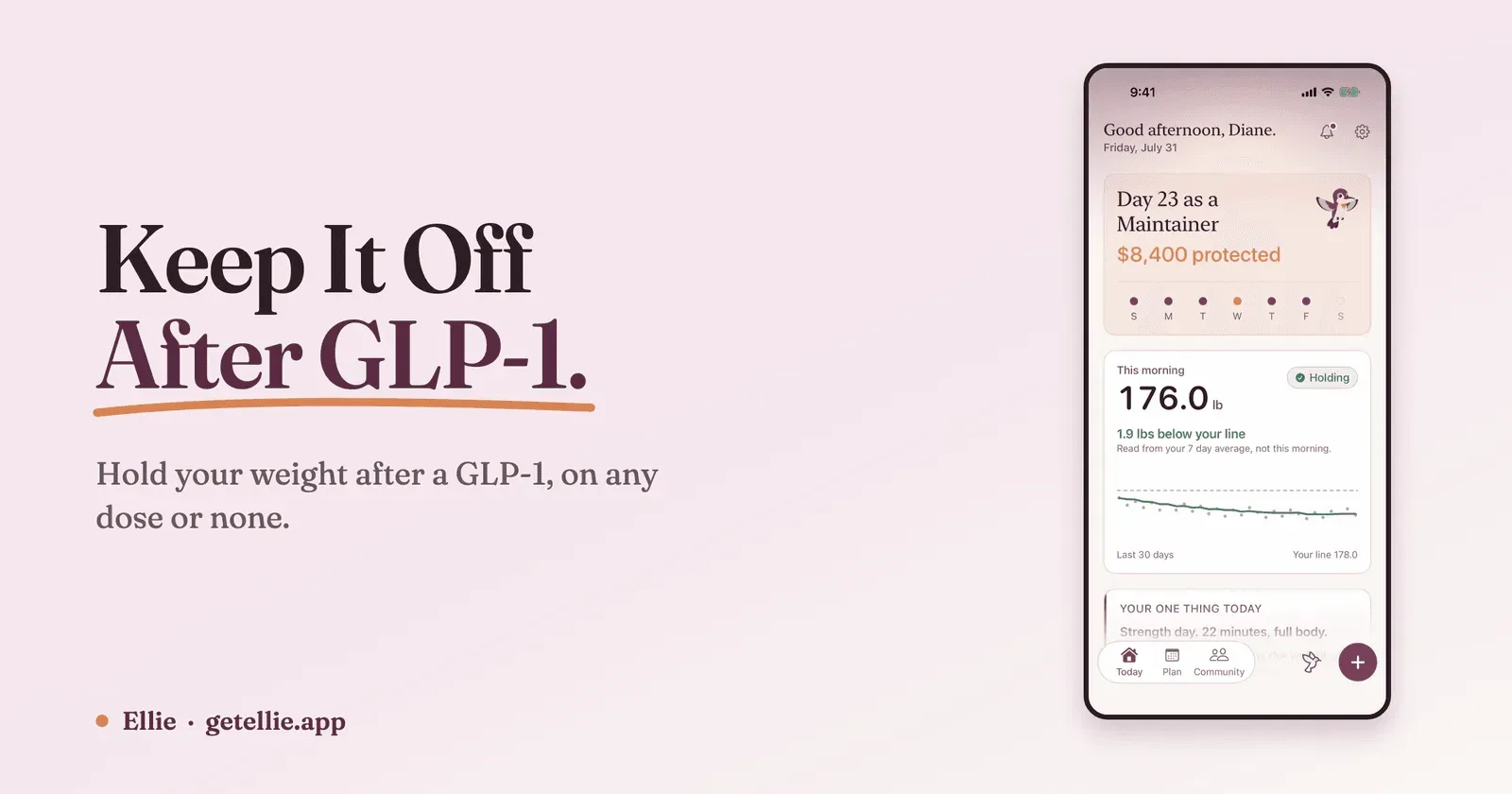
The daily log screen is designed to be minimal: it shows the current weight, a status indicator saying "Holding" or "Below line," and a quick action to log the day's weight. It also displays the current day in the maintenance journey and a cumulative amount of weight protected, for example "$8,400 protected," which seems to be a motivational metric based on the economic value of achieving the goal.
For moments of intense food cravings, the user can open the Food Noise SOS feature, which guides them through a ten-minute protocol that may involve breathing, water, or cognitive reframing. The app tracks the frequency and intensity of these episodes, charting them over eight weeks so users can see progress. The app also includes a strength training module that suggests 22-minute full-body sessions and tracks adherence to the weekly goal.
Every week, the After Plan updates with the predicted changes and recommends specific adjustments. The user can review what is coming next, such as the appetite surge in week three or the hard zone in weeks five to eight, so they can prepare mentally and practically. All of this data can be exported into a prescriber summary page, which the user can bring to a doctor appointment or share electronically.
The overall experience is designed to be low-friction. The app sends reminders to log weight and complete strength sessions, but it does not employ guilt or gamification. The companion character, a hummingbird named Ellie, appears on the log screen and "holds still" when the user is consistent, "rests" when they miss a day, and never scolds. This gentle approach is a clear departure from the harsh streaks and penalties found in many habit apps.
Use Cases
Ellie serves several distinct personas within the post-GLP-1 community.
One common scenario is the person who reached their goal weight on Ozempic or Wegovy and has decided to taper off under medical supervision. Their prescriber may have advised a gradual dose reduction, but offered little guidance on what to expect afterwards. Ellie's taper schedule visualizer and washout calculator help them understand how long the drug remains in their system and how the appetite will gradually return. They use Ellie to set a maintainable weight line and receive weekly reminders to adjust their protein and strength goals. The After Plan gives them a clear roadmap, so they do not feel lost when the hunger comes back.
Another case is someone who stopped cold turkey due to side effects or cost and is now struggling with the hunger rebound. They are not necessarily interested in a full structured plan, but they use the Food Noise SOS tool as a crisis management resource and read the guides on food noise and how to stop it. Over time, they begin logging their weight daily and eventually enroll in the full After Plan to avoid the regain they are starting to see.
A third user might be on a maintenance dose or stretching injections to save money or reduce side effects. They use Ellie to model how the medication level changes with their customized regimen, and they rely on the protein and strength floor to maintain muscle mass while in a reduced-dose state. Their prescriber appreciates the one-page export that clearly shows their medication timeline and weight trend, making telemedicine visits more productive.
Finally, there is the person who has been off medication for months and has managed to hold the line on their own, but is looking for a safety net. They may have experienced a 3-pound creep that they want to address before it becomes a problem. Ellie's early warning system gives them the data to catch the drift and reverse it, and the community guides keep them informed about the research. The app serves as an ongoing monitor rather than a crash course.
Pricing & Value
Ellie is currently available free to download from the App Store, with a subscription unlocking the full plan. The pricing tiers are not explicitly listed on the website, but the language suggests a freemium model where the basic download allows users to log their morning weight and access some tools, while the full After Plan, Food Noise SOS protocol, and prescriber export are part of a paid subscription. The website mentions "subscription unlocking the full plan" and "iPhone first, Android next," indicating a mobile-first subscription business.
The value proposition is strong: a targeted solution to a problem that affects millions of GLP-1 users, backed by published research and real-world clinical data. Compared to generic weight-loss apps that focus on calorie counting or fitness, Ellie addresses the specific biological timeline of GLP-1 discontinuation, which is a unique angle. Given the cost of GLP-1 medications themselves, a modest monthly subscription for a retention tool is likely to be seen as reasonable by the target audience, though the lack of published pricing on the landing page may be a barrier for some. More details about the team and philosophy can be found on the About page. The free tools and guides are a generous offering that allows potential customers to test the logic of the approach before committing.
Frequently Asked Questions
Do I have to be off my medication to use Ellie? No. Ellie is for holding your number on the medication, on less of it, or off it entirely. Stretching doses with your prescriber, tapering, rationing a final box, or fully done: the plan adapts to what you and your clinician decided.
Which medications does it cover? Zepbound, Mounjaro, Wegovy, Ozempic, the oral versions, and compounded semaglutide or tirzepatide. Ellie models the level of whatever you actually take, including the FDA-approved injectables and the compounded versions.
Does Ellie tell me how to dose? Never. Ellie records the regimen you and your prescriber chose and never suggests a dose or an interval. It also builds a one-page summary you can hand your doctor, so those decisions happen where they belong, which is a key differentiator from other apps that may give dosing advice.
Is this medical advice? No. Ellie is an educational companion built on published research, with sources cited in the app. Every medication decision belongs with you and your prescriber. The app is transparent about this boundary, which builds trust.
Is the app available now? Yes. Ellie is live on the App Store for iPhone, free to download, with a subscription unlocking the full plan. An Android version will follow, though no specific timeline has been announced.
Final Verdict
Ellie fills a real and growing gap in the digital health market: the post-GLP-1 maintenance phase that many users and even prescribers overlook. Its strength lies in its focused design, evidenced by the week-by-week After Plan that anticipates the appetite rebound and the weight trend monitoring that catches drift before it becomes regain. The app is refreshingly honest about its limits, explicitly stating that it does not provide dosing advice and is not a substitute for medical care. That transparency is a plus in a space often filled with overpromises. On the other hand, the current iOS-only availability excludes Android users, which is a significant portion of the potential audience, and the app's reliance on self-reported weight logs means it will only be as effective as the user's consistency. For anyone who is serious about keeping the weight off after GLP-1 therapy, Ellie is a practical, science-aligned tool that deserves a spot on their phone.
Pros & Cons
Pros
- The After Plan timeline prepares users for the expected water-weight jump, appetite surge, and high-risk regain windows, so nothing feels unexpected.
- The seven-day trend monitoring and 'line you will not cross' feature provides an early warning system that catches 4-pound drifts before they become full regains.
- Includes a prescriber export tool that creates a one-page summary of the user's medication regimen and weight trend, making doctor visits more productive.
- Offers a robust free tier with five calculators and 26 guides, allowing users to learn and plan before committing to a subscription.
- Addresses an underserved niche: post-GLP-1 maintenance, with a plan built on clinical research and real-world data.
Cons
- Currently available only on iOS, with no launch date for Android leaving a large portion of potential users excluded.
- The app's effectiveness depends on daily self-reported weight logging, which may be a friction point for users who are not consistent.
- Pricing details are not published on the website, making it harder for potential customers to evaluate the subscription value upfront.