AI Web Maker builds a hosted, chatbot-equipped website from a plain business description in minutes, bundling eight marketing tools into one plan.
Small businesses have long treated a website as a project rather than a product: a brief, a designer, a developer, a hosting account, and then a growing stack of subscriptions for blogging, email and live chat. AI Web Maker, built by Finclock LLC, proposes a different sequence. An owner types a short description of the company, and the platform generates a hosted website with a chatbot, blog automation, social scheduling, email tools and lead capture already connected. The company frames the entire exercise as a five-minute operation, and nearly every element of its homepage is organised around that compression of effort.
What is AI Web Maker?
AI Web Maker is an AI website generator that converts a plain-language description of a business into a complete, publish-ready website with hosting, an AI chatbot, blog automation, social scheduling, email management, lead capture and contact forms included under one account. It is aimed at owners and operators who need a credible online presence but have no appetite for code, template shopping or an agency retainer.
The gap it addresses is fragmentation. A typical small business assembles a site builder, a hosting plan, a blogging tool, a social scheduler, an email service and a chat widget, then pays for and maintains each one separately. AI Web Maker collapses that stack into a single dashboard and a single recurring charge, which puts it in competition with both DIY website builders and the traditional agency model.
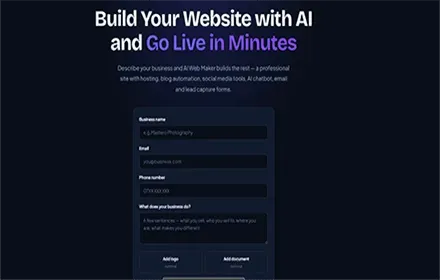
Its stated differentiators are speed and breadth rather than design customisation. The homepage advertises five minutes to a live website, eight bundled tools per account, round-the-clock chatbot coverage from day one and zero lines of code required. Whether the five-minute figure holds for every industry is debatable, but the positioning is unambiguous: the product sells a finished outcome rather than a toolkit. The build form on the AI Web Maker homepage doubles as the signup funnel.
Key Features
AI website builder. The core engine takes a business name, contact details and a written description of up to 4,000 characters, then generates a complete site with pages, copy, imagery and navigation. Optional logo and document uploads feed additional brand context into the generation step.
Blog automation. The platform writes and publishes SEO-oriented blog posts on a schedule the owner defines, with the option to review each post before it goes live or let the system run unattended. Headings and keyword placement are handled automatically, which addresses the content treadmill that stalls most small business blogs.
Social media automation. Posts can be composed and queued across Facebook, Instagram, LinkedIn and other connected accounts from the same dashboard that manages the website, removing the need to log into each network separately.
AI chatbot support. A built-in assistant answers common visitor questions, collects lead details and escalates anything it cannot handle by email. It is active from the moment the site publishes and requires no manual training, though deeper customisation is available.
Email management and lead capture. Welcome messages, follow-ups and promotions are sent from the dashboard, and visitor prompts feed contact data straight into the same contact system, so the marketing list grows without a separate email platform.
Hosting and contact forms included. Every generated site is deployed on the company's own infrastructure, and professional contact forms route submissions into an organised dashboard view for follow-up.
How It Works
The journey starts with a single form rather than a wizard. A prospective user supplies a business name, an email address, a phone number and a description of what the business does, with the option to attach a logo or a supporting document such as a PDF or Word file. A CAPTCHA check sits at the bottom of the form, and a hidden honeypot field guards against automated submissions.
Submitting the form triggers generation. The AI assembles the site in real time, producing page structure, marketing copy and imagery tuned to the industry described, and configures the supporting tools in parallel. The company says most users see a finished website within minutes rather than days.
From there the owner reviews the result, adjusts wording or branding where needed, and connects a domain before publishing. Because hosting is included, there is no separate deployment step or third-party account to configure.
Once live, the automation layer takes over. Blog posts appear on the chosen schedule, social content is queued, the chatbot begins fielding enquiries, and form submissions accumulate in the dashboard. For ongoing help, the support address published on the site is a standard email channel rather than an in-app live chat.
Who AI Web Maker Is Built For
The company names seven audience segments on its homepage: local retail shops, freelance consultants, food and hospitality businesses, health and wellness providers, real estate agents, creative agencies and e-commerce startups. The common thread is an owner-operated business where nobody has a spare week for design work.
Freelancers and consultants tend to value the blog automation most, because search visibility matters to them but writing time does not exist. Hospitality and retail businesses lean on the contact forms and chatbot, since enquiries arrive outside working hours. Agencies fit less comfortably, partly because the platform's standardised output limits the bespoke work that agencies sell, and partly because the value proposition assumes the client has no in-house design capability.
- Businesses that have never had a site and need one live quickly
- Owners migrating from an agency retainer who want predictable costs
- Operators replacing a stalled DIY build that was never finished
- Service businesses that lose enquiries because nobody answers after hours
Use Cases
A boutique fitness studio that has postponed its website for two years can describe its class schedule, membership tiers and location in a paragraph and have a working site with a booking enquiry form the same afternoon. The chatbot handles the repetitive questions about pricing and timetables, and staff see the qualified enquiries in one dashboard rather than across email, phone and direct messages.
A logistics startup paying an agency several thousand dollars a month for a static brochure site can rebuild with the generator and gain blog, email and social tools that the agency never offered. The cost comparison is the deciding factor here rather than design quality.
An independent consultant can rely on scheduled blog posts to build search visibility without writing anything, which is the specific pain the company's own testimonial section emphasises. The consultant retains editorial approval, so the automated output can be reviewed before publication.
A restaurant owner can generate a site with a contact form and an always-on chatbot and take bookings through the site daily, without hiring anyone to maintain the underlying technology.
The Free Tool Suite
Alongside the paid platform, the company operates a set of free, no-signup utilities that function as an on-ramp. The collection of free AI SEO tools includes an AI Website SEO Checker that scores public pages out of 100, an AI Domain Name Finder that suggests names with available domains, an AI Website Launcher that finishes abandoned builds, an AI Company Profile Generator, an AI Online Marketing Strategy Generator that produces a 90-day plan, and an AI Social Media Marketing Strategy Maker with a four-week posting calendar.
These tools serve two purposes. They give sceptical buyers a way to test the underlying models without committing an email address, and they generate qualified traffic from searches the core product would not otherwise capture. The strategic logic is sound, and the tools are genuinely usable rather than decorative lead forms.
Pricing & Value
The homepage does not publish pricing tiers. No plan table, no per-month figure and no feature comparison matrix appears anywhere in the marketing content, which leaves prospective buyers to register or email support before they can assess cost. The build form also asks for a phone number, suggesting a sales-assisted onboarding path for at least some segments.
What can be established is the structure of the offer. Every plan includes website generation, hosting, the chatbot, blog automation, social scheduling, email tools, lead capture and contact forms, because those are described as standard rather than optional add-ons. The site explicitly states that hosting carries no extra charge and requires no third-party account.
The value case therefore rests on consolidation. If the bundled tools replace even three separate subscriptions, the arithmetic favours a single platform, particularly for owners who would otherwise pay for hosting, a blog plugin, a scheduler and a chat widget. The absence of published pricing, however, is a real friction point for buyers who want to compare options without a conversation.
Competitive Positioning
AI Web Maker sits between two established camps. On one side are general-purpose website builders that offer strong design tooling but leave hosting, blogging, chat and email to integrations. On the other are agencies and freelancers who handle everything but charge accordingly and move slowly.
The company also publishes a comparison of website builders, which signals that it expects to be evaluated on breadth of included features rather than on template variety or design flexibility. That is a defensible position, since the target buyer is unlikely to care whether the grid system is customisable.
Where the product looks weaker is differentiation against other AI site generators. Most competing tools now promise a full site from a prompt. AI Web Maker's answer is the bundled operational layer, the chatbot, blog engine, email and social scheduling, which is harder for a prompt-only competitor to match and gives the platform a more defensible story.
Support, Onboarding and Trust Signals
Support is handled through a published email address, [email protected], with the company describing the platform as self-serve but offering guidance when users get stuck. There is no visible live chat, phone line or documentation portal on the homepage, which is a notable omission for a product aimed at non-technical buyers.
Trust markers are limited to a featured-on strip covering Startup Fame, Turbo0, PeerPush, Uno Directory and Fazier, plus a set of four customer testimonials from a fitness studio owner, a logistics founder, an independent consultant and a restaurant owner. Those testimonials are self-reported and unverified, and the metrics quoted, five minutes, eight tools and 24/7 coverage, are the company's own figures rather than independently benchmarked results. Buyers should treat them as directional.
The product is operated by Finclock LLC, and terms, privacy and refund policies are linked from the footer, which is a reasonable baseline for a subscription business.
Frequently Asked Questions
Does AI Web Maker require any technical skill? No. The workflow is built around a written description of the business, and the platform handles design, copy and configuration. The company states that anyone comfortable writing an email can produce a site.
How long does it take to get a website live? The advertised average is five minutes from signup, with the site generated in real time as the description is submitted. Domain connection and any manual editing add to that figure.
Is hosting included or is it an add-on? Hosting is included on every plan at no additional cost, and the published site runs on the company's own infrastructure without a separate hosting account.
What does the AI chatbot do? It answers common visitor questions around the clock, captures lead information, and forwards complex enquiries by email. It operates from day one without manual training.
Can a business move an existing site to the platform? Yes. The company positions migration as a minutes-long process in which the site is rebuilt and the existing domain redirected, and it offers a launcher tool specifically for unfinished builds.
Does the platform publish pricing? Not on the homepage. Prospective buyers need to register or contact support before plan costs can be compared.
Final Verdict
AI Web Maker makes a coherent, well-defined promise and mostly sticks to it. The consolidation argument is the strongest part of the offer: hosting, a chatbot, blog automation, social scheduling, email and lead capture in one account removes a genuinely annoying layer of subscription management for owner-operated businesses. Speed is the second strength, and the free tool suite gives sceptical buyers a low-risk way to sample the technology.
The limitations are worth weighing. Pricing is not published anywhere on the marketing site, which makes comparison shopping harder than it should be. Automation output is generated rather than written, and the homepage offers little detail on brand voice controls or platform-specific social integrations. Trust signals, meanwhile, consist of self-reported testimonials and directory badges.
For solo operators, local service businesses and consultants who want a functional site plus a marketing layer without hiring anyone, AI Web Maker is a sensible starting point, provided the quoted plan costs hold up once disclosed. Agencies and businesses with strict brand or design requirements should look at more customisable builders first.
Pros & Cons
Pros
- The generator converts a plain-language business description of up to 4,000 characters into a full website with pages, copy, imagery and navigation, and the company reports an average of five minutes from signup to a live site.
- Hosting is included on every plan at no extra charge and runs on the company's own infrastructure, eliminating a separate hosting account and deployment step for non-technical owners.
- Eight tools ship together by default, covering website generation, blog automation, social scheduling, an AI chatbot, email management, hosting, lead capture and contact forms.
- A round-the-clock chatbot answers visitor questions, collects lead details and escalates complex enquiries by email from the first day a site goes live, with no manual training required.
- Six free, no-signup utilities including an SEO checker, a domain name finder and a marketing strategy generator give sceptical buyers a low-risk way to sample the underlying technology.
Cons
- The marketing site publishes no pricing tiers, no monthly figures and no feature comparison matrix, so buyers must register or email support before they can evaluate cost.
- Blog and social automation rely on AI-generated content, and the homepage gives no detail on brand voice controls, approval workflows beyond review-before-publish, or the depth of platform-specific social integrations.
- Trust evidence is thin, consisting of four self-reported testimonials and directory badges, with no third-party review coverage, documentation portal or independent benchmark of the advertised speed and coverage claims.