PrivateTechShares helps founders and employees value startup equity, model exercise costs, dilution and tax, and prepare private secondary share sales.
PrivateTechShares is a niche research and tooling resource built for people who hold equity in privately held technology companies. The site targets a gap that mainstream secondary marketplaces leave open: the founder, early employee, or former staff member holding a modest stake that is too small for institutional platforms yet still meaningful to the person who earned it. Rather than brokering transactions, the platform supplies free estimators, country-specific tax explainers, and paid preparation toolkits covering the United States and Europe. This review examines its features, pricing, and market positioning as presented on the live site.
What is PrivateTechShares?
PrivateTechShares is an educational resource and toolkit provider that helps founders, employees, and former staff understand what private-company equity is worth, what it costs to exercise options, how dilution reshapes a stake, and how a secondary sale is taxed. The problem it addresses is informational rather than transactional. Most knowledge about private startup equity sits with venture capitalists, angels, and professional advisers, while the people who actually earned the shares are left to guess. The platform is built for holders of small stakes, roughly ten thousand to seven hundred fifty thousand euros in value, who fall below the minimums demanded by large secondary platforms such as Forge, EquityZen, and Nasdaq Private Market. Its positioning is deliberately non-transactional: no fund, no marketplace, no broker, and no cut of any deal. Instead it competes with scattered blog posts, expensive advisory hours, and generic online calculators that ignore how common shares differ from preferred stock. The tone throughout is plain English with sources shown and dated, which appeals to holders who want orientation before paying for professional advice.
Key Features
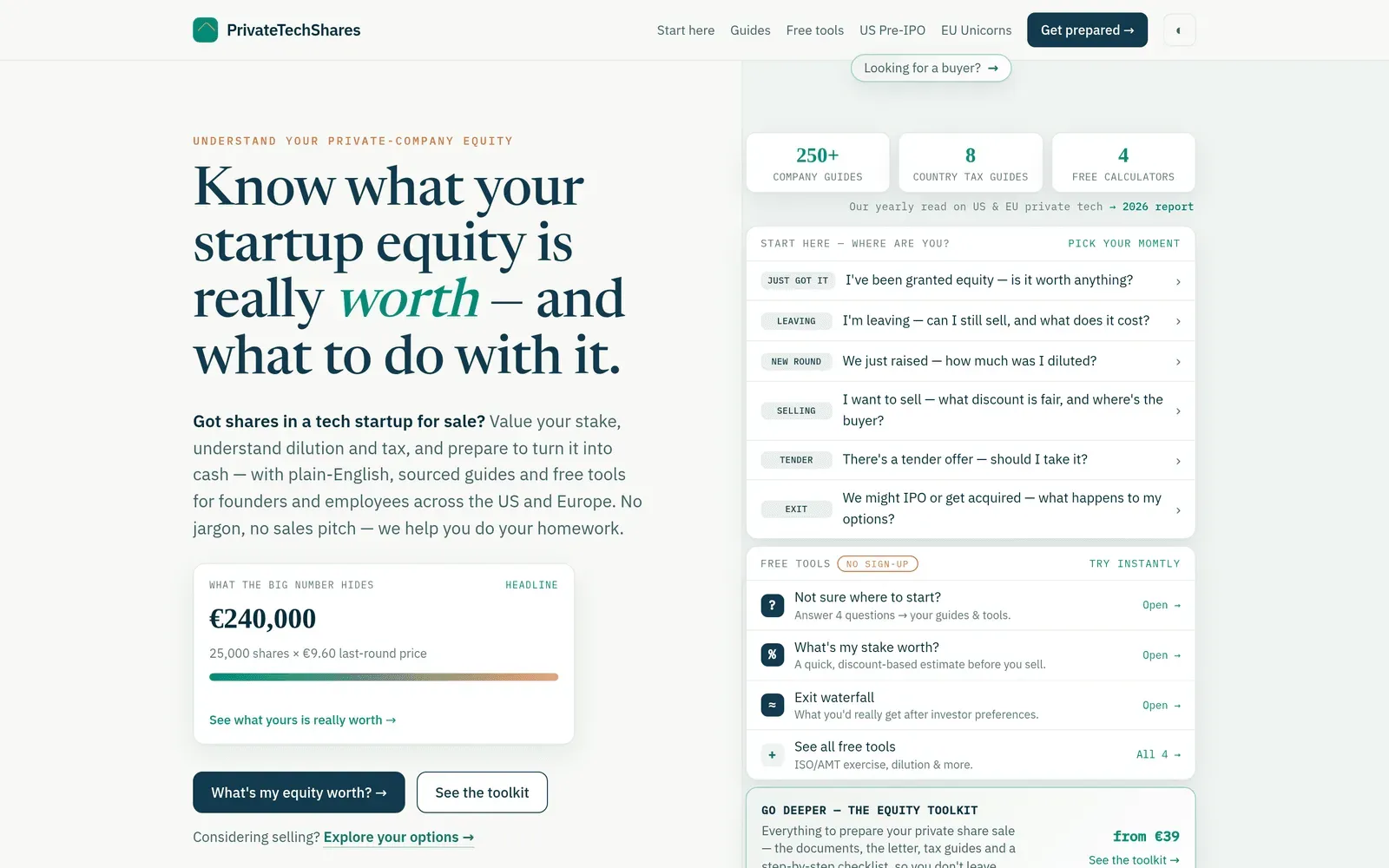
Valuation estimator. A free, no-sign-up calculator prices a stake off the last funding round and then adjusts for what the holder actually owns. Users select currency, share count, price per share at the last round, holding type, strike price where options are involved, and company stage. The output is a range rather than a single figure, and the tool openly flags that common shares are worth less than the preferred shares investors purchased.
Option exercise calculator. A second free tool estimates the cash cost of converting vested options into real shares and shows the paper spread against the last-round price. A country selector adds a rough tax note, and a separate AMT-aware variant for the United States layers in alternative minimum tax and ordinary income treatment.
Situation-based entry points. The homepage routes visitors through six life moments: just granted equity, leaving a company, a new funding round, wanting to sell, a tender offer, and an acquisition or IPO. Each links to a dedicated explainer, from country and process guides through to the equity navigator quiz that maps four answers onto a recommended reading path.
Company and country coverage. More than 250 company guides cover names such as OpenAI, Anthropic, SpaceX, Stripe, Databricks, Revolut, Monzo, Helsing, and Mistral AI, split across US Pre-IPO and EU Unicorns hubs. Eight country tax guides cover Germany, the United Kingdom, France, Spain, Italy, the Netherlands, Poland, and the United States. A yearly private tech equity report adds market context.
Paid preparation toolkit. A 39 dollar US edition and a 39 euro European edition deliver an eight-phase A to Z deal map with explicit STOP boxes marking where a lawyer, tax adviser, or notary takes over. Each bundle includes a live net proceeds calculator, a Deal Room control panel, an editable Word workbook, and eleven ready-to-send messages. The US version handles ISO, NSO, AMT, and QSBS questions, while the European version adds transfer and tax playbooks for seven countries.
Equity Position Report. At 129 dollars, a personalised report runs the entire picture on a single grant: pre-tax and post-tax scenarios, exercise cost, dilution modelling, an exit waterfall after investor preferences, a shareable one-page summary, and a conversation pack of questions for advisers. A 249 dollar tier adds expert human review, and the underlying Equity Position Methodology is published for scrutiny.
How It Works
The entry point is intentionally frictionless. A visitor lands on the estimator, picks a currency, enters share count and the last-round price, selects whether the holding consists of common shares, vested options, or preferred stock, and receives a discounted range within seconds. No account, email address, or payment is required. Inline hints explain unfamiliar terms such as strike price and virtual or phantom units, and the disclaimer states plainly that the number is an estimate and not a valuation or an offer.
From there the journey branches by circumstance. A departing employee follows the leaver path, which covers the roughly ninety-day exercise window and the tax consequences of exercising. A founder mid-round follows the dilution material. Someone holding a tender offer follows a walkthrough of how employee tender offers are structured. Free calculators, the equity navigator quiz, and the downloadable Equity Starter Kit support each branch, and every explainer cites its sources with dates attached.
Preparation is the paid step. Buying a toolkit unlocks the deal map, the spreadsheet calculator, and the document templates. The workflow then moves through readiness checks, a right-of-first-refusal or board approval request, price negotiation with a buyer, and completion of the transfer, often before a notary in European jurisdictions. The final link in the chain is the personalised Equity Position Report, positioned for holders who prefer their own numbers worked out in advance of a call with a company, buyer, lawyer, or tax adviser.
Use Cases
The departing employee with a deadline. A staff member leaves a Series C company with vested stock options and roughly ninety days to exercise. The exercise calculator shows the cash required and the paper spread, while the leaver guide explains the tax event and the consequences of letting the options lapse. The outcome is an informed decision rather than a default forfeit.
The founder seeking partial liquidity. A co-founder holds a meaningful but illiquid stake and wants cash for a property purchase without selling everything. The estimator produces a discounted range, the toolkit supplies the right-of-first-refusal request template, and the process map clarifies which approvals are needed before a buyer can be approached.
The employee facing a tender offer. A worker at a late-stage European unicorn is offered the chance to sell into a company-sponsored tender. The tender offer explainer sets out how such offers are typically priced and structured, while the country tax guide estimates net proceeds, helping the holder weigh participation against waiting for a future exit.
The former employee unsure whether a sale is even possible. Someone who left years ago holds shares governed by a shareholder agreement with transfer restrictions. The four-question eligibility check returns a clear answer about vesting, approval requirements, and stake size, then points toward the relevant guide instead of leaving the question unanswered. Each scenario ends with the same principle: the decision belongs to the holder.
Pricing & Value
The free layer is genuinely generous. The valuation estimator, the exercise calculator, the four-question eligibility check, the Equity Starter Kit PDF, the equity navigator quiz, and all country guides cost nothing and require no registration, which is unusual in a category that typically gates data behind email capture.
Paid products sit at three levels. The US Equity Toolkit costs 39 dollars, the European edition costs 39 euros, and the bundle covering both sells for 59 euros against a nominal 78 euro list price. The personalised Equity Position Report is 129 dollars, with an expert-reviewed version at 249 dollars. Checkout runs through Stripe, delivery is instant, and a thirty-day money-back guarantee applies. For anyone weighing a sale worth tens of thousands, the entry price is a rounding error, and the bundle is the obvious purchase for holders whose situation could touch both jurisdictions.
Frequently Asked Questions
Is PrivateTechShares free to use? The core tools are free and require no sign-up, including the valuation estimator, the option exercise calculator, the four-question eligibility check, the equity navigator, and all eight country guides. Only the toolkits and the personalised report carry a price.
Does the site buy, broker, or hold shares? No. The platform describes itself as an information and tools resource. It does not hold shares, act as a broker, introduce buyers directly, or take a percentage of any transaction.
Which countries and companies are covered? Tax and process guides exist for Germany, the United Kingdom, France, Spain, Italy, the Netherlands, Poland, and the United States. More than 250 company pages span US pre-IPO names and European unicorns, from OpenAI and SpaceX to Revolut, Helsing, and Mistral AI.
What does the paid toolkit actually contain? The US and European editions both include an eight-phase process guide with professional STOP points, a live net proceeds calculator, a Deal Room control panel, an editable workbook, and eleven pre-written messages. The American version adds ISO, AMT, and QSBS material.
How does it compare with EquityZen, Forge, or Nasdaq Private Market? Those platforms target large late-stage transactions with institutional minimums. PrivateTechShares targets holders of small stakes and concentrates on preparation and education rather than execution, which makes it complementary rather than directly competitive.
Final Verdict
PrivateTechShares occupies a sensible, underexploited corner of the private markets. Its free calculators deliver immediate utility, its sourcing is transparent and dated, and its dual US and European coverage addresses a real gap for holders whose stakes fall below institutional thresholds. The honest framing is refreshing: the site repeatedly states that it provides education rather than advice, and that documents are starting points requiring professional review.
The limitations are equally clear. The platform does not execute transactions, does not match buyers, and leaves the actual sale to the holder and their advisers, so anyone expecting an end-to-end marketplace will be disappointed. Coverage stops at eight countries, and every figure remains an estimate that ignores individual plan terms and exact tax positions.
For founders, employees, and former staff holding a modest illiquid stake who want to understand their position before spending money on advisers, the free tools justify a visit on their own, and the 59 euro bundle is a low-risk next step. Those seeking an actual buyer should look elsewhere. The best fit is the holder who wants to walk into a conversation with lawyers or accountants already prepared. A closer look at the free tool library and the Equity Position Report is the natural starting point.
Pros & Cons
Pros
- Free valuation and option exercise calculators work instantly without sign-up, email capture, or payment.
- Transparent, dated sourcing on tax rates and process rules makes every figure easy to verify independently.
- Dual US and European coverage, including country tax guides for Germany, the UK, France, Spain, Italy, the Netherlands, and Poland, serves holders in both major private markets.
- The paid toolkit includes an eight-phase A to Z deal map with explicit STOP points revealing exactly where a lawyer, tax adviser, or notary must take over.
- More than 250 dedicated company guides cover pre-IPO names such as OpenAI, SpaceX, Stripe, Revolut, and Mistral AI.
Cons
- The platform is purely educational and does not broker sales, match buyers, or hold shares, so no transaction can be completed on-site.
- Toolkit documents are starting-point drafts written in plain English and still require review by a qualified lawyer before use.
- Country coverage stops at eight jurisdictions, leaving holders in other markets without localized tax and transfer guidance.