CertWorthIt analyzes 362,748 real job ads across 10 countries to reveal which certifications employers actually name, by role and country.
What is CertWorthIt?
CertWorthIt is a data-driven research platform that answers a single expensive question for learners: is a given professional certificate actually named in the job ads for the role it claims to serve? Instead of leaning on vendor marketing pages or course platform testimonials, the site counts real job postings pulled from the Adzuna API and uses AI to parse the results, then publishes the frequency of each credential by role and country. The problem being solved is information asymmetry. Certification bodies and course providers have every commercial reason to overstate employer demand, while candidates have had almost no neutral way to check whether an employer has ever asked for a specific exam.
CertWorthIt is built for career switchers, help desk technicians, project coordinators, data analysts, cybersecurity professionals and anyone weighing a several-hundred-dollar exam fee against the salary it might unlock. It positions itself as evidence rather than opinion, and the homepage leads with a number rather than a pitch. In the United States, employers name PMP in 24% of project manager job ads, while Google Data Analytics appears in 7 of 6,094 data analyst ads. Against alternatives such as salary aggregators, forum threads and course reviews, the platform competes on method, transparency and country coverage rather than on volume of opinion, and every published figure links back to the ad set it came from.
Key Features
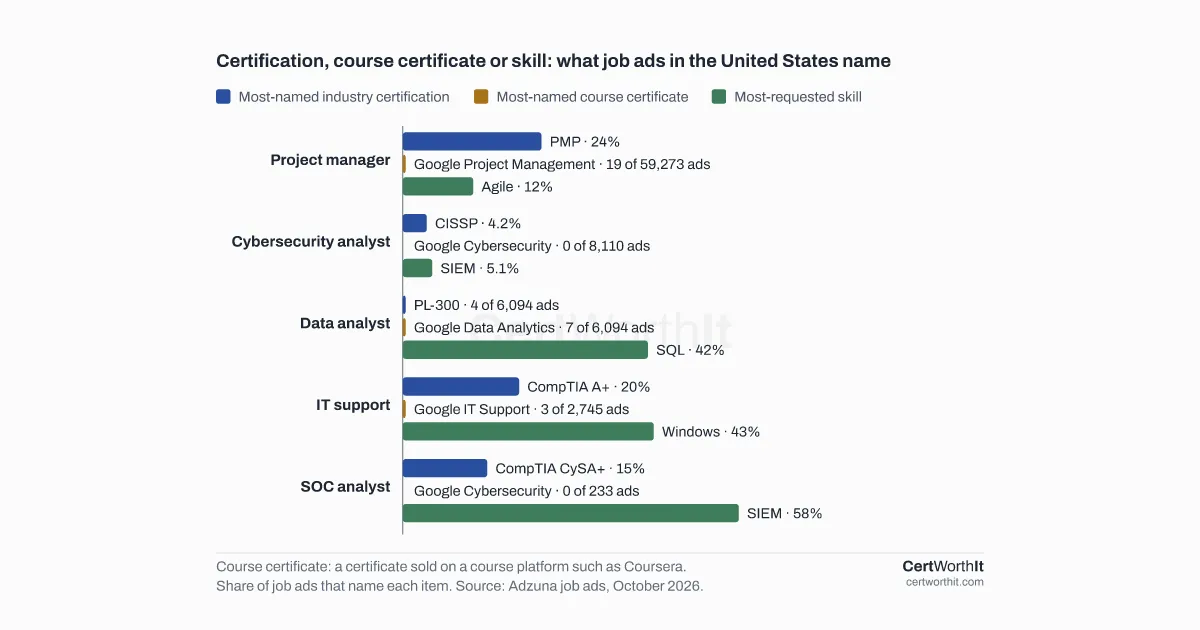
Job-ad frequency data across ten countries. The underlying dataset covers 362,748 job ads from the Adzuna API, spanning the United States, United Kingdom, India, Brazil, Mexico, Spain, France, Germany, Italy and Poland. Each certificate page reports the share of matching ads that name the credential, so PMP appears in 24% of United States project manager ads, CISSP in 4.2% of cybersecurity analyst ads, CompTIA CySA+ in 15% of SOC analyst ads and CompTIA A+ in 20% of IT support ads. Data is dated to October 2026 and labelled as such throughout.
A directory of 78 certifications with job-ad data. The certificate directory runs from AI-901, AWS and AWS AI Practitioner through CCNA, CCNP, CEH, CISM, CISSP, CompTIA A+ and CompTIA SecurityX (CASP+) to OSCP, PMI-ACP, PMP, PRINCE2, PSM, SnowPro Core, Six Sigma Black Belt and SSCP. Each entry is a dedicated page rather than a paragraph inside a listicle, which makes the index usable as a lookup tool rather than a reading exercise.
Side-by-side comparison pages. Dedicated comparison URLs set two credentials against each other using matching ad shares: CAPM versus PMP at 1.7% against 24%, PMI-ACP versus PMP at 1.1% against 24%, CCNA versus CCNP at 16% against 20%, CISSP versus OSCP at 4.2% against 73%, CISM versus CISSP at 1.7% against 4.2% and CSM versus PSM at 22% against 12%. Relative frequency matters more than absolute numbers when two exams cost similar amounts and demand similar study time, and this is the section of the site where that comparison is easiest to make.
Field and role browsing. Visitors who cannot name a certificate can browse by field instead. Cloud and DevOps carries 20 certifications with data, cybersecurity 15, data and analytics 11, IT support and networking 9, project management 9, AI 6 and Agile and Scrum 4. Role pages offer a parallel route, covering project manager, AI engineer, data engineer, network engineer, cybersecurity analyst, cloud engineer, system administrator and data analyst, each showing the most-named credential for that title.
Country rankings and a four-question quiz. Ranking pages order certifications by the share of ads in their main job for a given country, with OSCP leading the United States at 73%, CCNP leading the United Kingdom at 14% and PMP leading India at 24%. A separate quiz routes undecided visitors from their current job, experience level and goal to a shortlist rather than a single answer, and the search box supports autocomplete across the full index with placeholder hints such as PMP, CCNA and AWS.
Country reports and multilingual delivery. A report tool assembles a country-specific digest of the certifications employers name most and the skills those same ads request, and it can be generated before any email address is supplied. Adding an email brings a monthly update when the numbers change, with an optional newsletter covering the largest movements across all ten countries. The site is published in English, Brazilian Portuguese, Spanish, French, German, Italian and Polish, with hreflang tags connecting each locale.
Methodology and attribution. A published methodology page explains how counts are produced. A trust strip on the homepage states the Adzuna API source, the 362,748 ad count, the 78 certifications with data and the October 2026 date, while the footer names an editor and the operating company, Lumavera OU, registered in Tallinn, Estonia. For a free site making hiring claims, that level of attribution is unusual.
How It Works
The experience begins on the homepage, which opens with a specific finding rather than a mission statement. A headline cites PMP at 24% of United States project manager ads, Google Data Analytics at 7 of 6,094 data analyst ads, and SQL at 42% of the same ads. Directly beneath, a chart contrasts three things within each job category: the industry certification most often named, the most relevant course certificate, and the core skill the ads request. The pattern is consistent and deliberately unflattering to course credentials. In five of five tracked jobs, the top skill is named in more ads than the corresponding course certificate. A "Show the numbers" control expands the chart into an accessible table with raw values, a small design decision that matters for anyone who wants to verify a claim rather than trust a visual.
From that point, three routes lead deeper. The first is the search field, which accepts an acronym such as PMP, CCNA or AWS and returns the matching certificate page, with frequently checked items listed underneath. The second is the quiz, which asks a short sequence about the target job and returns a shortlist. The third is browsing, either by field, by role, or through the alphabetical index of all 78 certificates.
Anyone wanting a wider view can open the report tool, select one of the ten covered countries from a dropdown, optionally indicate experience level and goal, and generate a report without entering an email address. Supplying an email adds a monthly update tied to changes in the data, while a separate newsletter checkbox adds monthly commentary plus one new study, with a single-click unsubscribe. Turnstile protects the form against automated submissions and a hidden honeypot field filters bots. The footer discloses that job-ad counts come from the Adzuna API with permission, that certificate facts come from vendor pages, and that some outbound links are affiliate links which the publisher states never change a verdict.
Use Cases
A help desk technician choosing between CompTIA A+ and a Google certificate. Someone already working tier-one support can compare how often CompTIA A+ is named in IT support ads, at 20%, against Google IT Support, which appears in 3 of 2,745 ads, before committing study hours. In the United States data, the industry certification carries dramatically more employer recognition, which reframes the decision around exam cost and preparation time rather than perceived prestige.
A career switcher deciding between project management credentials. A candidate moving into project coordination can look at PMP at 24%, CAPM at 1.7% and Google Project Management at 19 of 59,273 ads, then weigh the experience requirements attached to each. The numbers suggest the entry-level options have minimal ad presence in the tracked market, pushing the planning conversation toward how to accumulate qualifying experience rather than which cheaper certificate to buy first.
A security professional choosing a specialisation. CISSP appears in 4.2% of cybersecurity analyst ads while OSCP, the most-named certification in the United States overall, appears in 73% of the ads for its main job. That spread helps someone decide between governance-oriented and offensive-security-oriented training, and the CISSP versus OSCP comparison page makes the gap explicit in a single view.
An L&D lead or recruiter auditing a job description. Talent teams can use the country ranking pages to check whether a certification requirement in a posting reflects the wider market. A requirement that filters candidates for a credential appearing in a handful of comparable ads imposes a measurable cost in candidate pool size, and the published ad shares give a defensible basis for removing or downgrading it.
A data analyst weighing industry and course credentials. PL-300 appears in 4 of 6,094 data analyst ads while Google Data Analytics appears in 7 of the same set, and SQL appears in 42%. For this role the data shows neither certificate dominates hiring language, and that demonstrable SQL ability is the more frequently requested signal by a wide margin.
Pricing & Value
CertWorthIt is free to use. There is no paywall on certificate pages, comparison pages, country rankings, field listings, role pages, the quiz or the report generator, and the report can be produced without supplying an email address. The business model is disclosed in the footer instead of hidden: some outbound links to certification vendors or course platforms are affiliate links, and the site states that these never change a verdict. Email capture is optional and limited to report delivery plus a monthly newsletter, both cancellable in one click. The honest value assessment is straightforward. The cost to the reader is attention and, at most, an email address, while the potential saving is the price of an exam and several weeks of preparation aimed at a credential employers rarely name. The caveat is that the free tier is the only tier, so there is no deeper commercial dataset, API access or historical export for teams wanting to run their own analysis.
Frequently Asked Questions
Is CertWorthIt free to use? Yes. Certificate pages, comparisons, country rankings, the quiz and the report generator are all accessible without payment, and the report can be generated without an email address.
Where does the job-ad data come from? Counts come from the Adzuna API, used with permission. The October 2026 dataset covers 362,748 job ads, and every published figure links back to its source, with a methodology page explaining how the counting works.
Which countries are covered? Ten markets are tracked: the United States, United Kingdom, India, Brazil, Mexico, Spain, France, Germany, Italy and Poland. Individual ranking pages exist for the United States, the United Kingdom and India, with an all-countries overview.
How does CertWorthIt compare to forum threads or course reviews? It substitutes ad-level counts for individual anecdote. Reddit quotes are linked where the site uses them, but the verdicts rest on how frequently employers name a credential across thousands of postings rather than on one person's hiring experience.
Does AI write the analysis? The site states openly that AI analyses the job-ad data and writes its pages and reports, while the counts originate from Adzuna data and figures and sources are checked automatically. That disclosure appears on the homepage and is repeated in the email capture form.
Who is CertWorthIt best suited to? Career switchers, IT support and networking staff, project managers, data and security professionals, and learning and development teams who need a neutral starting point before committing to an exam.
Final Verdict
CertWorthIt fills a niche that certification vendors and course platforms have little incentive to address, and it does so with unusual transparency for a free site. The strongest elements are the source-linked counts, the published methodology, the ten-country coverage and the comparison pages that turn abstract credential debates into concrete percentages. The limitations are just as visible. Coverage depends on what the Adzuna index contains, so postings on other boards, or roles filled through internal referral, never enter the count, and a job that requires a credential without naming it in the text will be undercounted. The dataset is also presented as a snapshot anchored to one collection period rather than a trend line, so the site shows current naming frequency but not whether a credential is gaining or losing ground over time. Readers who accept those constraints will find a fast, honest filter. CertWorthIt suits career switchers, IT professionals choosing between two exams, and talent teams auditing their own requirements, while anyone hunting salary benchmarks, exam vouchers or study material should look elsewhere.
Pros & Cons
Pros
- Counts 362,748 real job ads from the Adzuna API across ten countries, replacing anecdote with employer-level naming frequency for each credential.
- Publishes a public methodology page and links every figure to its source, an unusual level of attribution for a free careers resource.
- Comparison pages such as CISSP versus OSCP and CCNA versus CCNP convert disputed credential choices into directly comparable ad-share percentages.
- Completely free with no paywall, and the country-specific report can be generated without submitting an email address.
- Published in seven languages including English, Spanish, German, French, Italian, Polish and Brazilian Portuguese, which broadens coverage for non-English job markets.
Cons
- Coverage depends entirely on what the Adzuna index holds, so roles filled internally or advertised on other boards never appear in the counts.
- The dataset is a snapshot tied to a single collection period, with no trend line showing whether a certification is gaining or losing employer demand.
- No API, data export or historical archive is offered, which limits recruiters and analysts who want to run their own calculations on the underlying numbers.