Reel Motion converts YouTube, Instagram, and TikTok workout videos into illustrated iOS routines with coach audio, voice control, and Apple Health sync.
What is Reel Motion?
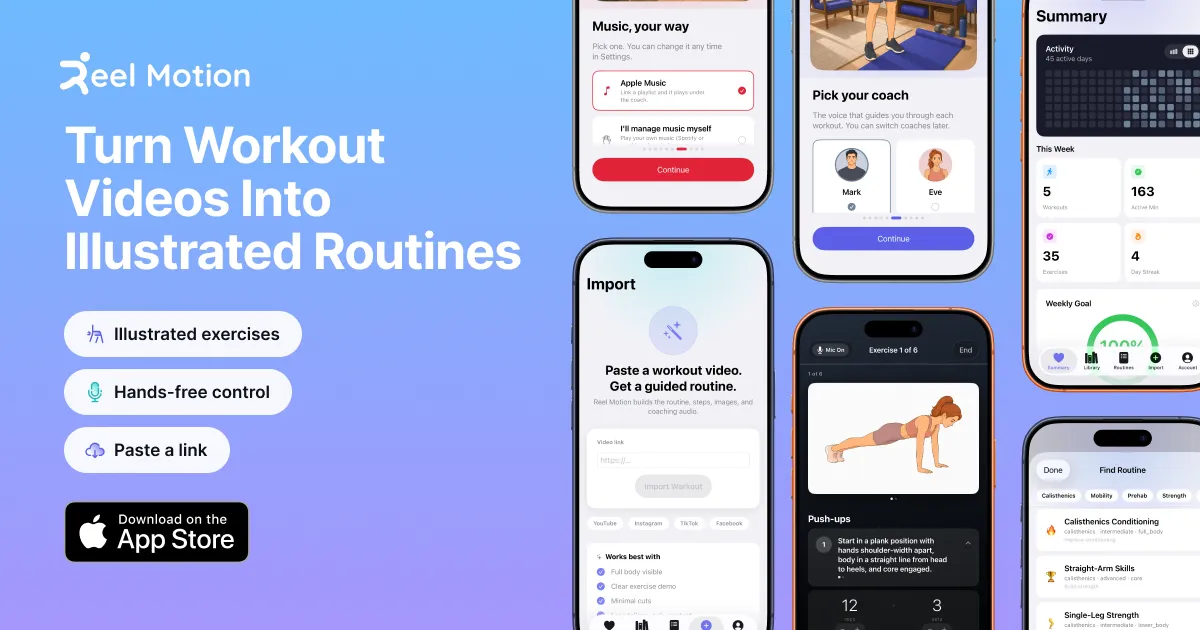
Reel Motion is an iOS application that turns a saved workout video from YouTube, Instagram, or TikTok into an illustrated, step-by-step exercise routine designed to be followed on an iPhone or iPad. The product targets a familiar friction point in home fitness: people collect exercise content on social platforms, then struggle to perform it because following along demands constant pausing, rewinding, and squinting at a small screen. Reel Motion extracts the movements from a pasted link, redraws each one as start and finish illustrations, and returns a structured session complete with timers, spoken cues, and hands-free controls. It is positioned for iPhone and iPad owners who train at home, in a gym, or in a hotel room and who want the flexibility of social media workouts without the awkward playback. Completed sessions write into Apple Health, so a single activity history stays intact across apps and wearables. The app is distributed through the App Store and markets itself as a leading iOS health and fitness tracker, though its real differentiation sits in the import pipeline rather than in tracking depth.
Key Features
-
Illustrated exercise breakdowns: Every movement found inside an imported video is redrawn with clear start and finish positions, letting a routine be read at a glance instead of replayed frame by frame. Subscribers also receive unlimited illustration redraws, which matters when a generated drawing does not match the movement as performed.
-
Hands-free voice control: Short spoken commands such as start, next, and done drive the session, so the phone can stay propped against a wall or stand and never needs to be touched between sets. This is the feature that most directly separates the product from simply watching a video.
-
Coach audio narration: A coach reads each exercise aloud while background music keeps playing, removing the need to look down at the screen mid-set. The combination of narration and voice commands is what the marketing positions as a genuinely hands-free training loop.
-
Apple Health (HealthKit) integration: Finished workouts are written straight into Apple Health, consolidating Reel Motion sessions alongside data from other fitness apps and wearables. This keeps activity rings and history consistent without manual entry.
-
Routine library: Users can browse routines that other people have imported, or assemble their own from scratch. The library addresses the cold-start problem common to import tools, since a new account is not limited to whatever video it happens to paste first.
-
Guided player with timers and step-by-step instructions: The player surfaces one exercise at a time with a timer and written instructions, keeping attention on the current movement rather than a full session list. Progress surfaces include weekly minutes, streaks, and completed session history.
-
Cross-device syncing: Routines and history sync between iPhone and iPad, so a routine built on one device remains available on the other. Every listed plan unlocks the entire feature set rather than gating individual capabilities behind tiers.
How It Works
The workflow starts outside the app. A user finds a workout video on YouTube, Instagram, or TikTok and shares the link into Reel Motion, most likely through the iOS share sheet. The service processes that video and returns a structured routine in which each movement appears as an illustrated card carrying a name, written instructions, and a timer. From that point the user props the phone on a stand, starts the session, and follows along.
During the workout, spoken commands replace taps and the coach audio narrates each step, which means the screen becomes optional once a set is underway. When the session finishes, the app logs the workout and, if permission has been granted, pushes the record into Apple Health. Over time the routine library accumulates both imported and self-built sessions, allowing a user to revisit a saved routine rather than re-importing the source video. Weekly minutes, streaks, and session history provide the long-term feedback loop that turns single imports into a repeatable habit.
Use Cases
The apartment dweller with a backlog of saved reels. Someone who saves short HIIT clips and mobility reels on Instagram but never actually performs them can paste each link into Reel Motion and receive an illustrated session in return. Because the coach narrates each movement and voice commands advance the routine, the workout can be completed in a small space without repeatedly handling the phone. The outcome is a saved-videos folder that finally converts into finished sessions.
The gym member following a creator's program. A lifter working through a twelve-week program published by a fitness influencer can import each session rather than memorizing exercise order. Coach audio plays over the user's own music, voice commands move the routine forward, and the finished workout lands in Apple Health so training volume stays visible next to other tracked activity. The result is program adherence without a notebook or a second screen.
The traveling professional or shared household. A consultant who trains in hotel gyms can import a single hotel-friendly video and run it in a small room. For households, Apple Family Sharing supports family plans starting at $7.99 per week for up to six people, letting each member import their own videos while the subscription stays shared. The outcome is one subscription covering several exercise preferences instead of several separate ones.
Frequently Asked Questions
How much does Reel Motion cost? The app lists three plans in US dollars: $4.99 per week, $19.99 per month, and $59.99 per year, with the annual tier marketed as roughly $5.00 a month and a 75 percent saving. Family plans begin at $7.99 per week and can be shared with up to six people through Apple Family Sharing.
Is there a free plan or free trial? The homepage does not advertise a free tier or a trial period. All three listed plans unlock the complete app, and billing runs through the App Store, so cancellation and refund handling follow Apple's standard subscription rules rather than an in-app process.
Which video platforms are supported? Reel Motion accepts links from YouTube, Instagram, and TikTok. That covers the large majority of consumer workout content, though a video hosted on a smaller platform or a private library would need to be handled another way.
Which devices does the app run on? Reel Motion is built for iPhone and iPad, with routines and history syncing between the two. The site does not reference an Android build, a web player, or a dedicated Apple Watch app.
Who is Reel Motion designed for? The product suits people who already discover workouts on social platforms and want a structured way to perform them, including home exercisers, gym members following published programs, and households that want one shared subscription. Users who prefer live classes or built-in trainer-led content are a weaker fit, since Reel Motion structures videos sourced elsewhere rather than producing its own programming.
Pros & Cons
Pros
- Converts a pasted YouTube, Instagram, or TikTok link into a structured, illustrated routine instead of requiring manual note-taking.
- Hands-free voice commands paired with coach audio let the phone stay propped and untouched for the duration of a session.
- Apple HealthKit integration writes finished workouts into Apple Health so activity history stays in one place.
- The routine library plus unlimited imports and redraws gives subscribers a reason to keep the subscription past the first month.
- Routines and history sync across iPhone and iPad, and every listed plan unlocks the complete feature set.
Cons
- The app is limited to iPhone and iPad, with no Android, web, or Apple Watch option mentioned anywhere on the site.
- The testimonials on the homepage are placeholder entries credited to fictional beta testers, so independent social proof is not yet available.
- There is no advertised free tier or trial, and the $4.99 weekly plan is expensive on an annualized basis compared with the $59.99 annual tier.