Forgefy turns SaaS product updates into weeks of ready-to-publish social and email content, an AI marketing co-pilot for founders who keep shipping.
What is Forgefy?
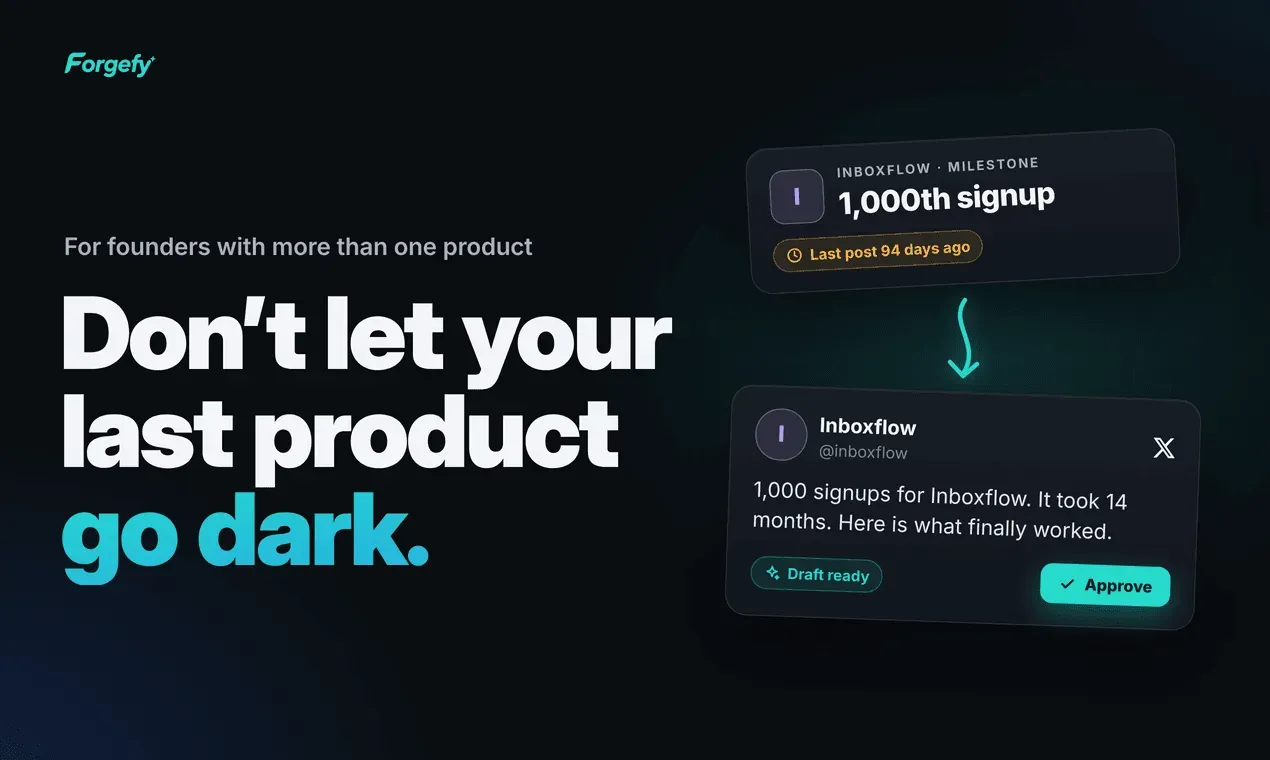
Forgefy is an AI marketing co-pilot for SaaS founders that converts product work into finished marketing material. Shipped updates, customer reviews and internal conversations are fed into the system, which returns social posts, email copy and visuals that are ready to publish. The problem it targets is a familiar one inside small software companies: the next release absorbs every working hour, and promotion for the product already on the market quietly stops without anyone deciding to stop it. Forgefy frames itself as a distribution engine rather than another scheduler, positioned between the build process and the channels where an audience already gathers. The target market is the founder economy at large, with dedicated pages for SaaS founders, indie hackers, startups and creators. Its named competitive set includes Buffer, Hootsuite, Typefully, Tweet Hunter, Hypefury, Later, Sprout Social and FeedHive, and the case against those incumbents rests on context, because Forgefy claims to write about genuine product events in a founder's own voice rather than prompting generic copy into an empty composer.
Key Features
Product-aware content generation. Forgefy ingests signals from a live product, covering updates, reviews and conversations, then turns them into drafted posts and emails. The emphasis on product awareness is the central technical claim here, and it separates the platform from schedulers that only queue text typed by hand.
Voice matching. The marketing message stresses that generated material arrives in the founder's own voice rather than in a detectable house style. That is the hardest part of automated writing to get right, and it is the claim most worth testing during a trial, since tone drift is the usual failure mode of AI copy tools.
Multi-format output. The platform produces finished posts, emails and visuals, and the front end also handles video exports. Technical detail on the site shows the browser pulling an FFmpeg WASM core of roughly five megabytes from a CDN when rendering video, which means media work happens client side and does not depend on a heavy server pipeline.
Cross-platform scheduling. Content is queued and published across social networks from a single dashboard. This is the area where Forgefy overlaps most directly with Buffer, Later and Sprout Social, and it also explains why the company maintains more than thirty head-to-head comparison pages.
Email campaign management. Beyond social, Forgefy manages email campaigns, so one product update can flow into a public post and a subscriber send without a second subscription. Consolidating those two channels is a meaningful operational saving for a team of one.
An unusually deep resource layer. The app is paired with free utilities and reference material, including a Content ROI Calculator, a Weekly Time Audit, a Positioning Statement Generator, a Revenue Leak Scanner and a Content Load Calculator. Template libraries cover build in public posts, cold outreach, LinkedIn posts, Instagram captions, product updates, landing page copy and customer stories, while reference sections hold a SaaS metrics glossary, industry benchmarks, playbooks and marketing checklists.
How It Works
The journey begins on the marketing site, where a single call to action routes new users to a free start page rather than a sales conversation. After onboarding, the working assumption is that a product already exists and is generating activity in the form of releases, user feedback and internal discussion. Those raw signals become the input layer.
From there, the founder selects the events worth broadcasting. The platform converts each one into drafts in several formats, then presents them for review. This review step matters, because automated drafting still requires human judgment on claims about pricing, roadmap and customer results.
Once drafts are approved, they move into a scheduling queue that distributes them across connected channels over the following days. A single release can therefore supply a fortnight of posts without additional writing sessions. Email campaigns follow a similar path, using the same source material for a subscriber send.
Daily use settles into a short loop: check the queue, approve or amend drafts, and move on. Weekly or monthly sessions are spent connecting new product events and reviewing performance. Supporting documentation explains each feature without marketing padding, and a public roadmap page signals what is still in development.
Use Cases
A solo SaaS founder after launch. A developer ships a major release, then returns to the backlog. Forgefy takes that release plus accumulated reviews and produces a run of posts and one email, so the marketing cadence survives the next sprint instead of collapsing under it.
An indie hacker building in public. Consistent posting is the growth engine for this audience, and consistency is exactly what breaks during a difficult debugging week. The build in public and thread starter template libraries shorten the distance between a milestone and a published narrative.
A small B2B SaaS running an email list. The product update templates and email campaign tools let a two person team announce a feature to social followers and subscribers from one workspace, avoiding a handoff between a social scheduler and a separate newsletter platform.
A marketer or fractional operator handling several products. Forgefy describes producing content for every product a founder runs, which suits consultants and agencies managing more than one brand and needing a repeatable production line rather than bespoke writing for each client.
Who Forgefy Is Built For
The company segments its audience explicitly rather than speaking to a single buyer. Dedicated pages address SaaS founders, indie hackers, startups and creators, which reflects four distinct motivations: founders want distribution without hiring, indie hackers want cadence for build in public storytelling, startups want a repeatable process that survives staff changes, and creators want output volume on a limited budget. The framing of a distribution engine also implies a preference for operators who already have something to distribute. A pre-product founder with no users, reviews or releases will find less raw material to work with, since the system depends on product activity as its input.
Forgefy vs the Established Schedulers
The comparison pages read as the most direct statement of strategy. Buffer, Hootsuite, Later and Sprout Social are positioned as tools that publish what a user writes, while Forgefy is positioned as a tool that proposes what to write in the first place. Typefully, Tweet Hunter and Hypefury sit closer on the writing side, and the distinction offered there is scope: those products concentrate on a single network, whereas Forgefy claims to span posts, email and visuals. That claim deserves scrutiny during evaluation, since breadth often trades against depth in any individual channel.
Pricing & Value
The crawled site does not publish a numbered pricing table or tier breakdown. The visible commercial signal is a free start path, described as a way to get started free, which implies an entry tier that requires no card and no sales call. Value therefore has to be judged on output quality rather than on a feature matrix, and the strongest argument in Forgefy's favour is substitution: a founder who cancels a scheduling subscription and a newsletter plan and folds both into one tool is likely ahead, provided the generated copy is publishable with light editing. Buyers should verify current tiers and limits directly before committing, because pricing detail lives outside the homepage. Anyone comparing options can review every alternative write up through view all of the platform comparisons.
Frequently Asked Questions
Is Forgefy free to try? The site offers a free start route with no visible credit card requirement, which points to a free entry tier or trial. Exact limits on posts, connected accounts and email sends are not disclosed on the homepage.
Which platforms does Forgefy support for scheduling? The product advertises scheduling across platforms from one dashboard, and separately manages email campaigns. Because the homepage does not list every supported network, checking the documentation is the safer path before migrating an existing calendar.
Who is Forgefy designed for? It targets SaaS founders, indie hackers, startups and creators, generally operators running at least one live product with real releases and user feedback to draw on.
How does Forgefy differ from Buffer or Hootsuite? Those products publish content that a user supplies. Forgefy generates the content first by reading product updates, reviews and conversations, then schedules it alongside email, which is closer to a marketing co-pilot than a queue.
Does Forgefy replace a copywriter? It reduces volume work such as routine release notes, announcement posts and newsletter drafts. Judgment heavy assets like positioning and launch narratives still benefit from human authorship, and the platform's own review step assumes that.
Final Verdict
Forgefy attacks a real and under served problem. Most small software companies do not lack marketing tools, they lack marketing hours, and a system that mines product activity for content addresses that gap more directly than another calendar view. The pairing of social output, email campaigns and free planning utilities in one workspace is pragmatic, and the reference library of benchmarks, playbooks and templates adds credibility beyond the app itself. The limitations are equally clear. Pricing is not published on the homepage, which makes budgeting harder than it should be, and automated voice matching is the kind of claim that only survives a hands on trial. Founders who ship constantly and market inconsistently are the natural audience. Teams with dedicated marketing staff and established editorial processes will find less to gain. Exploring the free tools such as the Content ROI Calculator is a reasonable first step, and the Forgefy documentation explains how the features behave before any commitment.
Pros & Cons
Pros
- Generates marketing content directly from real product signals such as shipped updates, customer reviews and internal conversations, rather than starting from a blank composer.
- Combines cross-platform social scheduling, email campaign management and visual asset creation in one dashboard, reducing the number of subscriptions a small team needs.
- Produces drafts in the founder's own voice, which addresses the tone drift that undermines most generic AI copywriting tools.
- Ships with a substantial free resource layer, including five interactive calculators, more than a dozen template categories, a SaaS metrics glossary and industry benchmark references.
- Maintains an extensive comparison library covering more than thirty alternatives such as Buffer, Hootsuite, Typefully and Sprout Social, making competitive evaluation transparent.
Cons
- No pricing table or tier breakdown appears on the homepage, so budget planning requires contacting the company or starting a trial first.
- The output quality depends entirely on the volume and quality of product activity available, which limits usefulness for pre launch founders with little feedback or release history.
- Breadth across social posts, email and visuals may come at the cost of depth in any single channel compared with dedicated single network tools.