WakeSharp is a mission-based alarm clock app for heavy sleepers, requiring math, photo, walking or voice tasks before an alarm can be silenced.
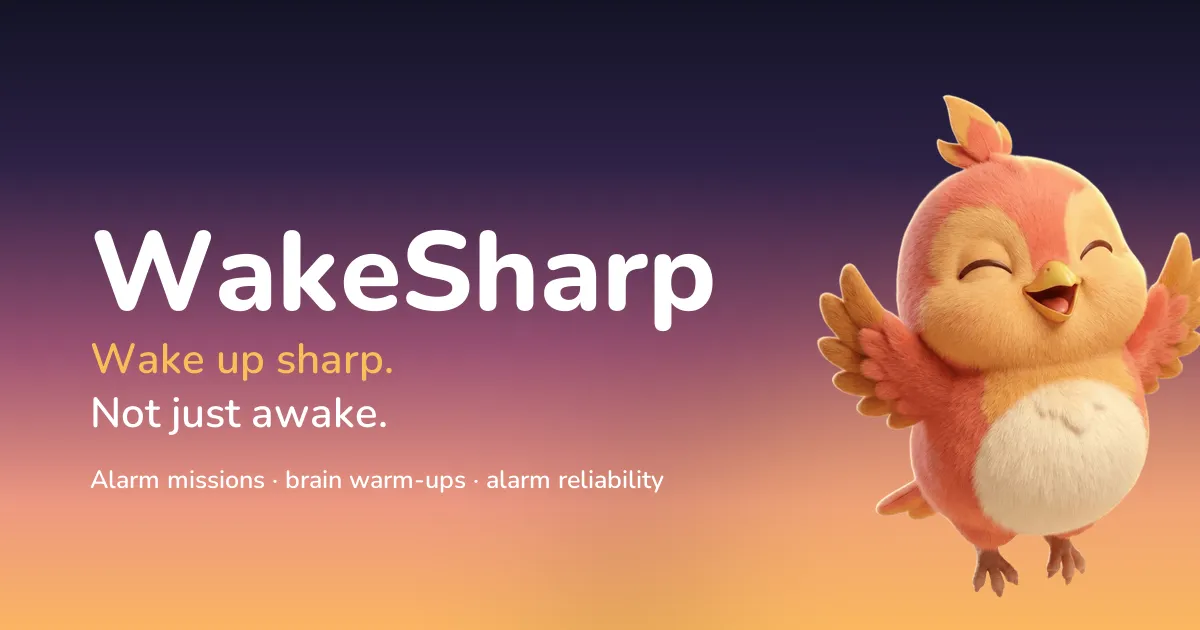
WakeSharp is one of a small group of alarm applications that treat waking up as a design problem rather than a volume problem. The product's own framing is unusually direct: wake up sharp, not just awake. That distinction runs through every part of the app, from the way an alarm is dismissed to the daily score that appears afterwards, and it explains why the company behind it, KineticBit Inc., has built something closer to a wake-up protocol than a simple timer.
What is WakeSharp?
WakeSharp is a mobile alarm clock application built for heavy sleepers, designed on the premise that a swipe is something a barely conscious person can accomplish while a mission is not. Instead of a snooze button, the app demands a completed task, whether that is quick arithmetic, a card-matching puzzle, a photograph of a location chosen the previous evening, a set number of counted steps, or an answer spoken out loud. The morning only counts once the mission is finished.
The problem it addresses is familiar to anyone who has silenced an alarm while half conscious and retained no memory of doing so. Volume alone rarely defeats a determined sleeper, so WakeSharp reframes the challenge as one of cognitive engagement, requiring the brain to perform something a sleeping person cannot easily fake. The app also measures how sharp the user actually woke up, producing a daily score out of 100 benchmarked against that person's own rolling baseline rather than against strangers.
The product targets shift workers, students with early lectures, professionals with rigid meeting schedules, and anyone repeatedly defeated by their own alarm. It is a paid subscription app for iPhone and Android, distributed through the App Store and Google Play, with companion apps for watchOS 26 and Wear OS 3. Its emphasis on privacy, offline operation and candid reliability reporting distinguishes it from alarm apps that promise more than a phone can reliably deliver.
Key Features
Mission-based dismissal across fifteen task types. Every alarm can be configured to require a task before it is considered complete. Missions fall into four families: brain tasks such as Mind Games arithmetic, Memory Match, Sequence Recall, Colour Clash and Type It Out; camera tasks including Photo Proof, Scan an Object, Fetch, Face Check and Fruit Slash; movement tasks such as Walk It Off and First Light; and voice tasks including Serial Sevens and Name Five. A single alarm can chain several missions in a chosen order, and if one cannot run on a given morning because of a dead camera or a missing step counter, the app falls back to a mission that can. Those who want the full breakdown can check out the complete feature list.
Alarm reliability checking with an honest verdict. Most alarm apps discover failure at the same moment the user does. WakeSharp inspects the conditions that actually stop alarms, covering permissions, alarm volume, notification settings, lock-screen takeover and battery restrictions, then leads with a plain verdict: it will ring, it may not, or it cannot. Where the platform refuses to disclose a setting, the app says so rather than displaying a misleading green tick. A pre-bed reminder folds the worst finding into the evening summary while there is still time to correct it, and a failed alarm can be explained afterwards with the provable cause or an admission that the cause could not be determined.
Smart calendar alarms and shift rotations. Users can create rules such as ringing 90 minutes before the first meeting of the day. The app reads the calendar locally on the device, re-checks it overnight and shifts the alarm when the meeting moves. The calendar integration is read-only, optional and never transmitted. Shift rotations handle non-weekly patterns such as two days on, two nights and four off, with a preview calendar and the ability to skip a single date without deleting anything. Profiles swap an entire set of alarms at once for work, vacation or on-call periods, while search, sorting and a Today view keep large lists manageable.
Sharpness Score backed by daily warm-up games. After the alarm is dismissed, three rotating warm-up games drawn from Mind Games, Memory Match, Sequence Recall, Word Dash and Reaction Tap produce a single number out of 100. That score is measured against the user's own rolling baseline rather than a public leaderboard, and the company is explicit that it is an in-app score rather than a clinical test. A streak counter, trend chart and freeze tokens track progress over weeks and months, with milestones at 7, 30, 100 and 365 days and a history that stretches back as far as the user goes.
Platform-native alarm behaviour. On iPhone, WakeSharp uses Apple's AlarmKit to present a system alarm over the lock screen, through Silent mode and Focus once alarm access is granted, even if the app was force-quit. On Android, an exact alarm plays on the dedicated alarm stream, rings through silent mode and through Do Not Disturb when alarms are permitted, and offers an Extra Loud mode with a build-up ramp rather than an abrupt blast. Both versions are written natively, with SwiftUI on iOS and Kotlin with Compose on Android, which is the only reason each side can exploit the capabilities unique to its platform.
Privacy-first design with no required account. No WakeSharp account is necessary. There is no email or password anywhere in the app. Camera recognition and calendar reading happen entirely on the device, and optional sign-in with Apple or Google exists solely to back up alarms, settings, scores and streaks so they return on a new phone. Backup is off by default, every feature works signed out, and no alarm ever waits on a network response to ring.
How It Works
The journey begins with a permission conversation rather than a signup form. Because WakeSharp has no mandatory account, the first meaningful step is granting alarm access, which on iOS is what allows AlarmKit to schedule anything at all. From there the app walks through the conditions that can prevent a ring, and the reliability screen returns a verdict rather than a checklist.
Setting an alarm involves choosing a time, selecting a wallpaper and tone, and then building the mission sequence. A user might decide that a 6:40 AM weekday alarm requires two rounds of quick arithmetic followed by a photograph of the kitchen kettle. Because missions are part of the alarm definition, the agreement is made the night before rather than negotiated at dawn.
The overnight phase is where WakeSharp does its quieter work. If a calendar rule is active, the app re-reads the day's events and recalculates the wake time. The pre-bed reminder surfaces the most serious reliability finding, and on Android a sunrise effect can brighten the screen and raise the volume ahead of the alarm.
When the alarm fires, the mission screen appears. On iPhone the alarm presents over the lock screen, while on Android it takes over with a full-screen alert. The user completes the configured tasks in order. A watch app taps the wrist before the room hears anything, and the phone alarm shifts a few minutes later as a backup, so only a dismissal on the watch cancels the phone alarm entirely. A flat watch, one out of range, or one not opened for 36 hours leaves the phone alarm exactly where it was.
After dismissal, three rotating warm-up games and the Sharpness Score follow. The score lands against a personal rolling baseline, and the streak, trend line and freezes accumulate in the history view. A shared link can then be sent to a friend through Wake with a friend, or a Beat my wake challenge can be issued with an identical mission seed, round count and difficulty so two people face the same problem set.
Use Cases
The rotating shift worker. A nurse working two days, two nights and four off never has a stable weekly rhythm, and conventional weekly alarms fail under that pattern. WakeSharp's shift rotation feature accepts the roster directly and renders a preview calendar, while profiles switch the whole alarm set when a rotation changes. A single skipped date can be excluded without deleting the underlying rule.
The office worker with an unpredictable calendar. Someone whose first meeting moves between 8:00 and 10:00 benefits from the calendar rule that rings 90 minutes before the first event. Because the app re-checks overnight and reads the calendar on-device, the wake time adjusts without manual editing, and the read-only, optional nature of the integration means declining it costs nothing functionally.
The chronic snoozer. A student who has slept through lectures for a semester sets Photo Proof as the mission, photographing a spot across the room chosen the night before. The result is a forced journey out of bed rather than a tap on a screen, and the Sharpness Score supplies a daily feedback loop that makes improvement visible over a term. Those curious about the underlying logic can explore the science in the WakeSharp blog.
The couple or flatmates waking together. Wake with a friend sends a link, and the receiving phone builds the same alarm locally with no account, no server in the middle and no shared state, so changing one alarm never reaches into another. Beat my wake issues an identical problem set to a friend after a mission, turning early rising into a lightweight competition rather than a solitary chore.
Pricing & Value
WakeSharp operates a single paid tier called WakeSharp Unlimited. New subscribers can begin with a 7-day free trial of the yearly plan, which costs $34.99 per year, roughly $2.92 per month. A monthly plan at $4.99 is also available and carries no trial period. Every feature sits inside that one plan: all wake-up missions, three daily warm-up games, full Sharpness history, smart calendar alarms, shift rotations, profiles, unlimited alarms, the reliability check, every alarm tone, every Lark scene and wallpaper, the Wake with a friend feature and the watch app. The app shows no ads.
Billing runs through Apple or Google, and subscriptions renew until cancelled in the respective store account. Deleting the app does not cancel a subscription, and customers who previously bought the Lifetime option retain it permanently through Restore Purchases. On value, the yearly price is competitive against the wider wellness subscription category, and the absence of advertising plus the on-device processing model justify a paid-only approach. The lack of any permanent free tier is the principal barrier, since trial eligibility is limited to new subscribers and the monthly option arrives without a trial period.
Frequently Asked Questions
Does WakeSharp really ring in Silent mode, Focus or Do Not Disturb? Behaviour depends on platform and permission. On iPhone, AlarmKit supports ringing through Silent mode and Focus once alarm access is granted, and declining that permission prevents scheduling entirely. On Android, the alarm plays on the dedicated alarm stream and shows a full-screen alert, but Total Silence mutes every sound including alarms. No app can ring on a phone that is switched off or out of battery.
How can a user verify that an alarm will actually fire? Settings and Alarm reliability read permissions, alarm volume, notification settings, lock-screen takeover and battery restrictions, then lead with a verdict rather than a promise. Where the platform withholds information, the app admits it instead of showing a green tick, on the reasoning that a checklist which quietly converts unknowns into passes is worse than no checklist at all.
Is a subscription required, and is there a free plan? There is no permanent free tier. WakeSharp Unlimited costs $34.99 per year with a 7-day trial for eligible new subscribers, or $4.99 per month without a trial. All features are included in the single plan.
Does WakeSharp track sleep? No. There is no sleep tracking of any kind, which means no overnight microphone listening, no sleep staging and no score for the night. The step counter is read only during the walking mission, and the product measures alertness after waking rather than sleep before it.
Where does WakeSharp sit against standard alarm clocks or sleep trackers? It targets a narrower problem than most sleep apps. Rather than analysing the night, it concentrates on the moment of waking, combining mission-based dismissal, calendar-aware scheduling and a personal alertness score. The trade-off is that it offers no sleep insight at all, which makes it a complement to a sleep tracker rather than a replacement. Free utilities such as the sleep calculator show that the company understands this adjacent audience.
Final Verdict
WakeSharp offers a coherent, well-argued answer to a problem most alarm apps treat superficially. Mission-based dismissal, the honest reliability verdict, on-device processing, the absence of a required account and native builds on both platforms form a package that feels considered rather than assembled. The companion watch behaviour, where only a watch dismissal cancels the phone alarm, shows unusual attention to failure modes that competitors rarely acknowledge.
Two limitations stand out. First, the app is subscription-only with no permanent free tier, which raises the cost of experimenting for anyone who simply wants a louder alarm. Second, and more significantly, the entire product rests on a phone that is powered on and adequately charged, a constraint the company states plainly in its own safety notice advising a second independent alarm for anything that cannot be missed. Feature scope is also narrower than it first appears, since WakeSharp deliberately tracks nothing about the night.
The recommendation is straightforward. Heavy sleepers who have exhausted volume-based solutions, shift workers with irregular rosters and professionals whose wake times move with their calendars will find the strongest fit. Anyone seeking sleep analysis, or a one-off free alarm, should look elsewhere.
Pros & Cons
Pros
- Alarms cannot be dismissed with a swipe alone, since fifteen mission types including arithmetic, memory puzzles, photo proof, counted steps and spoken answers must be completed first.
- The reliability screen leads with a plain verdict on whether an alarm will actually ring, and openly admits unknowns instead of showing false green ticks.
- Calendar-aware alarms read upcoming events locally, re-check them overnight and shift the wake time when the first meeting moves, with no data transmitted off the device.
- Native SwiftUI and Kotlin builds deliver full-screen lock-screen takeover, ringing through Silent and Focus modes, plus watch apps that tap the wrist before the phone sounds.
- No account is required, camera and calendar processing stay on the phone, backup is off by default, and the app carries no advertising.
Cons
- Subscription-only at $34.99 per year or $4.99 per month, with no permanent free tier and a trial limited to eligible new subscribers.
- Requires iOS 26 or later or Android 8.0 or later, and cannot sound at all on a phone that is switched off or out of battery, as the company's own safety notice concedes.
- Deliberately offers no sleep tracking whatsoever, so it complements rather than replaces a sleep analysis app.