White Space Signal is an AI opportunity intelligence platform ranking what to build and which business categories to buy.
What is White Space Signal?
White Space Signal is a subscription research platform that ranks the business opportunities and acquisition categories most likely to gain value as artificial intelligence becomes more capable. It addresses a gap in conventional market research, where most reports describe a market as it exists today rather than asking what happens to that market once AI makes core tasks cheaper, faster and more autonomous.
The service is aimed at founders, operators, acquisition entrepreneurs, small business owners and private investors weighing where to commit years of time or serious capital. Instead of publishing a stream of plausible startup ideas, it maintains two ranked lists. BUILD covers new products, services, data layers and infrastructure worth creating. BUY covers categories of existing businesses that may become more attractive to own as AI spreads.
Its positioning sits apart from an AI news feed, a generic idea generator or a business-for-sale marketplace. White Space Signal describes itself as opportunity decision intelligence, a system that reduces a huge, noisy universe of possibilities to a small set of investigated, challenged and compared theses, then keeps testing those theses as the evidence shifts.
Key Features
Dual ranked frontiers for BUILD and BUY. The platform refuses to force starting a company and acquiring one through the same scorecard. BUILD ranks opportunities to create, launch or assemble, while BUY ranks categories of existing businesses worth owning. BUILD is evaluated against 18 factors and BUY against 20, because the two decisions carry different economics, different risks and different time horizons.
A three-part scoring model. Every published entry separates Opportunity Quality, which measures how attractive the economics and strategic position appear, from Conviction, which measures how strong and complete the supporting evidence is, and from White Space, which estimates how much useful, under-recognised value may remain before the market catches up. The current number one BUILD entry scores 8.8 for quality, 8.2 for conviction and 7.0 for white space, showing how the framework separates a strong opportunity from a proven one.
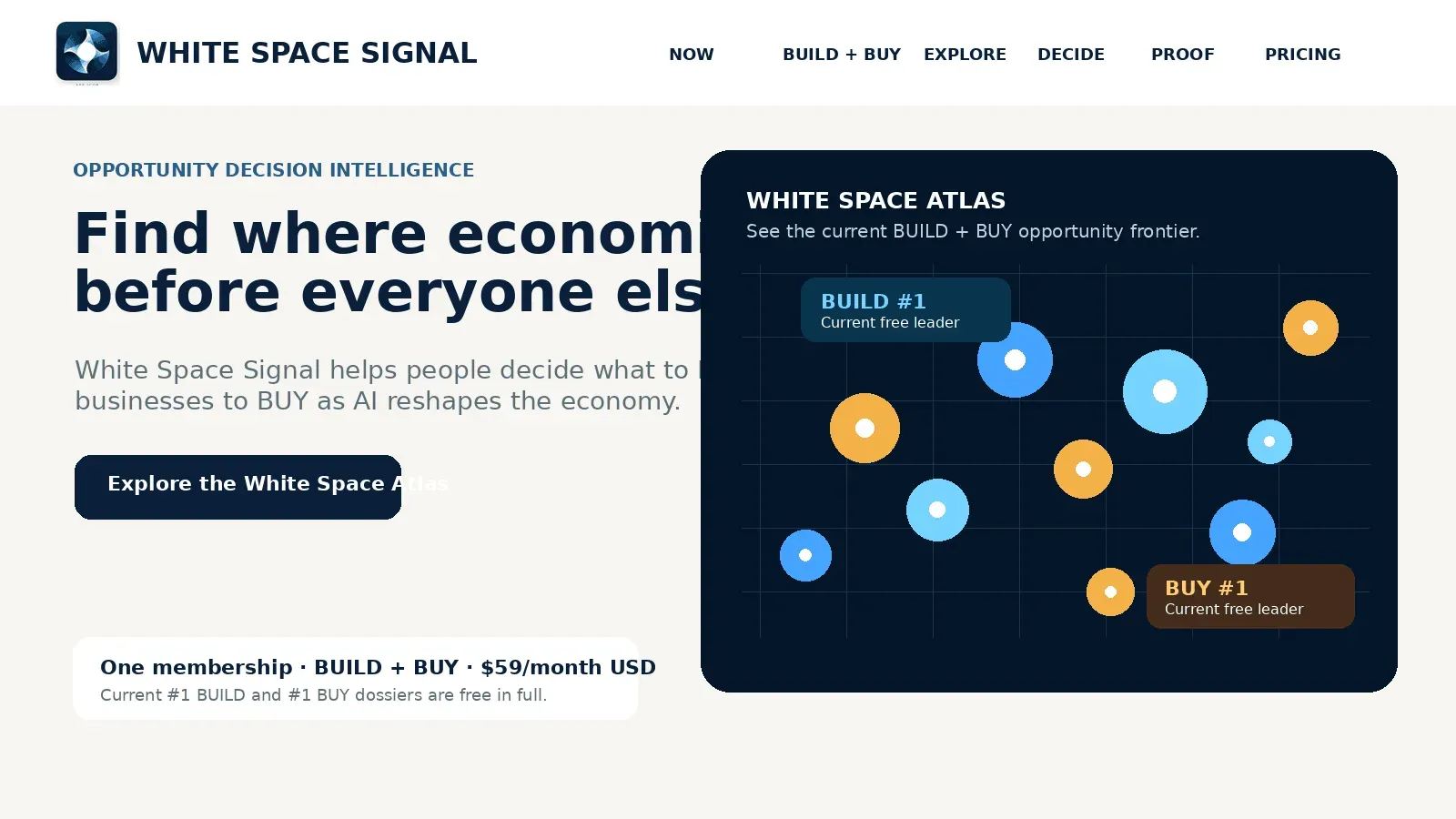
The White Space Atlas. This interactive frontier map plots the current ranked field rather than presenting a generic zero to ten scatterplot. Color indicates remaining white space, position reflects AI compounding strength against commercial quality, orb size reflects the amount of room left and a glow effect signals conviction. Visitors can filter between all opportunities, BUILD and BUY, with the two number one positions publicly visible while paid identities stay protected.
Emerging opportunity sets. Each ranking can include up to five emerging candidates. These are explicitly not ranks eleven through fifteen and not filler. Each entry explains why the opportunity is interesting, what evidence is still missing, what would move it into the Top 10 and what could remove it from consideration entirely.
A dated, auditable track record. Every published call carries a date and historical snapshots are preserved, so earlier judgments cannot be quietly rewritten after new evidence arrives. The public proof section allows a reader to inspect when a call was made and how the ranking has moved since.
Full free access to the two leading dossiers. The current number one BUILD report and the current number one BUY report are published in full as public proof, with no signup and no email address required. The remaining members of each Top 10 sit behind the subscription.
How It Works
The process starts on the public homepage, where the current number one BUILD and number one BUY opportunities appear as dated signal cards. Each card carries the three scores, a plain-language summary of the thesis and a direct link into the full dossier. A reader can open both leading reports in full before deciding whether the wider ranking deserves payment.
From there, the White Space Atlas offers a visual overview of the ranked field. Switching between the BUILD and BUY filters changes the composition of the map, and tapping an orb reveals its position relative to AI compounding strength and commercial quality. Public visitors see the field and the two leaders, while the identity of other ranked entries requires a membership. Full details of what sits behind the paywall are listed on the pricing page.
Subscribing unlocks both Top 10 lists, both emerging sets, the complete deep dossiers, the NOW briefing, the full Atlas, the DECIDE comparison tool, the Catalyst and Risk Clock, watch functionality and the historical proof record. Subscribers then typically follow individual theses over time, tracking how a rank rises when buyer evidence improves or falls when an incumbent bundles the solution.
The final step is ongoing review. Because rankings are reassessed continuously against new evidence, the practical routine involves checking what strengthened, what weakened, what entered the emerging sets and what dropped out, then using that movement as an input to the reader's own capital allocation decisions.
Use Cases
A technical founder choosing a second product. A developer who already ships software commercially can use the BUILD frontier to test a specific thesis, such as release compatibility regression guarding, against buyer reality, competitor presence and the question of whether stronger AI would strengthen or erode the business across a five-year horizon.
An acquisition entrepreneur screening categories. A searcher preparing to buy a small business can filter the BUY ranking for categories with recurring revenue, transferability and physical or regulatory moats. A category such as utility asset inspection and condition monitoring becomes interesting precisely because AI and autonomy may raise productivity, coverage and the value of collected data without removing the need for licensed field work. The publicly readable BUILD and BUY leaderboards show how those two number one positions are currently framed.
A services business owner assessing AI exposure. An owner of an agency, inspection firm or compliance practice can apply the five-year test to identify where AI compresses pricing, where it creates new bottlenecks and whether the business controls something AI cannot easily reproduce, such as a licence, installed infrastructure or a trusted relationship.
A private investor or family office. Investment professionals evaluating a sector can treat the dated proof record as a research log, checking which calls were made when and how the reasoning held up as conditions changed, rather than relying on a single undated market report.
Pricing & Value
White Space Signal runs on a single membership at $59 per month. That tier unlocks both BUILD and BUY Top 10 rankings, both emerging sets, full deep dossiers, the NOW briefing, the White Space Atlas, the DECIDE comparison system, the Catalyst and Risk Clock, watch functionality and the historical proof record.
There is no permanently free tier, but the current number one BUILD report and the current number one BUY report are available in full without signup or email, which functions as an unusually generous trial. No enterprise or team plans are advertised, and pricing is published openly rather than quoted on request.
Judged purely on cost, $59 monthly sits below the price of most professional research subscriptions and far below consulting retainers, but the value depends entirely on whether the subscriber has a live decision in front of them. A reader with a specific build or acquisition question will likely extract more than the annual cost from a single avoided mistake. A casual browser will not.
The Five-Year Test at the Core of the Method
The distinctive analytical move is a reversal of standard opportunity analysis. Conventional research typically starts with market size, growth, margins, competition and customer demand, then adds technology risk as one factor among many. White Space Signal places AI durability near the start of the decision instead, asking what happens to the value of a business, service or bottleneck if AI becomes dramatically more capable across the next five years.
The reasoning behind that order is straightforward. A business can post strong revenue, healthy margins and a recognisable moat while remaining exposed to a future in which AI automates its core task, makes the output nearly free, lowers switching costs or allows a larger platform to absorb the value. The reverse also holds, since an unremarkable looking operation can become strategically more valuable when it controls licences, physical access, installed infrastructure, trusted relationships, proprietary operating data or a necessary position inside a workflow that still has to happen.
Why BUILD and BUY Use Separate Scorecards
Starting a company and acquiring one are not variations of the same decision, and the platform refuses to treat them as such. BUILD evaluations cover the buyer, route to revenue, speed to first revenue, capital intensity, distribution, competition, defensibility and whether AI strengthens or weakens the business over time. BUY evaluations focus on cash-flow durability, recurring revenue, transferability, owner dependence, acquisition economics, physical and regulatory moats, installed-base advantages and the room for AI-driven margin improvement.
The divergence shows up in the factor counts. BUILD is scored on 18 factors and BUY on 20. The shared discipline is identical in both cases: each candidate is challenged for an exact competitor, a real buyer with a real budget, the risk of platform bundling, market crowding, realistic customer acquisition and whether the thesis depends on AI remaining weaker than it is likely to become.
How the Evidence Standard Works
Evidence is counted by what happened, not by how many outlets repeated it. If ten articles cover one announcement, that counts as one event rather than ten independent proofs. The platform separates distinct real-world occurrences and looks for varied confirmation through buyers, budgets, deployments, transactions, standards, regulation, competitors, substitutes and implementation evidence, along with material that could disprove the thesis.
The public method page explains factor families, evidence rules and failure tests in reasonable detail, while proprietary input weighting, exact score weights, internal queries and thresholds remain private. This is a deliberate compromise between transparency and protecting the research engine that produces the rankings.
Reading the White Space Atlas
The Atlas is described as a frontier zoom rather than a conventional scatterplot. Four named zones structure the map: proven value for high quality with lower AI leverage, compounding frontier for high quality combined with high AI leverage, emerging leverage for AI-strong categories where the commercial case is still forming, and a watch zone for earlier or less compelling ideas. Color encodes remaining white space, with open, moderate and closing or crowded states distinguished visually.
For prospective subscribers the map functions as a fast orientation tool. It shows where the current ranked field clusters and whether a category sits on rising AI leverage or in a crowded corner where most of the useful value has already been recognised by the market.
How It Compares to Traditional Opportunity Research
Most opportunity research describes the present accurately: market size, growth rate, competitors, valuations and recent funding rounds. Those remain useful inputs, but they can describe a market correctly while missing where the economics are heading. White Space Signal adds a different set of questions about what becomes abundant, what stays scarce, which new failure point appears, which part of the value chain gains bargaining power and whether the opportunity improves or deteriorates as AI becomes more capable.
The trade-off is scope and certainty. The platform deliberately rejects weak ideas rather than collecting them into a large database, which means subscribers receive a narrow set of ranked theses instead of exhaustive coverage. It is also decision support rather than a guarantee, and the platform states plainly that no ranked opportunity is promised to succeed.
Frequently Asked Questions
Is White Space Signal an AI startup idea list? No. The platform starts with real changes in technology, markets, regulation, infrastructure and behavior, then looks for the commercial constraints those changes create. Ideas are ranked only after buyer reality, competition, economics and stronger future AI have been tested.
What is the difference between BUILD and BUY? BUILD ranks opportunities to start, create, assemble or launch something new. BUY ranks categories of existing businesses that may become more attractive to own as AI advances. The two lists use separate scoring models because building and acquiring are fundamentally different economic decisions.
How much does a subscription cost? A single membership is priced at $59 per month and covers both frontiers plus the Atlas, DECIDE, the Catalyst and Risk Clock, watch functionality and the proof archive. The current number one BUILD and BUY reports can be read in full at no cost.
Are the two number one reports genuinely free? Yes. Both leading dossiers are published in full with no signup and no email requirement. The platform treats them as the proof layer that allows a prospective subscriber to judge research depth before paying.
How often do the rankings change? Rankings are reassessed continuously, but movement must be earned by evidence. A stable rank is treated as a valid outcome, and the platform explicitly avoids manufacturing changes simply to appear busy.
Who is the platform best suited for? Founders, operators, acquisition entrepreneurs, small business owners and private investors. Some ranked opportunities suit a solo operator, while others require capital, licences, specialist expertise or partnerships, and the research makes that difficulty visible rather than hiding it.
Final Verdict
White Space Signal occupies a narrow but genuinely underserved position. It is not another AI newsletter, and it does not pretend to be a marketplace of businesses for sale. The strongest aspects are the discipline of the scoring model, which separates the attractiveness of an opportunity from the strength of the evidence behind it, the insistence on dated and preserved calls, and the unusual willingness to publish two complete dossiers at no cost so the research can be judged before any money changes hands. The White Space Atlas and the separate BUILD and BUY scorecards give the product a structural coherence that most idea lists lack.
The limitations are equally clear. Everything rests on the quality of a single team's judgment, with no independent audit of the underlying research. Coverage is deliberately thin, since weak candidates are removed rather than listed, so subscribers seeking breadth will find the ranked sets small. The $59 monthly subscription also assumes an active decision, and readers without a live build or acquisition question will struggle to justify the recurring cost.
For founders, acquisition entrepreneurs, small business owners and private investors genuinely weighing where to commit capital or years of work in an AI-shaped economy, the free dossiers alone justify an initial look, and the full membership is a reasonable expense against a single avoided misallocation. Casual observers of AI trends should stay with the free layer.
Pros & Cons
Pros
- Every opportunity is scored three separate ways, with Opportunity Quality measuring economic appeal, Conviction measuring evidence strength and White Space measuring remaining upside, which prevents exciting but unproven ideas from appearing as solid as established ones.
- The current number one BUILD and number one BUY dossiers are published in full with no signup and no email requirement, giving prospective subscribers a genuine sample of research depth before any payment.
- Each published ranking is dated and historical snapshots are preserved, so earlier judgments remain auditable instead of being quietly revised once conditions change.
- BUILD and BUY run on separate scoring models with 18 and 20 factors respectively, acknowledging that launching a company and acquiring one are economically different decisions.
- The White Space Atlas maps the ranked field across AI compounding strength, commercial quality, remaining white space and conviction, converting an abstract ranking into a quickly readable frontier visualization.
Cons
- Research quality rests entirely on one team's judgment, and there is no third-party verification or independent audit of the underlying analysis.
- Coverage is intentionally narrow because weak candidates are rejected rather than collected, so subscribers wanting broad multi-sector scanning will find the ranked sets quite small.
- At $59 per month there is no permanent free tier beyond the two public dossiers, and the recurring cost is difficult to justify without an active build or acquisition decision.