Vibes'n'Feels is a private emotion map app that turns fresh photos and 20 second videos into place anchored Vibe pins that expire.
What is Vibes'n'Feels?
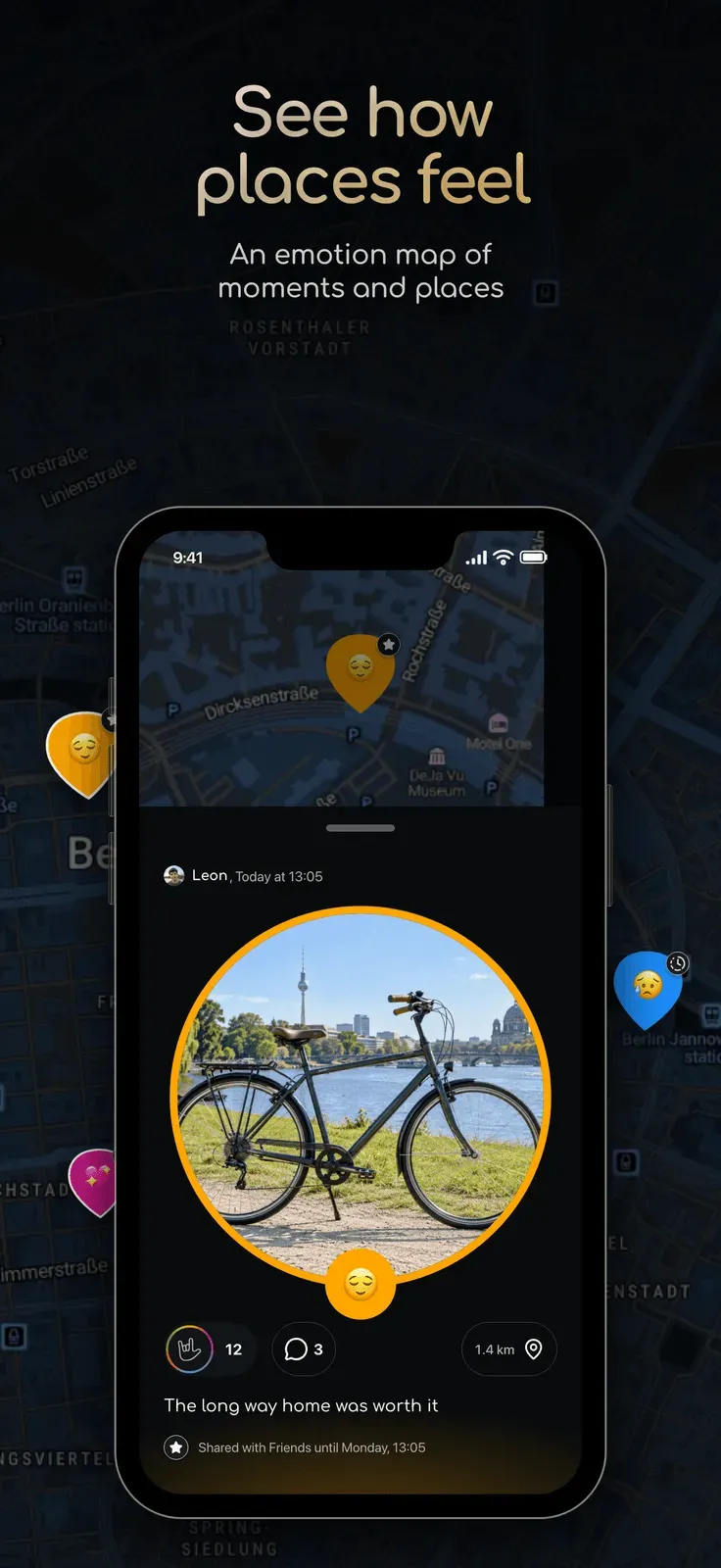
Vibes'n'Feels is a mobile application that converts fresh camera photos and short videos into location anchored emotional markers, an approach the developer describes as an emotion map of moments and places. Each entry, named a Vibe, pairs a live capture with a nearby place, an expressive emoji drawn from one of six emotional spectra, and an optional written note. The product targets a specific frustration with mainstream social platforms, where engagement metrics, follower counts and permanent archives turn everyday moments into performance. Vibes'n'Feels inverts that model by binding a capture to a place and a feeling, then letting the shared version expire.
The intended audience is adults aged 18 and older who want a low pressure way to remember how places feel and to share that impression briefly with a chosen group. Three audience tiers define the reach of any Vibe. Personal Vibes remain on the device, Friends sharing stays visible for three days to mutual connections, and public sharing lasts 24 hours at the exact pin. The developer is explicit that Vibes'n'Feels is not a mental health tool, does not diagnose anything and does not require mood naming. The app is in private testing, with store buttons currently disabled and listings marked as coming soon.
Key Features
Live capture as the only entry point. Gallery imports cannot become Vibes, which forces every entry to reflect something happening in the present moment. A Vibe begins with a photograph taken through the device camera or a video recorded on the spot, capped at 20 seconds, and video recording requires a confirmed account even when the result stays Personal.
Six emotional spectra with a refinement layer. Each Vibe starts from one of six spectra: Joy, Love, Anger, Sadness, Discomfort and Surprise. Each spectrum carries its own colour, including orange for Joy, deep magenta for Love, blue for Sadness, green for Surprise and purple for Discomfort, and that colour follows the pin across the map and the phone interface. A second step narrows the feeling through an emoji refinement row featuring expressions such as 😊, 😄, 😁, 😂, 😌, 😎 and 😮💨 alongside symbolic markers such as ✨, 🔥, 💯, 🏆 and 🧘.
Place anchoring inside a 250 metre radius. The Add flow instructs users to drag a pin or tap inside a circle, and the pin can be repositioned within 250 metres of the position detected by the app. After capture, the app uses recent location data or requests a fresh fix to confirm the user is still nearby. If a check detects significant movement, the place must be updated and the capture repeated. The developer states that no background location tracking takes place, and that a shared Vibe exposes its exact pin to its chosen audience while it is live.
Three clearly separated audience tiers. Personal Vibes are stored on the device and visible only to their creator. Friends Vibes remain visible for three days to people who are mutual friends at that moment, and they ignore the public sharing limit. Everyone Vibes appear on the community map for 24 hours after photos and videos pass a safety review.
Map, Feed and Discuss. A Map tab plots visible pins across a real map view, while a Feed tab lists vibes for the current area with author names, timestamps, distances such as 3.6 km, the written note and an expiry line reading Shared with Friends until Monday, 17:25. Discuss attaches a threaded conversation to a single live Vibe, supporting quoted replies, emoji reactions with counts and a notification setting restricted to mentions only.
Feels instead of likes. A Feel is described as a small response to one live shared Vibe. The count is visible, supporter identities are not shown publicly, and Feels never influence discovery or ranking, which removes the incentive loop that drives popularity contests elsewhere.
How It Works
The onboarding path is deliberately short. A new user can begin without adding an email address, and the landing experience centres on a phone mockup that walks through the Add Vibe, Map, Feed, Vibe and Discuss screens in sequence. An explainer video is linked from the hero section for anyone who prefers to watch the flow before installing.
Creating a Vibe starts in the Add flow, where the first decision is Photo or Video. Photo captures a moment immediately, while Video records up to 20 seconds and requires a confirmed account. The next screen asks for a place. A pin sits inside a circle over a map, and the pin can be dragged within 250 metres of the detected position because the app expects a Vibe to describe somewhere the user actually is.
The camera opens next on a familiar mobile capture interface with zoom, flash and a PHOTO or VIDEO indicator. The developer frames this restriction as intentional, arguing that a fresh capture connects the place and the feeling to the moment as it is experienced, and that gallery photos lose that link.
After capture comes the emotional step. Six petals arranged in a circle represent the spectra, and tapping one reveals a refinement row of emoji. A selected emoji, for example ✨ under Joy, becomes the visual signature of the Vibe. The final screen asks who can see it, offering Personal, Share with Friends and Share with Everyone with plain language explanations of duration and visibility. Saving the Vibe writes it to the map, where it can be revisited by place, time and feeling.
Daily use then divides between the Map and the Feed. The Map shows visible pins in the surrounding area, and the Feed presents the same content as a browsable list with distance, notes and expiry. When a shared Vibe interests someone, Discuss opens a conversation thread attached to that single Vibe, and the thread closes automatically when the Vibe expires. Feels accumulate quietly in the background without exposing who reacted.
Use Cases
Commuting and neighbourhood memory. A cyclist in Berlin takes the long route home along a river path, stops, captures a photo and marks it with the Joy spectrum and a note about the ride. The Vibe sits on the map for 24 hours for the community or three days for friends, and a Discuss thread with two companions develops around it. The value here is contextual recall, since the map preserves the association between a feeling and a stretch of road that a camera roll alone would flatten.
Travel documentation with real geography. A visitor in Tokyo turns a corner near Akihabara, encounters an unexpected green glow and logs a Surprise Vibe. Because pins are anchored and the Feed reports distance in kilometres, a trip becomes a sequence of emotional waypoints rather than an undifferentiated album. Travellers who care about how a place felt, not only how it looked, get a structured record they can filter by emotion later.
Small group coordination. Friends planning an evening can post a Friends Vibe from a specific park or bar, visible for three days to mutual contacts only. The absence of public profiles, follower counts and direct messages keeps the interaction tied to a place and a moment rather than to a social graph.
Personal journaling tied to place. Someone who wants a private record of a difficult week can keep Vibes Personal, stored on the device, and return to them later by location and time. The app reinforces this by declining to diagnose moods, treating a spectrum and emoji as context rather than clinical data. Optional sync restores up to 1 GB of the newest eligible Vibes for users with a confirmed account.
Privacy, Safety and Sharing Boundaries
The sharing model is the most distinctive part of the product. Camera originals are never uploaded. Sharing and synchronisation use a processed JPEG for photos or an MP4 with a JPEG poster for video, and shared videos may be reviewed through sampled frames and speech. Photos and videos aimed at the public map are checked for safety before appearing, which adds friction but also explains why the public tier is capped at 24 hours.
Account design follows the same philosophy. Friends are private and mutual, added by exact username, with no people search and no public friend list. There is no follower system, no public profile history, no popularity ranking and no direct messaging. A confirmed account unlocks video Vibes, Friends, writing in Discuss, a custom Avatar and Vibes sync, while email remains optional for basic photo use.
The limits are documented honestly. Another person can still take a screenshot while a Vibe is visible, and limited safety records may be retained after expiry as described in the privacy policy. Those caveats matter for anyone expecting absolute ephemerality.
Design and Interaction Model
The interface leans on a dark, calm visual language with a flowing logo, a Comfortaa typeface and a system aware theme toggle. The landing page animates a phone through the entire product so that the workflow is legible before installation, and the hero presents tappable emotion pins in five colours to demonstrate how the map behaves.
The information architecture avoids the usual social vocabulary. There are no likes, only Feels. There are no profiles, only moments. There are no threads that outlive their subject, because Discuss is bound to a live Vibe and closes with it. For users fatigued by engagement mechanics, that restraint reads as the core feature rather than an omission.
Discoverability is a visible trade off. Without follower graphs, algorithmic ranking or people search, growth depends on geographic coincidence and on friends exchanging usernames directly. The product is designed for small, intentional audiences rather than reach.
Availability and Technical Requirements
Vibes'n'Feels is currently in private testing across iOS and Android. The Google Play and App Store buttons on the site are disabled and labelled as coming soon, and the closing section repeats that the app is not yet publicly downloadable. The website is available in English and Russian, with localised routes and hreflang tags, suggesting a bilingual launch strategy.
A confirmed account is required for every video Vibe, including Personal ones, and for Friends, Discuss participation, custom Avatars and cloud sync. Sync covers up to 1 GB of the newest eligible Vibes. Location access is mandatory for creating any Vibe at all, since a photo without a place cannot become one. The service is restricted to adults aged 18 and older, and the terms of use sit alongside a dedicated account deletion route and a support address for legal and account questions.
Pricing & Value
No pricing information appears on the marketing site. There is no pricing page, no tier table, no subscription copy and no mention of in app purchases, trials or credit limits. Because the app is in private testing with disabled store buttons, the commercial model remains unpublished, and any figure quoted elsewhere would be speculation.
What can be assessed is the shape of the value proposition. Cloud sync is capped at 1 GB of the newest eligible Vibes, which suggests a generous free allowance rather than an aggressively metered one. The heaviest costs for the developer are content safety review of publicly shared video and storage for synchronised Vibes, so a future free tier with paid sync expansion would be a logical structure. Until official numbers exist, prospective users should treat the product as unpriced and watch for the public launch announcement.
Frequently Asked Questions
Does Vibes'n'Feels cost anything? No pricing has been published. The website contains no subscription tiers or purchase links, and the app is still in private testing, so the commercial model will only be confirmed at public launch.
Can a Vibe be created without location access? No. Location access is required because a Vibe must connect a fresh photo or video to a nearby place. The pin can be moved within 250 metres of the detected position, and the app rechecks proximity after capture, meaning significant movement forces a new place selection and a new capture. There is no background location tracking.
How is Vibes'n'Feels different from a mood tracker or a social network? It is neither. The developer states that spectra and emoji add context without diagnosing or requiring users to name a mood, and the app provides no mental health advice. Compared with social networks, it has no follower counts, no public profile histories, no popularity rankings and no direct messages, and shared Vibes expire after three days or 24 hours depending on the audience.
What happens when sharing expires? The Vibe stops being available to that audience, while the Personal version can remain on the device. Limited safety records may be retained as described in the policy, and another person may have taken a screenshot while the Vibe was visible.
Who can use the app, and is an email required? Vibes'n'Feels is limited to adults aged 18 and older. An email address is optional at the start, but a confirmed account is required for every video Vibe, for Friends, for writing in Discuss, for a custom Avatar and for sync of up to 1 GB of the newest eligible Vibes.
Final Verdict
Vibes'n'Feels takes a genuinely contrarian position in a crowded social category. By requiring live captures, anchoring every entry to a nearby place and attaching an emotional spectrum, it produces something closer to a personal place memory system than a feed. The expiring audience tiers, hidden Feel identities and absence of follower mechanics are coherent design choices rather than marketing embellishments, and the privacy documentation is unusually specific about what leaves the device.
The trade offs are real. Mandatory location and camera first creation rules out retroactive posting, which will frustrate anyone hoping to import existing photos. The 18 and older restriction and the reliance on username exchange for Friends will slow organic growth. Most importantly, there is still no public pricing and no downloadable build, so the product cannot be fully evaluated today. Readers can track progress on the official site as private testing gives way to a store release.
For adults who want a lightweight, deliberately bounded way to record how places feel, Vibes'n'Feels is worth watching closely. For anyone seeking reach, follower growth or a permanent public archive, this is the wrong tool by design.
Pros & Cons
Pros
- Fresh capture rule enforced through the camera, with gallery imports blocked, so every Vibe reflects a genuine present moment rather than recycled media.
- Three explicit audience tiers give precise control over reach, with Personal storage on device, Friends visible for three days and public sharing limited to 24 hours.
- No follower counts, public profiles, popularity rankings or direct messages, removing the engagement mechanics that dominate conventional social apps.
- Camera originals are never uploaded, location tracking runs only in the foreground, and Friends require exact username mutual confirmation with no people search.
- Feels show counts without revealing supporter identities and never influence discovery or ranking, keeping reactions low stakes and decoupled from visibility.
Cons
- The app is still in private testing with disabled store buttons, so it cannot be downloaded or evaluated today.
- No pricing, subscription tiers or free plan details are published anywhere on the site, leaving the commercial model entirely unclear.
- Location access and a live camera capture are mandatory for every Vibe, which blocks retroactive posting and restricts the app to adults aged 18 and older.