Wandurance is a free digital nomad budget calculator that estimates how many days your travel funds last in any country using local cost of living.
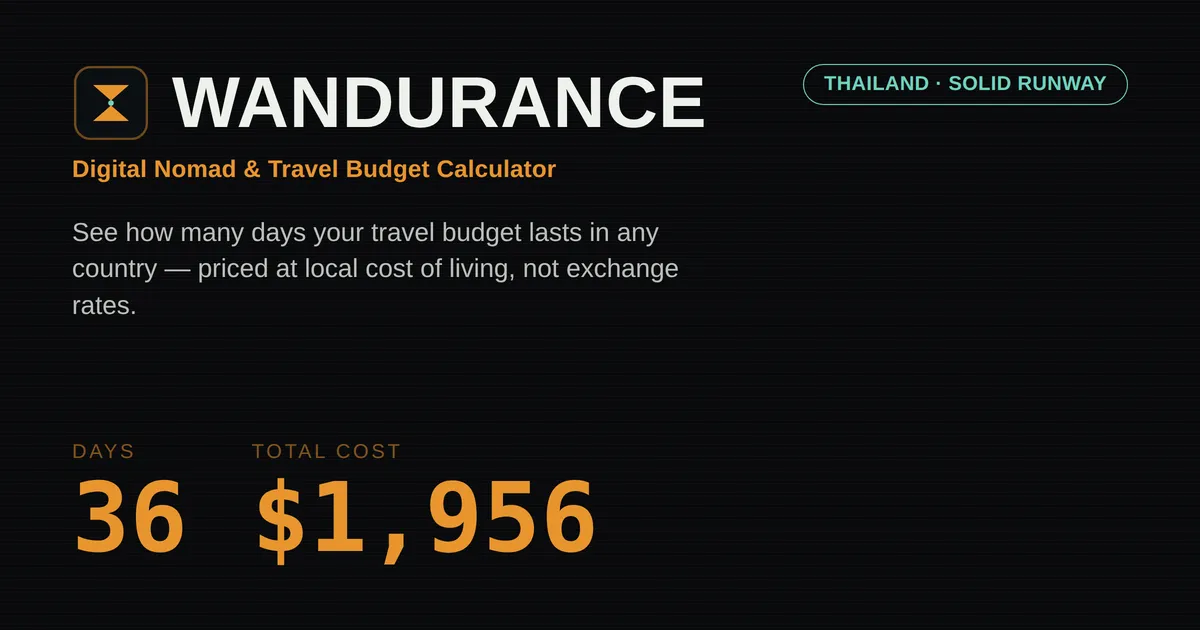
Wandurance is a free, browser-based digital nomad budget calculator designed to answer a deceptively tricky question: how many days will a fixed travel budget actually last in a specific country? Rather than relying on exchange rates, the tool uses country-level price indices to approximate local purchasing power, scaling baseline daily costs for accommodation, food, transport, and medical care to match the destination. That makes it a useful planning reference for digital nomads, backpackers, and long-term travelers who want a quick, credible estimate before committing to a ticket or a lease.
The application runs entirely in the client, so no personal data leaves the device and the calculator keeps working offline once the page is loaded. Users enter a total budget, choose a destination from a searchable list of more than 190 countries, and pick a lifestyle tier (Frugal, Normal, or Lavish). The result appears on a departure-board style display showing the number of days the budget covers and the estimated total cost, with a visual breakdown of daily spending across categories. Additional controls allow for adjusting the city cost level (capital hub versus smaller town), including a coworking and connectivity allowance, and overriding any daily cost manually.
What is Wandurance?
Wandurance is a free travel budget calculator for digital nomads and long-term travelers that estimates trip runway using local cost-of-living data rather than currency exchange rates. The core idea is that a dollar buys more in a low-cost country than in a high-cost one, and raw conversion rates do not reflect that. By applying a country-specific price-level index to a set of baseline daily costs, the tool produces a more meaningful estimate of how long money will last on the ground.
The interface is deliberately simple. A single grid places the input controls on the left and the result board on the right. The budget field, destination search, lifestyle tier buttons, and city cost level toggle are all visible on first load, while advanced settings sit inside a collapsible panel. The tool does not require an account, does not set cookies, and runs no analytics. All calculations occur locally in the browser, and the page remains usable without an internet connection after the initial visit.
Key Features
-
PPP-based daily cost estimates: The calculator scales accommodation, food, local transport, and a basic medical buffer according to each country's price-level index, then converts the result back into US dollars. This approach, rooted in purchasing power parity, gives a more realistic daily number than a simple currency conversion.
-
Searchable destination list: A combobox-style search field with autocomplete lets users find any of more than 190 countries by name, and the selected country drives the cost calculation. Keyboard navigation and a scrollable listbox make the selection process fast even on long country lists.
-
Lifestyle tiers: Three preset spending levels (Frugal, Normal, Lavish) adjust the baseline costs for accommodation, food, and transport. Frugal assumes hostels and street food, Normal assumes guesthouses and sit-down meals, and Lavish assumes hotels, restaurants, and taxis, giving a quick way to model different travel styles.
-
City cost level and connectivity toggle: Users can indicate whether they expect to stay in a capital or hub city, which nudges the price index upward, or a smaller city or town, which nudges it downward. An optional checkbox adds a daily allowance for coworking desks and local SIM data, which is useful for remote workers.
-
Daily cost breakdown and comparison tools: A visual bar and category list show how the estimated daily total splits across accommodation, food, transport, medical, and connectivity. The comparison panel allows adding multiple countries side by side to see days and total costs at a glance.
-
Multi-stop trip planner: Beyond a single destination, the planner lets users stack several countries with day counts and calculates the running total against a single budget, helping identify whether an entire route is affordable before booking.
Other practical touches include the ability to override any daily cost manually, a shareable link that encodes the exact state of the calculator, and a print/save-as-PDF option for offline records.
Use Cases
-
A digital nomad with $6,000 in savings wants to compare Chiang Mai, Lisbon, and Mexico City as potential bases. By adding each country to the comparison tool and setting the Normal tier plus connectivity, they can see which city offers the longest runway before a visa run becomes necessary.
-
A backpacker planning a three-month route through Southeast Asia uses the multi-stop trip planner, entering Thailand, Vietnam, and Indonesia with realistic day counts. The running total confirms whether the full itinerary fits inside their $2,500 budget or whether a stop needs to be shortened.
-
A remote retiree with a fixed monthly pension tests whether a year in Medellín is financially viable. They switch the lifestyle to Normal, select the small-city cost level, and manually bump the accommodation figure to match a known apartment rental, getting an adjusted daily estimate they can compare against their income.
Frequently Asked Questions
Is Wandurance free to use? Yes, Wandurance is completely free, requires no account, and runs entirely in the browser with no server-side processing.
Does it include flights, visas, or travel insurance? No, the calculator covers ongoing ground costs like accommodation, food, local transport, and medical care, but flights and insurance need a separate budget.
How accurate are the cost estimates? The figures are planning-grade estimates based on general cost-of-living patterns and World Bank price-level data, not live booking prices, so they serve as a ballpark rather than a guarantee.
Can I save or share my results? Yes, the copy shareable link button generates a URL that restores the exact budget, destination, and settings, and the print option saves the result as a PDF or printout.
Pros & Cons
Pros
- PPP-based methodology gives a more realistic sense of local spending power than exchange rate conversion.
- Runs entirely in the browser with no account, no cookies, and no analytics, and keeps working offline after first load.
- Offers granular adjustments through lifestyle tiers, city cost level, and manual overrides for each daily expense category.
- Includes practical planning features like side-by-side country comparison and a multi-stop trip planner.
- Shareable stateful links and print/PDF export make it easy to save or revisit a specific budget scenario.
Cons
- Estimates are based on broad national price-level data, not live prices or per-city details, so real-world costs can vary significantly.
- The tool does not factor in flights, travel insurance, or visa application fees, and its visa reference notes are generic rather than personalized.
- The city cost level adjustment is only a coarse multiplier, not a precise per-city index, which limits accuracy for specific destinations.