SourceX helps companies license rights-cleared operational data to AI labs, managing sourcing, privacy review, contracts and payment in one enterprise platform.
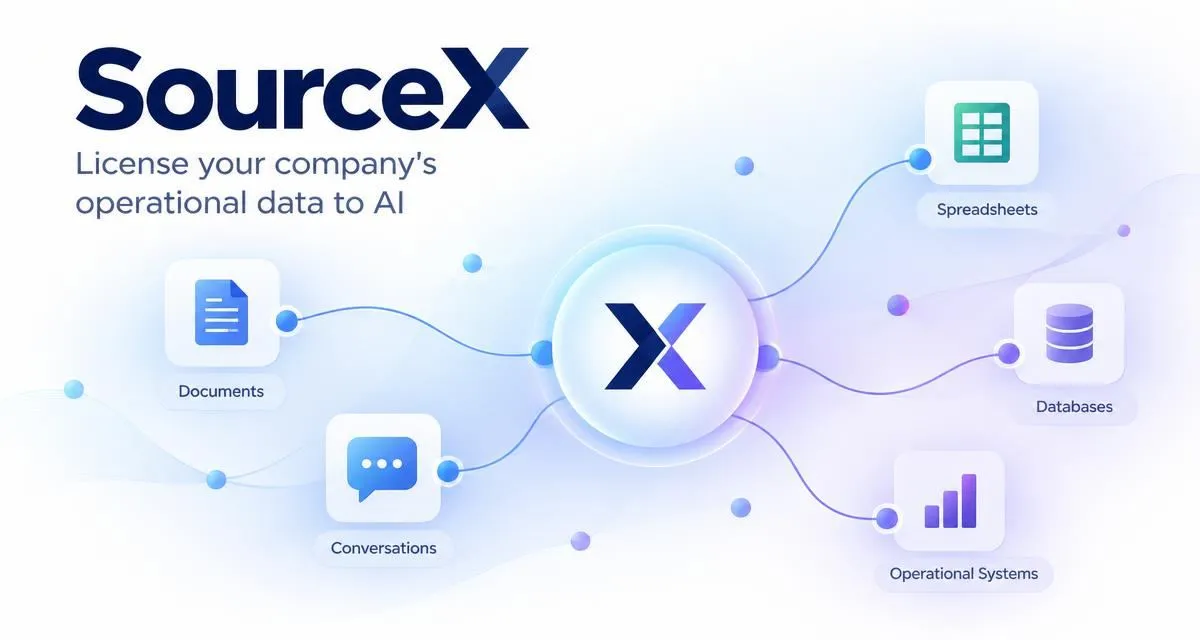
SourceX has carved out an unusual position in the artificial intelligence supply chain. Rather than training models or selling tooling, the Los Angeles company operates what it calls the enterprise data transaction layer, a managed service that helps established businesses license the operational records created inside their organizations to the AI labs that want them. The proposition is blunt: years of accumulated work may already hold commercial value, and SourceX handles the legal, privacy, and delivery work required to turn that archive into a transaction.
What is SourceX?
SourceX is an enterprise data transaction layer for AI, meaning it acts as the intermediary between companies that own real-world operational records and the developers building the next generation of models. The company handles sourcing, rights review, privacy preparation, contracting, delivery, and payment through a single relationship, so a supplier does not have to assemble its own legal and data engineering team to complete a deal.
The gap it targets is supply. Most openly available text has already been consumed by current models, and what remains is often duplicated, low quality, or restricted. Scraped data, meanwhile, carries legal and reputational exposure that AI developers increasingly avoid. The material that best captures how work actually happens, such as support escalations, engineering histories, and negotiated contracts, sits inside private business systems and almost never reaches the open web.
SourceX is built for companies with 50 or more full-time employees at peak headcount, several years of operating history, and a base in the United States, Canada, or the European Union. Businesses that are still operating, acquired, or wound down can all qualify. On the demand side, the site catalogs major AI developers including OpenAI, Meta, Google, Anthropic, and Amazon, and notes that it is not affiliated with or endorsed by any of them. Positioned against scraper-based data brokers and generic labeling vendors, SourceX leans on documented provenance and supplier consent as its core differentiator.
Key Features
Five-stage transaction workflow. Every deal moves through Supply, Rights, Preparation, Approval, and Delivery, presented in an interactive panel on the homepage. The first stage defines the records, scope, and potential licensing fit, and each subsequent step is documented before anything is released.
Rights review before licensing. SourceX states that rights are reviewed before any license is issued and publishes a legal framework alongside a trust center. A packet structure shown on the site lists where data came from, licensing rights, permitted uses, the privacy process, and the release step, which requires supplier authorization.
Privacy preparation and de-identification. Personal details are removed before any dataset is shared. The site's illustrative packet shows a sample sentence in which a name and a company are replaced by bracketed placeholders, and states that preparation is documented for each dataset individually.
Fit assessment estimator. A five-question check asks about employee count at peak, years of operating history, company status, industry, and the type of data available. The tool explicitly requires no uploads and no commitment, and it is designed for organizations with 50 or more full-time employees.
Data library spanning multiple record types. The catalog covers customer support conversations, software engineering histories, legal and contract documents, sales and CRM activity, call recordings, workflow data, and step-by-step task execution records. Each entry describes the context, action, and outcome captured in the data.
Broad system compatibility. SourceX lists exports and records from a long roster of platforms, grouped into customer and support tools such as Zendesk, Intercom, Salesforce Service Cloud, ServiceNow, Genesys Cloud, NICE CXone, Five9, and Amazon Connect; sales and CRM systems including HubSpot, Microsoft Dynamics 365, Pipedrive, Gong, and Salesloft; engineering platforms such as GitHub Enterprise, GitLab, Bitbucket, Azure DevOps, and Jira; document repositories including SharePoint, Google Drive, OneDrive, Box, Confluence, and Notion; and finance, legal, and operations software such as NetSuite, QuickBooks Online, Xero, iManage, NetDocuments, DocuSign CLM, Ironclad, and Procore. The site notes these names appear for reference only and do not imply partnership or endorsement.
Buyer directory. A dedicated section explains who builds AI with business data and links to individual profiles for major labs, so a prospective supplier can see what each company builds and which records relate to it.
How It Works
The journey starts with a fit check. A company answers five short questions about headcount, operating history, status, industry, and available data. No files are uploaded at this stage, and submitting the assessment does not commit the business to anything. The estimator returns an indicative read on whether the organization is likely to qualify.
If the fit looks reasonable, SourceX moves into the Supply stage, where the records, scope, and potential licensing fit are defined. The Rights stage follows, in which ownership and licensing rights attached to the selected material are reviewed and confirmed by the supplier. Only then does the Preparation stage begin, where personal details are removed and a dataset-specific record of that process is produced.
Approval is the gate that distinguishes the model from a typical data sale. The supplier reviews the scope and the terms before anything is released, and the agreement spells out how buyers may use the prepared dataset. Delivery happens after that authorization, and payment follows under the terms of the signed transaction agreement. The site's walkthrough video, which runs about 56 seconds, promises to show the full path from the first check to payment.
Two contractual details matter for anyone modeling the economics. Deals typically include an exclusivity term during which the supplier agrees not to license the same data elsewhere for AI training, while SourceX retains the right to distribute or sublicense the deidentified dataset. Once SourceX has selected data in writing and paid the fee, the license becomes permanent.
Use Cases
Customer support and contact centers. A BPO or in-house support organization with years of Zendesk or Intercom history holds thousands of escalations and expert responses that demonstrate how real customer problems get resolved. Licensing that archive gives model developers a record of diagnostic reasoning that is difficult to synthesize from public sources.
Software engineering organizations. An engineering platform export from GitHub Enterprise, GitLab, or Jira can contain issue histories that move from report to review to resolution. The site markets this as context, action, and outcome data, which is precisely the structure that teaches a model how expert decisions unfold over time.
Legal and contract operations. Approved documents, clause libraries, and negotiation records from systems such as iManage, NetDocuments, or Ironclad represent knowledge built through experience rather than scraped from public filings. Firms and in-house teams with a multi-year archive are the natural suppliers.
Sales and revenue teams. CRM records, call recordings, and deal histories from Salesforce, HubSpot, Gong, or Zoom Revenue Accelerator capture how pricing objections are handled and how pipelines move. For a sales organization with a long operating history, this is a byproduct of normal work rather than an extra project.
Wind-down and acquired companies. SourceX explicitly accepts companies that are still operating, acquired, or wound down, which opens a route for dormant archives to generate a one-time payment instead of sitting idle on aging infrastructure.
Data Sources and Integration Surface
The platform is not a connector that plugs into live systems and streams records continuously. The site describes compatibility with exports and records from the listed platforms, which suggests a batch-oriented model where a dataset is assembled at the time of a transaction. That is a meaningful architectural difference from data pipeline vendors. It reduces ongoing engineering burden on the supplier, but it also means the dataset is frozen at delivery rather than continuously refreshed.
The data library is organized by domain rather than by file format. Support and communication records, engineering workflows, legal and contract documents, sales and CRM activity, and call recordings each have their own landing page with a short explanation of what the material shows. The framing is consistently about the work being represented rather than the volume of files, which is a sensible way to differentiate from brokers that quote raw token counts. Industry pages extend the same logic into verticals such as software, business process outsourcing, recruiting, finance, accounting, consulting, legal, healthcare administration, and logistics.
Pricing & Value
SourceX does not publish a price list. The model described on the site is a one-time fee paid after SourceX selects the data in writing, with payment timing and conditions set by the signed transaction agreement. There is no free plan and no subscription tier, because the product is a transaction rather than a tool. Checking fit costs nothing and requires no uploads.
That structure creates a real information gap. A prospective supplier cannot estimate the value of its archive before engaging, and the fee is negotiated privately rather than posted. For companies with a large, well-documented corpus in a domain AI labs actively want, the upside is a payment for records that already exist and cost nothing extra to produce. For smaller organizations with thin or poorly structured archives, the effort of review and preparation may not justify the return. The exclusivity term also restricts how else the same data can be monetized during the agreed period, which is worth weighing against the one-time payment.
Frequently Asked Questions
Does applying commit a company to selling its data? No. Submitting a company for review does not commit it to anything, and the fit check involves no file uploads.
Can a supplier back out after starting? Yes. A company can decline at any point before signing, at no cost. Once an agreement is signed, its terms apply, and those terms are approved in advance. After SourceX has selected data in writing and paid, the license becomes permanent.
Is customer or employee information shared? No. The fit check only asks about company size, industry, systems in use, and operating history. If a deal progresses, personal details are removed before anything is shared, and the scope is approved first.
Which companies qualify? The best fit is a business based in the United States, Canada, or the European Union with 50 or more full-time employees at peak, excluding contractors, and several years of operating history. Companies that are operating, acquired, or wound down can all qualify.
What are the standard deal terms? A one-time fee after SourceX selects data in writing, with ownership of the original data retained by the supplier. Rights to the prepared dataset, exclusivity, review, and confidentiality are set by the signed agreement. Full terms are published on the standard deal terms page.
Does exclusivity apply? Usually. During the exclusivity term the supplier agrees not to license the same data elsewhere for AI training. The restriction applies to the supplier, not to SourceX, which keeps the right to distribute or sublicense the deidentified dataset. The term is disclosed before agreement.
Final Verdict
SourceX addresses a genuine bottleneck in AI development. Rights-cleared, real-world operational data is scarce, and the compliance risk of scraped alternatives keeps rising. By packaging rights review, de-identification, contracting, delivery, and payment into a single relationship, the company lowers the barrier for ordinary businesses to participate in the data economy without building legal and engineering capacity from scratch. The trust materials, including a published legal framework and a documented packet structure, are unusually transparent for this corner of the market, and the willingness to work with acquired and wound-down companies widens the pool of eligible suppliers.
The limitations are equally clear. Pricing is not published, so suppliers negotiate without a reference point, and the one-time fee model means there is no recurring revenue stream once a deal closes. Exclusivity terms can restrict other uses of the same data for the duration. The platform is also selective by design, with a 50 employee threshold that excludes most small businesses, and the transaction is batch-oriented rather than a continuous pipeline.
For mid-sized and large organizations sitting on years of support tickets, engineering histories, or contract archives, SourceX is worth exploring the fit check to see whether the records qualify. Smaller teams and companies without a substantial, well-structured archive will likely find the threshold out of reach.
Pros & Cons
Pros
- End-to-end transaction management covers rights review, de-identification, contracting, delivery, and payment through one relationship, removing the need for suppliers to assemble their own legal and data teams.
- The five-question fit assessment requires no file uploads and no commitment, letting companies gauge eligibility in minutes without exposing proprietary records.
- Public trust materials, including a published legal framework, a documented packet structure, and a security status page, give suppliers unusual visibility into how rights and privacy are handled.
- Integration guidance spans a wide range of enterprise systems, from Zendesk and Salesforce to GitHub Enterprise, SharePoint, and NetSuite, which suits organizations with heterogeneous tooling.
- Eligibility extends to acquired and wound-down companies, allowing dormant archives to be monetized rather than left idle.
Cons
- Pricing is not published, so suppliers have no reference point for valuing a dataset before entering negotiations.
- Deals typically require exclusivity, restricting the supplier from licensing the same data elsewhere for AI training during the term.
- The 50 full-time employee minimum excludes smaller businesses, and the one-time fee model provides no recurring revenue after the license is granted.