UltraBall tracks live prices, graded values and sales history for 20,903 English Pokémon cards across 185 sets, updated daily.
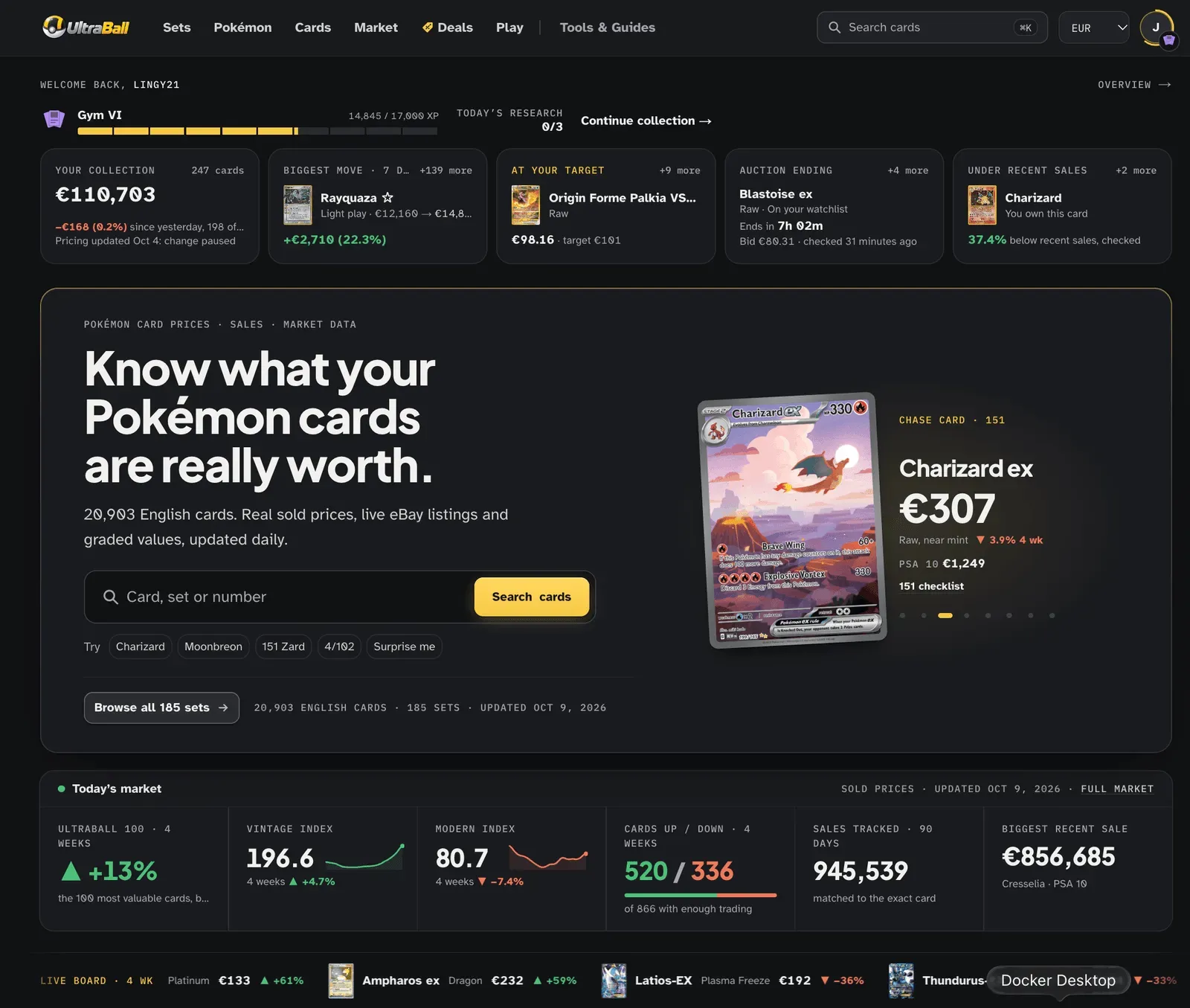
Pokémon card collecting has matured into a data-driven market, and UltraBall is one of the clearest examples of that shift. The platform publishes pricing, sales history, liquidity signals and grading intelligence for 20,903 English Pokémon cards spread across 185 sets, refreshing the dataset daily. For anyone who has scrolled through pages of eBay sold listings trying to work out whether a Charizard is worth $60 or $600, the appeal is immediate. This review examines what UltraBall actually delivers, where its data model is stronger than the alternatives, and which limitations a prospective user should weigh before adopting it as a primary reference.
What is UltraBall?
UltraBall is an English Pokémon card price database and market data platform that tracks 20,903 cards across 185 sets, spanning the 1999 Base Set through to 30th Celebration and the wider Mega Evolution era. It exists to answer a question that marketplace search and forum threads handle poorly: what is one specific card actually worth right now, in one specific grade, with enough supporting evidence to trust the figure. Every card page publishes an ungraded price with its four week change, a price ladder for graded conditions, a price chart, liquidity and confidence marks, and the recent sales behind the number. The audience is collectors, sellers, graders and investors who treat cards as inventory rather than nostalgia. UltraBall positions itself against scattered alternatives by consolidating raw pricing, graded ladders, population signals and live marketplace listings into one reference, and by labelling thin evidence openly instead of burying it under a confident looking figure.
Key Features
Per card price pages with graded ladders. Every one of the 20,903 cards receives a dedicated page carrying an ungraded market value, its four week movement, a graded price ladder, a price chart and the sales behind the figures. Raw and encapsulated values are kept apart rather than averaged into one blurry number, which matters enormously when a PSA 10 can trade at many multiples of a raw copy.
Independent graded market treatment. UltraBall states plainly that each graded price belongs to that exact grader and grade, and that PSA, CGC, BGS, SGC and TAG data are never mixed. Grade specific population views include low pop cards, hardest PSA 10s and most PSA 10s added, which speaks directly to collectors chasing scarcity within a single grade.
Market indexes and the UltraBall 100. A tracked index family covers the UltraBall 100, Vintage, Modern, PSA 10, Raw and Charizard segments. The homepage shows the Vintage index at 196.6 against a Modern index of 80.7, giving a fast read on how older printings perform relative to recent releases. These indexes are the closest thing the hobby has to a stock ticker.
Sales tracking at scale. The platform reports 925,164 sales tracked over a 90 day window, each matched to the exact card rather than to a loosely related listing. Record sales appear too, led by a Rayquaza Star from Deoxys in a CGC 10 Pristine grade at $1,020,000. A most traded ranking, topped by Mega Gengar ex from Ascended Heroes with 1,893 sales in that window, shows where liquidity actually concentrates.
A deep free toolset. Beyond pricing, UltraBall ships a price checker, a set symbol identifier, a nickname finder, an AI card grader, a card centering tool, a grading calculator, a selling calculator and a collection tracker. Centering and grading tools target the two questions that decide whether slabbing a card is worthwhile, while the selling calculator handles fee arithmetic before a listing goes live.
Marketplace hunting and alerts. The deals section links out to eBay listings and adds purpose built modes, including Sniper for auctions with a max bid and Slab Hunter for raw cards worth grading, alongside feeds for auctions ending soon, new listings and price drops. A watchlist, Grail Radar and alerts complete the monitoring layer.
How It Works
A typical session begins on the homepage, where a prominent search field accepts a card name, a set name or a card number. Suggestion chips such as Charizard, Moonbreon, 151 Zard and 4/102 shortcut the most common lookups, and a Surprise me option surfaces a random pick for the undecided. Results lead into a card page carrying the ungraded price, the graded ladder, the price chart and the recorded sales.
Navigation then broadens. Sets can be browsed by era, from Wizards of the Coast through EX, Diamond & Pearl, Platinum, HeartGold & SoulSilver, Black & White, XY, Sun & Moon, Sword & Shield, Scarlet & Violet and Mega Evolution, or located through set symbols and release dates. Cards can be filtered by rarity, including Special Illustration Rare, Illustration Rare, Alternate Art, Gold Star and Shining, or found through nicknames such as Crystal Charizard and Van Gogh Pikachu. A currency selector converts every figure across roughly thirty currencies, from USD and GBP to KRW and BRL.
Daily use centres on the market layer. The market overview aggregates recent sales, top sales, records, low population cards and trading volume, while the deals section converts that intelligence into shopping actions. Cards under watch are added to a list with alerts attached, and grading candidates run through the centering tool or AI grader before the grading calculator checks projected slab value against current graded prices. Progress features such as the daily challenge and fantasy portfolio sit alongside as a lighter habit loop.
Use Cases
The returning collector with a childhood binder. Someone who has rediscovered a box of late 1990s and early 2000s cards can search by set and card number, identify printings through the 1st Edition versus Shadowless versus Unlimited explainer, and review current ungraded values before deciding whether to sell, hold or slab. Record sale data and the rarity chart supply context that a single marketplace listing cannot.
The reseller pricing inventory at scale. A seller working through bulk stock can use the most traded rankings to see which cards clear quickly, monitor price drops and new listings for buying opportunities, and run the selling calculator to model fees before listing. Slab Hunter highlights raw cards whose graded value justifies the submission cost, which is where the widest margins tend to sit.
The grading speculator. Collectors chasing PSA 10 premiums can study hardest PSA 10s, low pop cards and most PSA 10s added to judge whether a card is genuinely scarce in top grade or simply heavily submitted. Because UltraBall keeps each grader and grade separate, the price ladder reflects the real market rather than a blended average.
The set completionist. Someone working through Ascended Heroes, 151 or Crown Zenith Galarian Gallery can track set completion, follow Collector Routes, check set values and chase cards, and use the daily challenge and Wrapped summaries as a running record of a long collecting project.
The Methodology Behind the Numbers
The methodology page sets out three principles that shape how every figure is produced. The first is that sales sit beside every price: each card lists the recent sales recorded for it, with counts and recency, and listings still for sale are kept apart from completed transactions. That separation matters because asking prices on marketplaces routinely outrun what buyers actually pay.
The second principle is that graded is its own market. Every graded value belongs to a specific grader and grade, with its own supporting sales, so a PSA 10 figure is never blended with a CGC 10 or a BGS 9.5. The third principle is disclosure of confidence and liquidity. Each price states how many copies sold, how recently, and how readily a card in that condition changes hands, and thin evidence is labelled rather than hidden.
The output of that framework reads like a market terminal. The homepage displays a Vintage index of 196.6, a Modern index of 80.7, 925,164 tracked sales over 90 days and a headline record sale of $1,020,000 for a Rayquaza Star in CGC 10 Pristine. Prices across the site carry a stated update date, and the footer makes clear that values are estimates rather than offers to buy or sell.
UltraBall Compared to Alternatives
Most collectors price cards through one of three routes: marketplace sold listings, a general card pricing site, or grading company population reports. Marketplace data is free and enormous but messy, since a sold listing rarely specifies print variant, centering quality or the difference between a raw card and an encapsulated one. Pricing sites aggregate broadly but often merge conditions. Population reports answer how many copies exist in a grade without saying what any of them trade for.
UltraBall's argument is consolidation with discipline. It combines a 20,903 card catalogue, per grade pricing ladders, liquidity signals, population derived rankings and live marketplace listings inside one interface. The trade-off is scope: the database covers English cards specifically, so Japanese exclusives and other language printings sit outside it. The platform also routes buying activity outward to eBay rather than operating its own marketplace, which keeps listings live and current but means transactions happen elsewhere.
The Guide Library and Learning Resources
Alongside the database, the guide library contains 37 collector guides aimed at the questions that precede a purchase or a sale. Value oriented titles cover how to check a card price, which Pokémon cards are worth money, whether a collection is worth anything and what makes a card valuable. Rarity and authentication content explains the rarity chart, how to tell whether a card is rare, and how to spot fakes. Print variant guidance tackles 1st Edition versus Shadowless versus Unlimited distinctions, which routinely swing values by an order of magnitude.
Grading and selling coverage rounds out the set with material on PSA grading costs, PSA 10 cards, whether grading is worthwhile, where to sell, and which online venues perform best. For newcomers arriving with an unlabelled shoebox, the combination of explanatory guides and identically structured card pages forms a reasonably complete on ramp.
Play, Progress and Community Layer
The database is not purely utilitarian. A daily card challenge, a fantasy portfolio with public leaderboards, a pack simulator and a luck tracker give the platform a habit forming side familiar to anyone who has used a trading or collecting app. Collector Routes organise longer term goals, levels and achievements record milestones, set completion pages track progress across individual releases, and an annual UltraBall Wrapped wraps activity into a shareable summary.
Even the search experience carries this tone. A Surprise me dialog offers to pick either a card or a set, with filters for any card, vintage, modern, grails, and price ceilings of $25, $100 or $500. It is a small feature, but it signals that the product is designed for hobbyists as much as for spreadsheet driven sellers.
Pricing & Value
The homepage does not publish tiered pricing, subscription terms or a plan comparison table, and the material reviewed presents the platform as freely browsable. Card pages, the six market indexes, the deals feeds, the guides and the calculator tools are all reachable without a stated paywall. Monetisation appears to lean on outbound marketplace traffic through eBay deal links rather than on gated features, which is a common and largely frictionless model in hobby databases.
That structure delivers strong value for occasional users who need a defensible price before a purchase, a sale or a grading submission. The honest caveat is that no commercial terms are documented, so it remains unclear what a future premium tier might cost or which features it might hold back. Compared with paid pricing subscriptions elsewhere, the open access makes UltraBall an easy addition to an existing toolkit.
Frequently Asked Questions
Is UltraBall free to use? No pricing tiers or paid plans appear on the homepage, and the core database, market pages, guides and tools are presented openly. Any premium layer is not documented in the published material.
How large is the UltraBall card database? It covers 20,903 English cards across 185 sets, running from the 1999 Base Set to 30th Celebration and the Mega Evolution era, with prices refreshed daily and 925,164 sales tracked over a rolling 90 day window.
Does UltraBall separate raw and graded prices? Yes. Each graded value belongs to a specific grader and grade, so PSA, CGC, BGS, SGC and TAG figures are never blended. Prices also carry confidence and liquidity marks so weaker evidence stays visible.
Can UltraBall help decide whether a card is worth grading? The platform offers an AI card grader, a card centering tool, a grading calculator and a Slab Hunter view that flags raw cards worth submitting, all of which support grading decisions with current graded values.
Which cards fall outside the database? Coverage is limited to English Pokémon cards. Japanese exclusives, other language printings and non Pokémon trading cards sit outside the tracked catalogue.
Final Verdict
UltraBall's defining quality is discipline about evidence. Prices arrive with the sales behind them, graded markets stay unmixed, and confidence and liquidity labels expose weak data instead of flattering it. A catalogue of 20,903 English cards, daily updates, six market indexes and a toolset spanning centering analysis to selling fee maths make it a credible primary reference for collectors, resellers and grading focused investors. The limitations are structural rather than damaging. Coverage stops at English printings, the richer monitoring features assume an account, and commercial terms remain undocumented. Anyone who wants a defensible number rather than a guess should treat UltraBall as a first stop, while Japanese only collectors will need to supplement it elsewhere.
Pros & Cons
Pros
- Tracks 20,903 English Pokémon cards across 185 sets with daily price updates and 925,164 sales recorded over a rolling 90 day window, giving unusually deep coverage for a niche collector database.
- Keeps raw and graded markets strictly separate so PSA, CGC, BGS, SGC and TAG prices are never blended into a single misleading average.
- Publishes a transparent three point methodology with confidence and liquidity labels attached to each price, plus a dedicated page explaining where values come from.
- Ships a broad free toolset beyond pricing, including an AI card grader, card centering tool, grading calculator, selling calculator, set symbol identifier and collection tracker.
- Connects market intelligence to live eBay activity through deals feeds, ending auctions, price drops, a Sniper mode for max bid auctions and a Slab Hunter view for raw cards worth grading.
Cons
- No pricing tiers, subscription terms or plan comparison are published on the homepage, leaving commercial terms for any future premium features unclear.
- Coverage is explicitly limited to English Pokémon cards, so Japanese exclusives and other language printings fall outside the tracked catalogue.
- The richer monitoring features such as watchlists, alerts and fantasy portfolios depend on account linked functionality rather than anonymous browsing.