The Audio Stuff delivers honest, score-anchored audiophile gear reviews, buying guides, and free audio tools with zero sponsored verdicts.
What is The Audio Stuff?
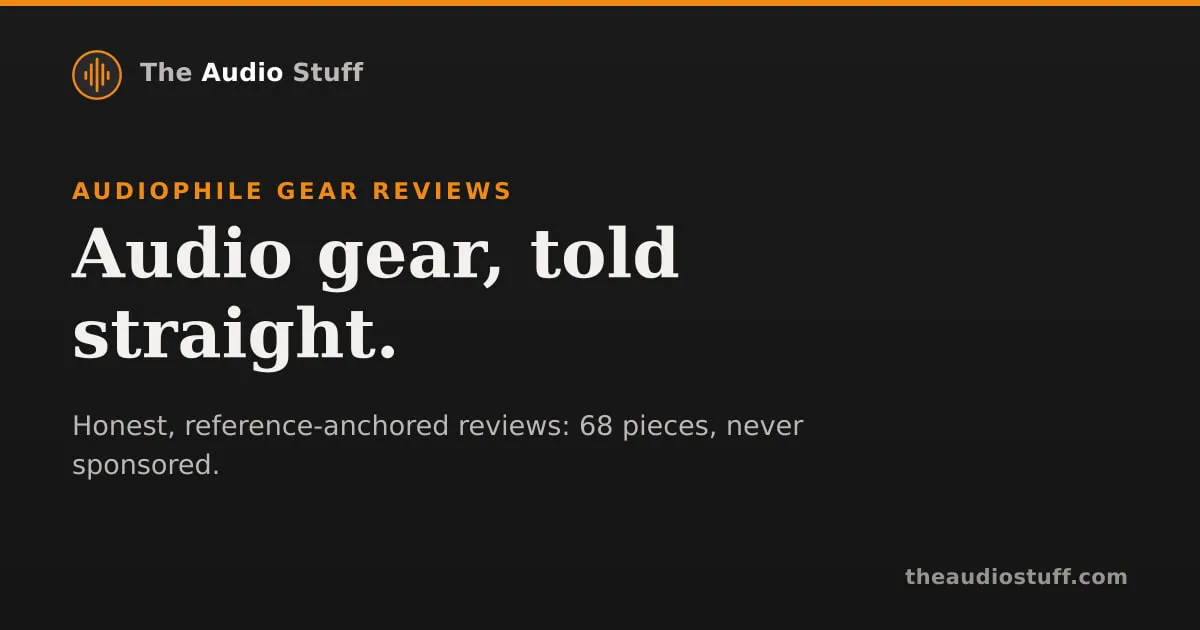
The Audio Stuff is an independent audiophile gear review platform that combines score-anchored evaluations, buying guides, and free browser-based tools. It targets enthusiasts and professionals who need honest, comparative analysis of headphones, speakers, DACs, and amplifiers without the influence of sponsor deals. The site differentiates itself through a transparent, reference-anchored scoring methodology, where every product is judged head-to-head against a published benchmark within its category. As of August 2026, it hosts 68 reviews, each scored on a 0 to 10 scale and mapped to verdict tiers such as Reference, Highly Recommended, Recommended, Mixed, and Pass. The editorial team, led by Jakub Charkiewicz, explicitly states that no sponsored verdicts are ever published, and brands receive zero editorial input. The platform also offers a suite of 16 free tools, including a headphone power calculator, ABX blind test, FLAC checker, and room mode visualizer, all running client-side without tracking. The Audio Stuff positions itself as a data-driven alternative to subjective influencer reviews, with published standards from ITU, AES, and EBU underpinning its methodology.
Key Features
- Reference-anchored scoring: Every review is compared against a fixed reference chain of six previously reviewed components, ensuring that a 9.0 in one category carries the same weight as a 9.0 in another. The scoring rubric is public, with five weighted axes: tonality (30%), technicalities (25%), build and ergonomics (15%), system fit (15%), and value (15%).
- Editorial independence: Brands cannot influence verdicts, pre-publication review of drafts is never granted, and any attempt to pull advertising over a negative review is disclosed. Loaner units are always flagged in the review header, and mid-tier and budget gear is often purchased outright.
- Published listening methodology: The site follows ITU-R BS.1116-3 for double-blind subjective testing, volume-matches using EBU R 128 loudness normalization, and uses IEC 60318-4 headphone couplers and ANSI/CTA-2034-B spinorama for loudspeaker measurements. This transparency lets readers reproduce the context of each score.
- Free browser-based tools: Sixteen tools are available without registration or upload, including a headphone power calculator, an ABX blind test that returns p-values, a hi-res audio checker that detects upsampled files, an online equalizer, and a room mode calculator. These tools are built from the same engineering data used in reviews.
- Comprehensive comparison and guide system: The site includes 37 head-to-head comparisons and 11 buying guides, each populated only with products that have been scored under the same protocol. The comparison tool highlights point gaps, such as a 0.1-point difference between the HIFIMAN Arya Organic and HE1000se.
Use Cases
A headphone enthusiast deciding between the HIFIMAN HE1000se and Arya Organic can browse the direct comparison page, see the 0.1-point gap, and read both full reviews to understand tonal and technical differences before making a $1,700+ purchase. A studio professional evaluating a new DAC can cross-check the Denafrips Enyo 15th Anniversary against the published reference chain and use the FLAC checker to validate the integrity of incoming files. A budget-conscious buyer can start with the "Best Budget Headphones" guide, which lists eight scored picks with the Kiwi Ears tri-set as the top pick, and then use the headphone power calculator to ensure the chosen pair will be driven properly by the amplifier on hand.
Frequently Asked Questions
Does The Audio Stuff accept paid reviews? No, the site explicitly states that brands have zero editorial input, pre-publication review is never granted, and no payment ever influences a verdict.
How long does a typical review take? Reviews require a minimum of two weeks of real-world listening, with flagship gear often evaluated over four to eight weeks against multiple reference components and genres.
Is the scoring scale consistent across product categories? Yes, each category maintains a published reference list, and all products are measured against the same five weighted axes, so a high score in headphones means the same as a high score in DACs or speakers.
Can users submit gear for review? Manufacturers and distributors can email [email protected] with product details, pricing, and a pitch; however, there is no guarantee of a positive verdict or a fixed publish date.
Pros & Cons
Pros
- No sponsored verdicts, guaranteeing editorial independence and reader trust.
- Transparent, reference-anchored scoring with a published methodology and rubric.
- Extensive free tools for audio analysis, comparison, and calibration.
- Detailed head-to-head comparisons and buying guides derived from actual scored reviews.
- Long-form listening periods (minimum two weeks) ensure thorough and reliable evaluation.
Cons
- Limited number of reviews (68) with some categories containing only a few entries.
- Focus on mid-to-high-end gear, potentially less relevant for budget-only listeners.
- No community features or user reviews, limiting the diversity of opinions available.