Citation checker CiteTrue verifies references against authoritative academic databases and flags fake or AI-generated sources in seconds.
What is CiteTrue?
CiteTrue is a free, AI-powered citation checker that validates academic references against authoritative scholarly databases including Crossref, PubMed, arXiv, IEEE, Springer, OpenAlex, and Semantic Scholar. The tool exists to solve a problem that has grown sharply alongside large language models: fabricated, misattributed, or quietly altered references that reach submission without anyone noticing. Its audience spans undergraduate and graduate students polishing a thesis, professors screening the work their advisees hand in, journal editors filtering manuscripts during initial triage, and peer reviewers checking a paper before endorsing it. Rather than trusting that a citation merely looks plausible, CiteTrue decomposes each entry into its component fields and tests every one against the record on file. The output is a confidence score and a readable report that separates an authentic reference from an invented one.
Key Features
- Field by field verification: Every reference is split into title, authors, year, DOI or other identifier, venue, volume, and pages. Each field is compared individually against indexed records, so a citation that points at a real paper but credits the wrong people is still caught.
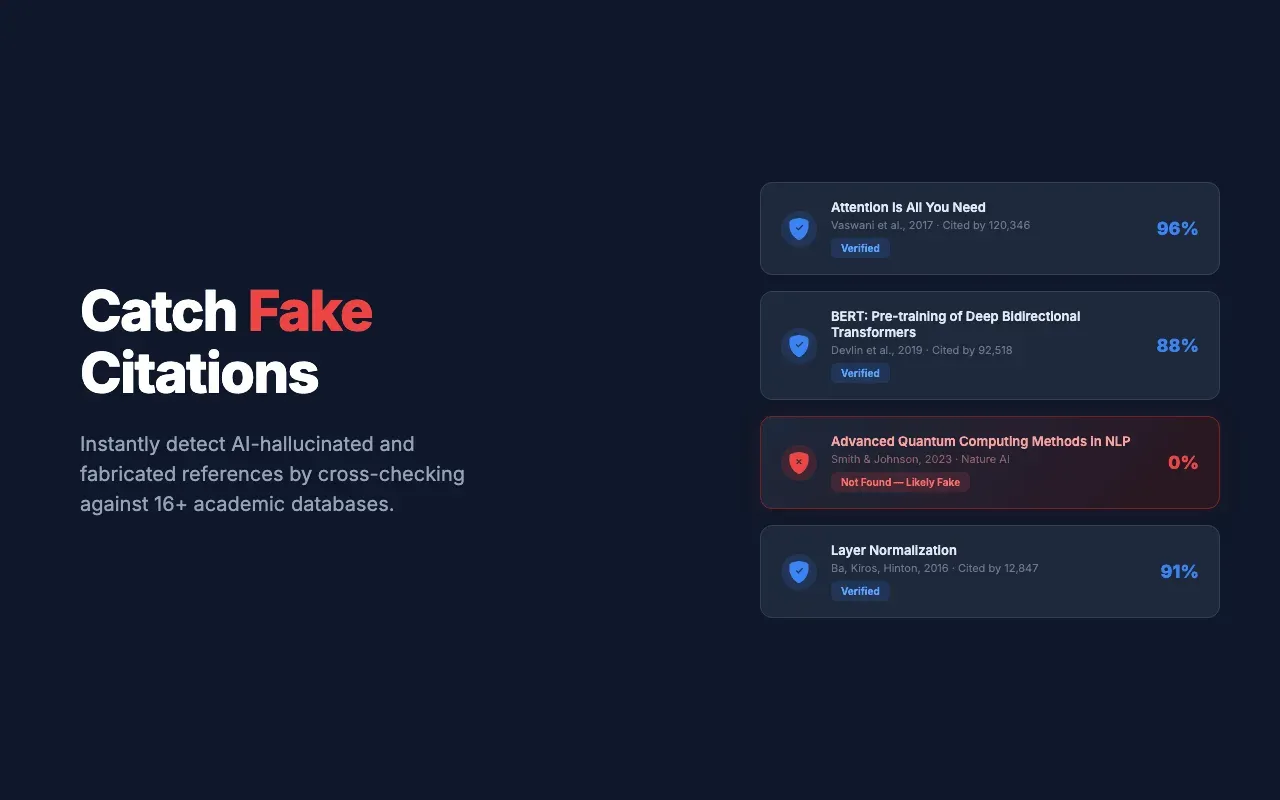
- Hallucination and fabrication flags: References that resolve to nothing across the connected databases are marked as Not Found, while mismatched details such as year drift trigger a warning label. A demonstration panel on the site shows a plausible looking invented source returning a zero percent score next to two verified entries.
- Bulk reference processing: Dozens or hundreds of entries can be submitted in a single pass. Reviewers and editors working through long manuscripts or thesis bibliographies avoid the slow manual labor of looking up sources one at a time.
- Confidence scoring model: A proprietary scoring engine returns a percentage for each reference indicating how likely it is to be authentic. High scores signal a clean match, mid range percentages flag partial matches, and zero signals a reference with no supporting record.
- Format normalization: Pasted citations in APA, MLA, and other common styles are normalized before verification, which strips formatting noise out of the accuracy assessment.
- Connected research toolkit: Alongside the checker, CiteTrue ships a Citation Finder that returns real peer reviewed sources for a paragraph, a Paper Draft tool, an AI Humanizer, a Chrome extension, a Mac app, and documented API and MCP access for programmatic workflows.
How It Works
A researcher pastes a reference list into the input area of the citation checker and triggers verification. The system first segments the pasted block into individual citations, then places each one into a task queue. From there, queries fan out across the connected databases, and the platform re-queries additional sources when a first pass returns an ambiguous result. Retrieved records are analyzed, aggregated, and converted into a report that lists every citation beside its confidence score and any flagged discrepancy, with labels such as year mismatch or not found rendered directly in the results panel. Accounts are created through Google, email, or phone sign in, and the interface ships in ten languages spanning English, French, German, Italian, Spanish, Portuguese, Russian, Arabic, Chinese, Japanese, and Korean. Registered accounts receive a daily allowance of free citation checks, and a referral program awards credits to both the inviter and the new signup once a quota runs out.
Use Cases
- A doctoral candidate finishing a thesis bibliography. A PhD student in computer science assembles several hundred references and runs them in one batch. Several entries return no matching record at all, exposing sources that were never published, and the student removes them well before the defense rather than after a reviewer raises the issue.
- A professor screening advisee submissions. An engineering faculty member verifies each student paper before it moves forward, and the report surfaces fabricated entries within minutes instead of after weeks of reading, which also protects the advisor from reputational fallout.
- A journal editor triaging incoming manuscripts. An editor at a medical journal applies the checker during initial screening to filter out submissions built on bogus references, keeping reviewer attention on work that is actually sound.
- An undergraduate preparing a course paper. A social sciences student pastes a short reference list before submitting an assignment, confirming that each source exists and that the publication details match the record.
Frequently Asked Questions
Is CiteTrue free to use? The citation checker is free, with a daily allowance of citation checks for registered accounts. Extra credits can be earned by inviting colleagues, and heavier workloads can move to paid options.
Which citation styles and databases are supported? References in APA, MLA, and other common styles are accepted, and verification runs against sources including Crossref, PubMed, arXiv, IEEE, Springer, OpenAlex, CORE, Google Scholar, ResearchGate, and OpenLibrary.
What kinds of errors does the checker catch? It flags references to papers that were never published, real papers credited to incorrect authors, mismatched publication years, invented or dead DOIs, and altered venue, volume, or page details.
Who is CiteTrue built for? The primary audience includes students, researchers, professors, advisors, journal editors, and peer reviewers, essentially anyone who produces or evaluates academic writing with a bibliography.
Are there integrations beyond the web app? Yes. The platform publishes documentation for API and MCP access and also offers a Chrome extension plus a Mac desktop application for workflows outside the browser.
Pros & Cons
Pros
- A genuinely free tier with a daily quota of citation checks keeps the tool accessible to students and independent researchers.
- Field level comparison catches subtle errors such as wrong authors or drifted publication years, not just wholly invented references.
- Bulk verification of entire bibliographies in one pass suits thesis writers, editors, and reviewers handling long manuscripts.
- Cross references a broad set of academic sources including Crossref, PubMed, arXiv, IEEE, Springer, and OpenAlex.
- Extends beyond the browser with a Chrome extension, a Mac app, and documented API and MCP access.
Cons
- Verification quality depends on coverage in the underlying databases, so niche or non indexed publications may return inconclusive results.
- The fast verification mode can struggle with unstructured text and may require reformatting entries into a standard reference list.
- Free checks are capped by a daily quota, so heavy users eventually need credits or a paid plan.