Turbofy is an AI app builder that turns a described business process into a live, production-ready app with data, auth, and hosting built in.
Turbofy, the AI app builder from GraphApi.io GmbH, enters the crowded vibe coding market with a pointed promise: describe a business process in a chat field and receive a live application rather than a throwaway prototype. The pitch sits squarely between no code platforms such as Bubble and Airtable and professional development environments driven by coding agents. Turbofy argues that the missing layer in modern software delivery is not intelligence but infrastructure, and that data, authentication, hosting and workflow orchestration should arrive pre wired the moment an idea is expressed. The platform is aimed at operations teams, founders and in house developers who understand their processes intimately but do not want to assemble a stack from scratch.
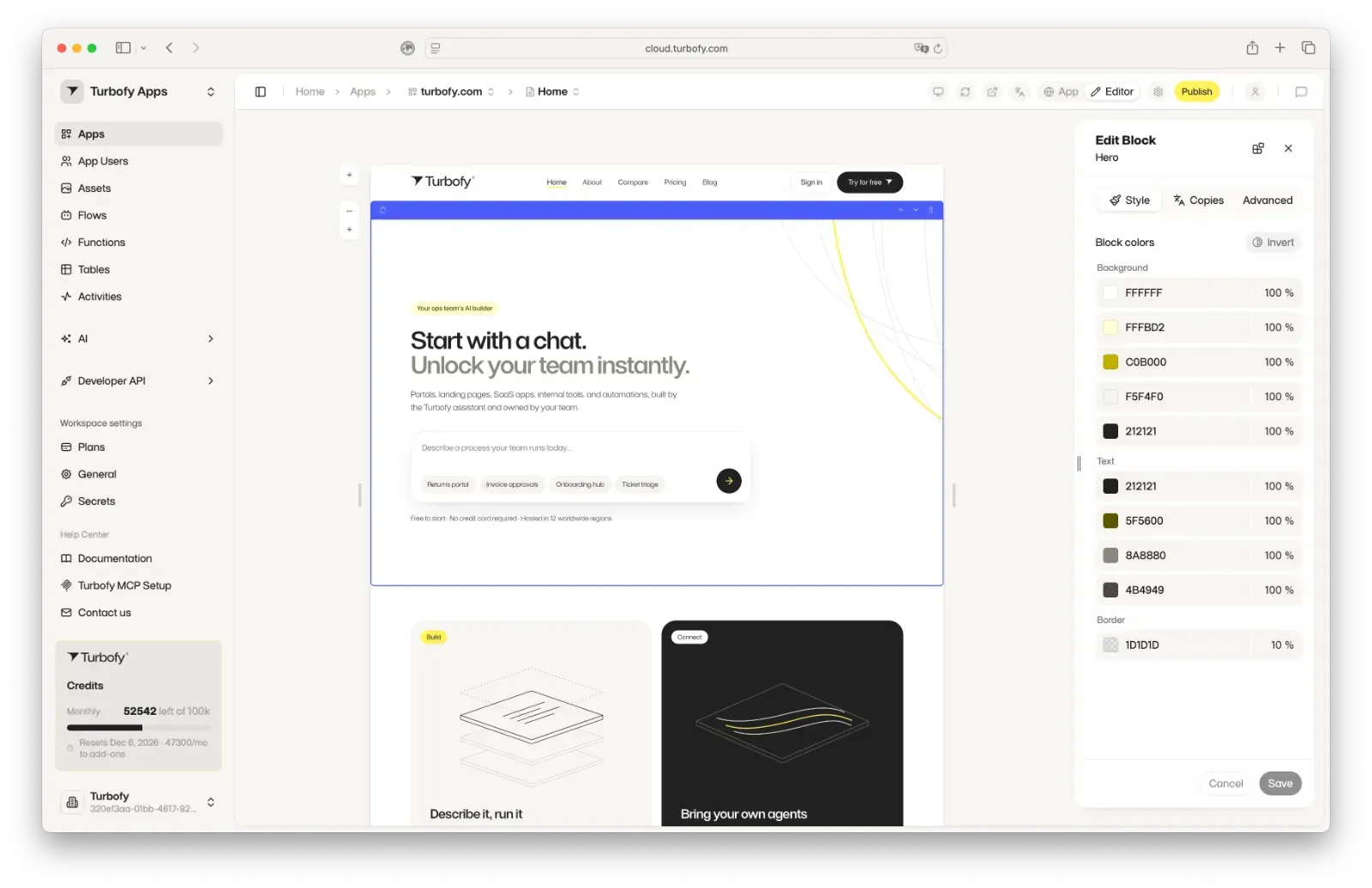
The homepage frames this positioning bluntly. Instead of asking visitors what they want to build, the hero prompt asks them to describe a process their team runs today, with example chips for a returns portal, invoice approvals, an onboarding hub and ticket triage. That framing signals a business software orientation rather than a landing page generator. Turbofy also ships a Model Context Protocol plugin, letting Claude Code, Codex, OpenCode and Cursor operate the same workspace, a concession that professional developers remain central to how serious software gets made.
What is Turbofy?
Turbofy is a conversational application platform that converts natural language descriptions into deployed business software, bundling a database, user authentication, hosting and automation into a single managed environment. The problem it addresses is the gap between a good idea and a running system. Traditional development requires teams to select a data layer, wire up identity, provision servers and maintain all of it. Turbofy compresses those steps into the initial build, so the first version of an application is already a functioning product.
The target audience spans operations managers, small and mid sized business owners, product teams inside larger companies, and developers who want to accelerate delivery without surrendering control of the codebase. Turbofy positions itself against two camps at once. Against low code suites, it argues that conversational iteration is faster and less brittle than drag and drop builders. Against pure code generation tools, it argues that generation without hosting, data and governance is only half a product. The company calls the result vibe coding for business software and stresses that applications remain owned and editable by the customer's team.
Key Features
Conversational build surface. The central interaction is a single text field in the hero section, framed as a place to describe a process rather than a prompt engineering exercise. Four starter chips, covering a returns portal, invoice approvals, an onboarding hub and ticket triage, hint at the kind of internal tooling Turbofy expects to produce. Users type a plain language brief, submit, and land in a workspace where the generated application appears as an editable artifact.
Model Context Protocol support. Turbofy publishes an MCP plugin at github.com/turbofy-ai/turbofy-ai-plugin that connects external coding agents to the platform. Claude Code, OpenAI Codex, OpenCode and Cursor are all listed as compatible, alongside badges for Claude, OpenAI, Gemini, OpenCode and Cursor. This is the most strategically interesting piece of the product: teams can keep their preferred agent and terminal workflow while using Turbofy as the managed backend, deployment target and governance layer. The company describes it as the same platform with the same governance, whether the work originates in chat or in an editor.
Pre provisioned data, auth and hosting. Rather than treating infrastructure as a later concern, Turbofy bundles the database, identity and deployment targets into the initial build. The site advertises hosting across twelve worldwide regions, which matters for latency sensitive business tools and for teams with data residency questions. Because the data model is created alongside the interface, generated apps can persist records immediately instead of stalling at the mockup stage.
Visual editor and refinement loop. Video walkthroughs on the site repeatedly describe generated apps being refined in a visual editor after the first prompt. One demonstration starts from a single line agency brief and produces an editable landing page with services, case studies, results and a call to action. Another builds a property marketplace, then adjusts listings, photos, reviews, bookings and permissions. The combination of chat, visual editing and agent driven changes gives three routes to the same codebase.
Multi model routing and image generation. Turbofy routes work across models from Anthropic, OpenAI, Google, Moonshot AI and xAI, and its video library shows Kimi K3 building a first version followed by Grok 4.6 refining the layout. A separate Image Studio demonstration compares FLUX from BlackForestLabs, Gemini and GPT Image for generation and editing. Access to a rotating model roster without re platforming is a genuine advantage for teams that want to follow capability improvements rather than commit to a single vendor.
Automation and workflow execution. Apps built on Turbofy are not read only dashboards. Published demos include exporting generated pitch decks to PDF and pushing them to LinkedIn as drafts, plus a weather application that fetches and renders forecast data. Workflow logic, notifications and outbound actions are treated as first class parts of the build rather than add ons requiring a separate automation service.
How It Works
The journey begins at cloud.turbofy.com/signup, where the site promises a free start with no credit card required. New accounts arrive in a workspace that opens with the conversational prompt as the primary navigation element. A user describes an existing process in plain language, optionally borrowing one of the suggested patterns for a portal, an approval flow, an onboarding hub or a triage queue.
Turbofy's assistant responds by scaffolding the application: interface, underlying data structures and the automations that connect them. The result appears as a running application rather than static code, which means the first review happens in a browser against real records. From that point the work becomes iterative. Changes can be requested in chat, applied directly through the visual editor, or delegated to an external coding agent connected through the MCP plugin. Teams using Claude Code or Cursor can open the workspace from a terminal, modify the data model and redeploy without leaving the agent environment.
Deployment is handled by the platform across its twelve hosting regions, so publishing is a state change rather than a separate pipeline. Subsequent work follows the same rhythm: describe a change, review the result, adjust visually where precision matters, and let an agent handle larger refactors. Because the codebase is owned by the customer organization, the usual exit paths remain open if priorities shift. Documentation lives at docs.turbofy.com for teams that prefer to read before building.
Use Cases
Operations teams replacing spreadsheets. A logistics or manufacturing operations group currently tracks returns in shared spreadsheets with email approvals. Using the returns portal and invoice approval patterns, the team generates an internal application with a real database, role based access and status notifications. The outcome is an auditable queue instead of an inbox, delivered without a procurement cycle.
B2B commerce operators extending a storefront. RM Components, a customer featured on the homepage, runs a high performance B2B shop and surrounding applications built on Turbofy by non programmers. The Managing Director's testimonial emphasizes independence, describing a shift from dependence on external development to internal delivery of complex applications. That pattern suits distributors and wholesalers who need bespoke tooling around an existing commerce system.
Product companies shipping weekly. G-W Technologies reports shipping weekly features at the pace that previously covered six months of work on its Typograph product. For small product teams, the appeal is not replacing engineering judgment but removing the maintenance overhead that slows release cadence.
Agencies producing client sites and tools. The video library shows a one line brief becoming a complete marketing agency website, and separately a pitch deck generator with LinkedIn automation. Agencies can prototype client deliverables in a single session, then hand over an editable asset rather than a frozen design file.
Pricing & Value
The homepage does not publish tier pricing, and the honest reading is that Turbofy expects buyers to visit the pricing page for current numbers. What the site does state clearly: starting is free, no credit card is required, and hosting is included across twelve worldwide regions. A frequently asked question addresses whether Turbofy adds a markup on AI tokens, which confirms that model usage is metered and billed in some form. Teams should therefore model two cost lines, platform subscription and model consumption, rather than one.
Value depends heavily on comparison baseline. Against hiring a developer for an internal tool, the arithmetic is favorable within weeks. Against a mature low code suite with an existing license, the case rests on speed of iteration and the MCP bridge to professional agents. Buyers evaluating alternatives will find published comparisons against Lovable, Retool, Bubble and Airtable on the site's compare section, which is a reasonable starting point before requesting current quotes.
Frequently Asked Questions
Is Turbofy free to try? Yes. Signup requires no credit card, and the site advertises a free start so teams can evaluate the assistant and hosting before committing to a plan.
What integrations does Turbofy support? The headline integration is the Model Context Protocol plugin, which connects Claude Code, OpenAI Codex, OpenCode and Cursor to a Turbofy workspace. Model access spans Anthropic, OpenAI, Google, Moonshot AI and xAI, with image generation through FLUX, Gemini and GPT Image.
Who is Turbofy built for? Operations teams, small and mid sized businesses, product groups inside larger organizations, and developers who want managed data, auth and hosting without giving up their own coding agent.
How does Turbofy differ from Lovable, Retool or Bubble? Turbofy leans on conversational generation plus agent access and treats production infrastructure as part of the build. Retool emphasizes internal tooling with existing data sources, Bubble emphasizes visual development, and Lovable leans toward rapid product prototyping. Turbofy's differentiator is the combination of chat, MCP and managed hosting.
Does Turbofy charge extra on AI usage? The site addresses this in its FAQ and confirms that token consumption is part of the commercial model, so budgets should include model costs alongside any subscription.
Final Verdict
Turbofy makes a coherent argument that the bottleneck in business software is infrastructure rather than inspiration, and it backs that argument with a product that provisions data, identity, hosting and automation at the moment of the first prompt. The MCP plugin is the strongest signal of intent, because it respects existing developer workflows instead of pretending they disappear. Multi model routing, twelve hosting regions and a genuine visual editor round out a platform that feels designed by people who have shipped software before.
The limitations are real. Pricing detail is thin on the homepage, token metering adds a variable cost that finance teams will want modeled up front, and conversational iteration can obscure the shape of a data model in ways a hand written schema would not. Teams without a technical owner may also find the breadth of models and agents harder to govern than a single opinionated stack.
For operations leaders, small product teams and agencies that need working software quickly and are prepared to own it, Turbofy is a serious contender worth a trial. Organizations that require published, predictable pricing before any evaluation, or that want a fully hand held visual builder, should compare carefully before committing.
Pros & Cons
Pros
- Conversational build flow converts a plain language process description into a live app with data, authentication and hosting provisioned together.
- The Model Context Protocol plugin lets Claude Code, Codex, OpenCode and Cursor drive the same workspace, so professional developers are not locked out.
- Output is positioned as production software rather than a disposable prototype, with the resulting application owned and editable by the customer team.
- Multi model routing across Anthropic, OpenAI, Google, Moonshot AI and xAI plus image generation through FLUX and Gemini avoids single vendor dependence.
- Free start with no credit card and hosting across twelve worldwide regions lowers the barrier to a realistic trial.
Cons
- Tier pricing and token billing mechanics are not published on the homepage, so budgeting requires visiting the pricing page or contacting sales.
- The breadth of models and connected agents creates governance and cost management work for teams without a dedicated technical owner.
- Conversational iteration can hide the underlying data model, making complex schemas harder to audit than a hand written design.