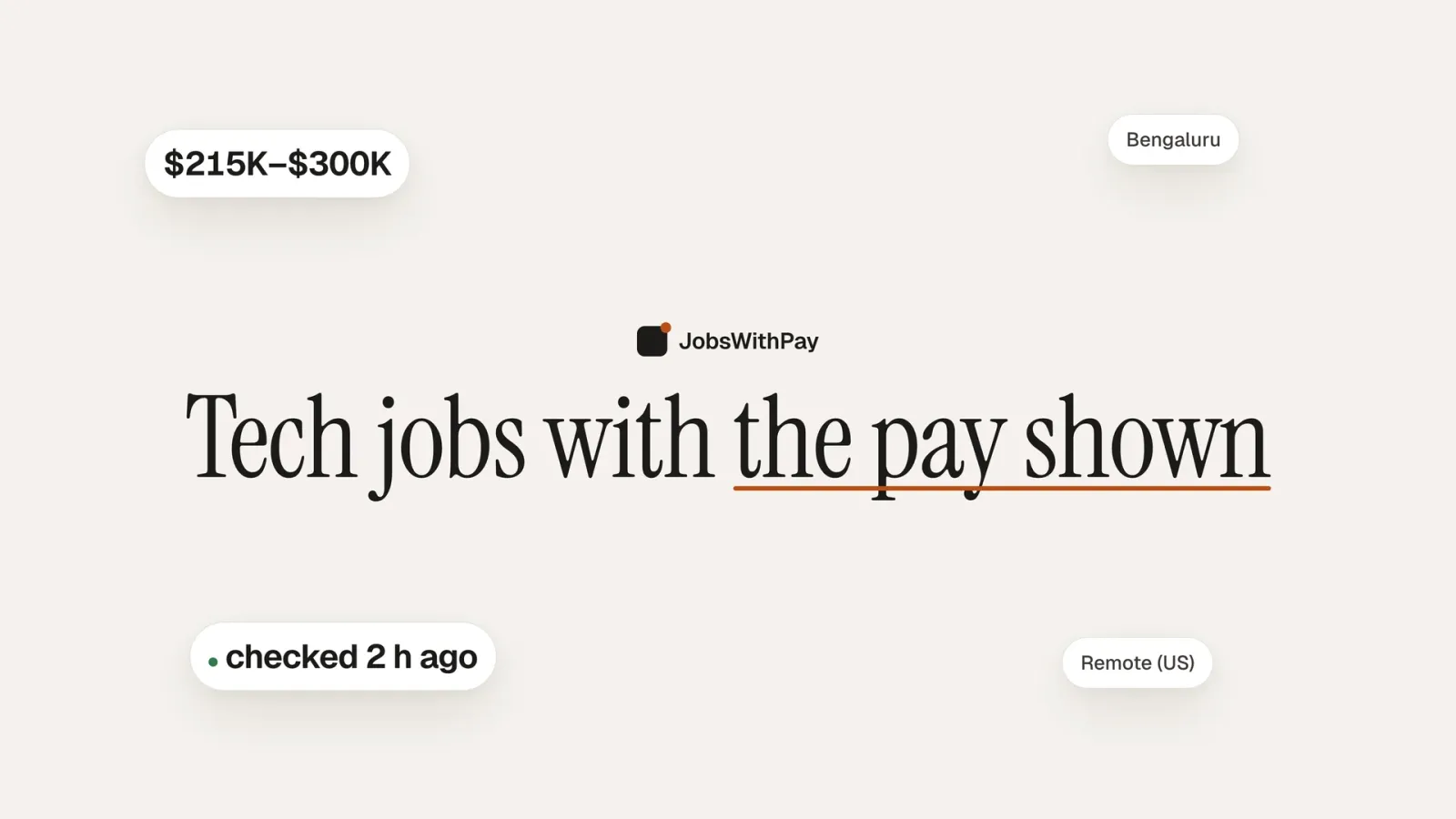
JobsWithPay is a tech job board that shows the posted pay on every listing, pulling 93,000+ roles straight from company career sites and rechecking them daily.
What is JobsWithPay?
JobsWithPay is a technology job board that surfaces the compensation attached to each opening instead of hiding it behind an application form. The project grew out of a familiar frustration: engineering candidates burn hours filtering listings that never mention salary, while mainstream boards dilute genuine company postings with staffing agency reposts, scraped duplicates and loosely tagged results that have little to do with the query. JobsWithPay takes the opposite approach by reading every role from the hiring company's own careers page, whether that page runs on Greenhouse, Ashby, Lever, Workday or a bespoke site built in house. At the time of writing the index holds 93,089 open technical roles drawn from 7,793 companies, and 47,723 of those listings state a pay range. The audience is deliberately narrow: software engineers, machine learning and AI researchers, data scientists, infrastructure and security specialists, product managers, designers, and students hunting internships or new graduate positions. Against LinkedIn and Indeed, the pitch is cleanliness and pay transparency rather than raw volume.
Key Features
Posted pay, extracted verbatim. Every listing that carries a published range displays it on the search card itself, so a candidate sees compensation before clicking. Figures run from roughly $130K to $250K on research and applied science roles up to $558K at the top of the market. When a company publishes no range, the card says so plainly rather than guessing.
AI-assisted natural language search. The home page input accepts a sentence such as a request for remote senior ML jobs that pay $200K or more, and an AI layer parses location, seniority, compensation floor and stack terms before returning matches. Filters for remote work, posted pay, entry level, AI and ML, and jobs posted today sit one click beneath the box.
A pay explorer with company benchmarking. A dedicated Pay section charts the highest posting employers by job type and region. Filters cover software, ML and AI, data science, product and design, paired with the Bay Area, New York or remote within the United States. The software chart in the Bay Area lists Netflix at a median posted base range of $388K to $558K across 23 jobs, Anthropic at $320K to $485K across 65, OpenAI at $266K to $445K across 121, and Thinking Machines Lab at $300K to $400K. A company needs at least five jobs with posted pay to qualify, and the chart excludes stock and bonus.
Daily re-checks with automatic removal. Roughly 93 percent of open roles carried a verification inside 24 hours, 86,575 of 93,089 listings. A posting missing from the company board at two consecutive checks disappears from the index, which reduces wasted applications to closed roles.
Portfolio pages that attach proof to skills. A resume becomes a public page where each skill is labelled Proven, Stated or No proof, backed by merged pull requests, published papers and citation counts, shipped releases or repositories. A recruiter can compare that page against a specific job description in a single click.
A published comparison against LinkedIn. The team ran the same 18 AI and ML searches on both platforms, where LinkedIn returned 2,952 results posted in the preceding seven days. On pay visibility LinkedIn showed 18.7 percent against 44.3 percent, while 26.7 percent of LinkedIn results were not AI or ML jobs at all, 3.3 percent came from staffing agencies or scraped sites, and 8.4 percent were duplicate copies of the same role.
How It Works
The onboarding path is short. A visitor lands on the home page, which leads with the total job count, the share of listings showing pay and a single large search field. From there the journey splits three ways.
The first route is plain browsing through the jobs directory, narrowed by workplace, pay visibility, seniority or recency. Each result card shows the job title, company, the date of the most recent verification and the posted range, and clicking through opens the employer's own application page rather than an interstitial form.
The second route is the AI search, where a natural language query replaces checkbox filtering. A visitor describes the role in plain words, the parser extracts intent, and the result set appears already tagged. That tagging step is what the site credits for its low rate of irrelevant matches.
The third route is the portfolio builder. A user signs in with an email address, imports a resume, and the system scans public work such as GitHub repositories, Hugging Face models and published papers to classify each claimed skill. Saved jobs, email alerts and the resulting portfolio page live behind that same lightweight login, with a dashboard acting as the home base.
The Pay Explorer in Detail
The pay charts deserve separate attention because they are the most distinctive asset on the site. Rather than reporting a single median, each bar spans the median low end to the median high end of the ranges a company posts across its open roles, which means the visual reflects how employers actually write salary bands. Selecting a different job type or region redraws the leaderboard instantly.
Two caveats matter. Only companies with five or more jobs carrying posted pay appear, so smaller startups with a handful of openings are invisible on the chart even when they pay well. And the numbers are base salary in US dollars, excluding equity, signing bonuses and annual refreshers, which understates total compensation at exactly the kind of companies that dominate the top of the list. The tool is therefore best read as a floor comparison rather than a total rewards benchmark. For deeper exploration there is a full pay explorer that lists every qualifying company.
Use Cases
A senior machine learning engineer setting a compensation floor. Someone with five years of experience who refuses to entertain roles below $200K can enter that constraint in natural language on day one and skip the dozens of inbound recruiter messages that never state a number. The pay column does the negotiating groundwork before a single call happens.
A new graduate needing visa sponsorship in New York. Using the filtered entry level and location views, a final year student can narrow to companies that publicly commit to sponsorship and see which of those publish pay, which is a strong proxy for structured, transparent hiring processes.
A data engineer in Bengaluru evaluating a stack move. Location pages for Indian metros such as Bengaluru, Hyderabad, Pune and Delhi NCR let a candidate compare employers hiring for Spark or streaming work, while the daily verification gives confidence that the role is still live.
A hiring manager or recruiter benchmarking a band. Compensation teams can open the pay explorer, filter to a job family and metro, and read competitor median ranges in seconds, which is faster than commissioning a survey for a quick sanity check.
Portfolio Pages and Skill Verification
The portfolio feature is the least conventional part of the product. It starts from a resume and ends with a public page where every listed skill carries an evidence label. In the site's own worked example, an inference engineer profile shows serving language models at low latency as Proven through 23 merged pull requests in vLLM and torchwave, CUDA work as Proven through nine merged pull requests, Rust as Proven through a personal inference server, team leadership as merely Stated, and Kubernetes as having no proof at all.
That three tier labelling is unusually honest for a job product, and it is the feature most likely to divide opinion. Engineers with substantial open source footprints will benefit immediately. Engineers whose best work sits behind corporate firewalls will find large parts of their profile marked as unproven, which could feel punitive rather than clarifying. A sample portfolio page demonstrates the format before committing.
Data Freshness and Coverage
The sourcing mix is published transparently. Greenhouse boards account for 36,187 open jobs, Ashby for 21,875, direct company careers sites for 10,685, Lever for 9,507, Workday for 6,146, a paid job data feed for 5,127, the Y Combinator board for 3,224, Hacker News hiring threads for 184 and Workable for 154. Most of those sources are re-read daily, though the paid feed refreshes weekly, which is a meaningful freshness gap for the roughly five thousand roles it supplies. A coverage page lists the employers currently tracked.
JobsWithPay vs LinkedIn
On volume, LinkedIn wins comfortably and there is no serious argument otherwise. On signal density, the comparison the team published is persuasive: fewer postings, no agency intermediaries, no duplicates, and pay disclosed on more than twice the share of listings. The trade off is reach. A candidate targeting an obscure startup that posts only on its own careers page and never appears in an aggregated feed may find nothing at all. The honest framing is that JobsWithPay functions as a high precision filter, not a replacement for broad reach.
Pricing & Value
Every feature is free while the product remains in beta, including the job search, the AI tooling, email alerts and portfolio pages. There are no published tiers, no trial clock and no card requirement, and account creation needs only an email address. Anonymous browsing of the job directory works without signing in, with the login gating saved jobs, alerts and portfolios.
The value calculation is favourable for candidates, since the alternative is unpaid research across dozens of careers pages. The obvious risk is that free beta pricing is a customer acquisition phase, and a paid tier for recruiters or for advanced portfolio analytics is the likely next step. Nothing on the site commits to permanent free access, so anyone building a workflow around the portfolio page should treat that as provisional.
Frequently Asked Questions
Is JobsWithPay free to use? Yes. All features, including AI search, job emails and portfolio pages, are free while the product is in beta, and browsing requires no account at all.
Where do the job listings come from? Listings are read from the hiring company's own job board or careers site, including Greenhouse, Ashby, Lever, Workday and Workable, plus the Y Combinator board and Hacker News hiring threads. Staffing agencies and sites that copy jobs are excluded.
How accurate is the posted pay? The figure is exactly the range the company published, neither adjusted nor estimated. Charts use yearly base pay in US dollars, so equity and bonuses are not included.
Does it cover jobs outside the United States? Yes, though the pay benchmarking charts focus on the Bay Area, New York and US remote roles. Location pages exist for India including Bengaluru, Hyderabad, Delhi NCR, Pune and Mumbai.
How quickly are closed jobs removed? Boards are re-read daily, and a role absent at two consecutive checks is dropped. About 93 percent of open listings had been verified within the previous 24 hours.
Final Verdict
JobsWithPay is one of the sharper responses to the pay transparency era, and it earns its place for two reasons: first party sourcing that removes agency noise, and a pay explorer that turns public salary bands into a usable comparison tool. The portfolio concept is genuinely novel, and the published LinkedIn comparison is the kind of evidence most job boards never bother to produce.
The limitations are just as clear. Coverage is a fraction of what major boards offer, the pay charts exclude the equity that dominates senior compensation, and the verification scoring could disadvantage engineers whose work is proprietary. Free beta pricing also carries an obvious expiry risk.
For software, ML, data and infrastructure candidates who already know their target band and want to spend time only on live, first party roles, it is a strong addition to the search routine. Recruiters and compensation analysts will find the benchmark charts useful as a quick reference. Anyone needing maximum volume or heavy non technical coverage should still keep a mainstream board open in a second tab.
Pros & Cons
Pros
- Pay ranges are displayed directly on search result cards for the 47,723 listings that publish them, letting candidates filter by compensation before applying.
- Every listing is read from the hiring company's own job board rather than an aggregator, which eliminates staffing agency reposts and duplicate entries.
- The pay explorer benchmarks median posted base ranges by job type and metro, including a Bay Area software chart led by Netflix at $388K to $558K.
- Daily re-verification covers about 93 percent of open roles within 24 hours, and postings missing at two consecutive checks are removed automatically.
- Portfolio pages label each skill as Proven, Stated or No proof using public work such as merged pull requests, papers and releases, giving recruiters verifiable evidence.
Cons
- Overall volume is far smaller than mainstream boards, so niche employers that never appear in aggregated feeds may be absent entirely.
- Pay charts show base salary only and omit equity and bonuses, understating total compensation at exactly the large tech firms that top the rankings.
- Free access is explicitly a beta phase with no published pricing or long term commitment, leaving future costs for portfolios and alerts uncertain.