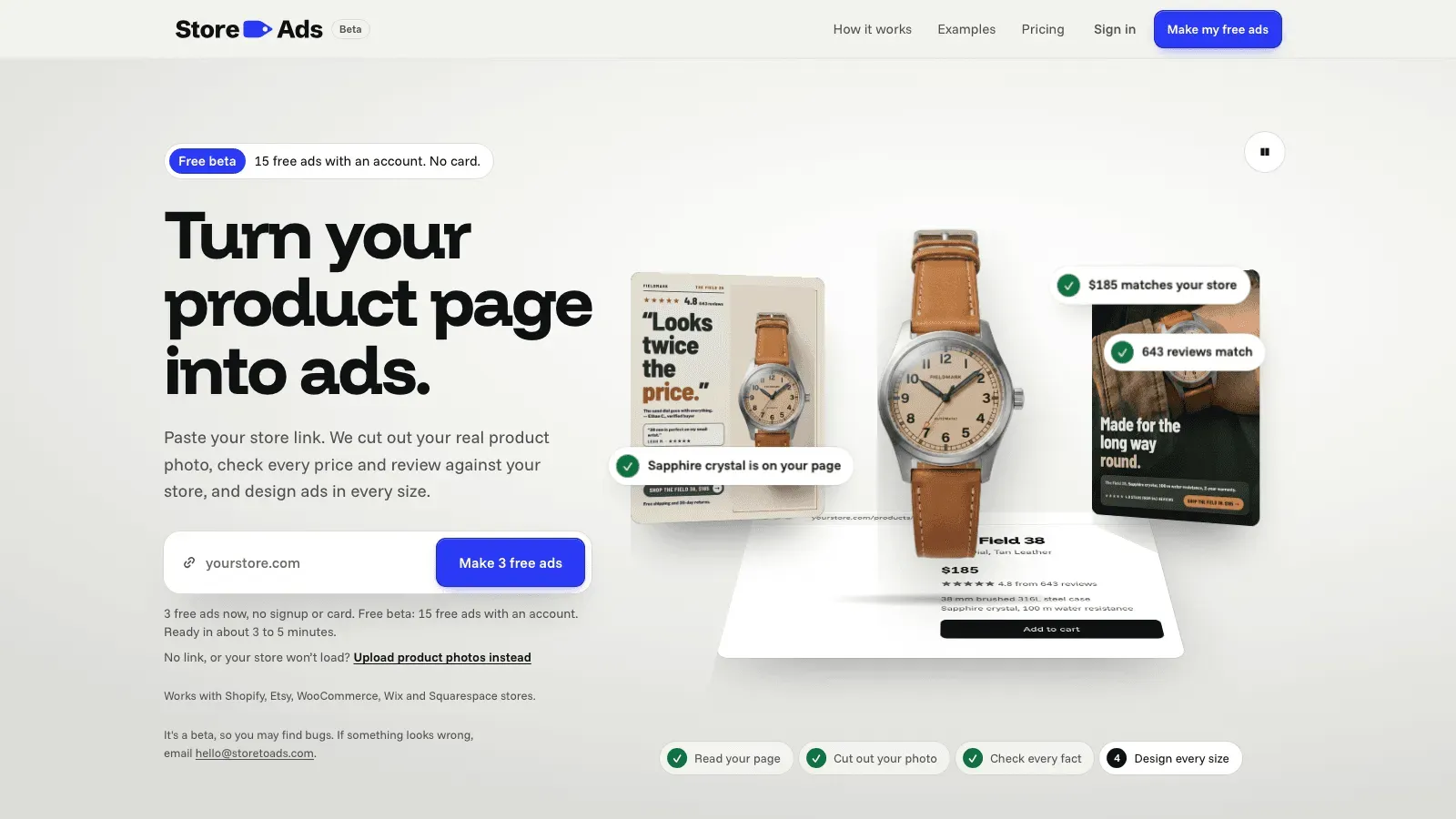
StoreToAds turns a live product page into source-checked ad creatives in five sizes, without ever redrawing the original product photo.
What is StoreToAds?
StoreToAds is an AI ad generator built specifically for online store operators, and its defining premise is restraint. Instead of generating new product imagery, the platform reads a live product page, lifts the merchant's own product photograph, verifies every price and review count against that source, and then composes that untouched image inside advertising layouts sized for feeds, stories, Pinterest, and Google. The problem it targets is the operational bottleneck of paid social: a store may own one good product shot but needs dozens of creative variations each month to keep campaigns fresh. StoreToAds automates the manufacturing step without touching the product itself.
The audience is clearly the small to mid-sized commerce operator on Shopify, Etsy, WooCommerce, Wix, Squarespace, or PrestaShop, someone who can write product copy but cannot justify a design retainer. Its positioning is deliberately adjacent rather than competitive. The company frames the tool as a creative supply layer that feeds Meta Advantage+ and Shopify Campaign Autopilot, not a replacement for campaign management. That distinction matters, because it sets expectations correctly: StoreToAds produces assets and hands them off, and it does not pretend to optimize bidding or audience targeting. The service currently carries a Beta label, and the site is candid that bugs may surface.
Key Features
Source-verified fact checking. Every number that appears in a finished ad, from the price to the review count to a materials claim, is matched against the merchant's own product page before the file is delivered. Anything that cannot be confirmed is removed rather than softened. The site demonstrates this with a visible example where a "Best seller" badge is struck out because the claim does not exist on the store. For merchants who worry about accidentally shipping an outdated discount into a live campaign, this is the most consequential feature in the product.
Non-generative photo cutout. StoreToAds does not redraw product pixels. The workflow isolates the real photograph from the page, refines the silhouette, and designs the ad around that asset. The practical consequence is that a watch dial, a skincare label, or a coffee bag's origin text stays legible and factually correct at export. Most competing AI ad tools synthesize a plausible-looking product, which is unusable for commerce because the buyer receives something that does not match the parcel.
Five standard ad sizes on every paid design. Each paid creative ships in feed, square, story, Pinterest, and Google dimensions. The free preview tier is narrower, offering only the 4:5 feed format for the three no-signup ads. Merchants testing the product should expect to see the full multi-size output only after upgrading.
Conversational copy editing. Headlines, prices, badges, and button labels are editable directly in the browser, and changes apply instantly at no additional cost. There is also a request-based path where a merchant describes the change in natural language rather than hunting for the text field. This is a meaningful detail, since the most common failure mode in template-driven ad tools is being trapped inside a layout that cannot accommodate a revised hook.
Paused Facebook and Instagram handoff. Ads can be pushed into a Meta ad account in a paused state, which means creative arrives in the platform without triggering spend. The merchant still presses go. The site is explicit that sending ads is included on higher tiers and that the media budget itself is paid to Facebook separately, at whatever level the advertiser chooses.
Scheduled and chat-native creation. Merchants can generate ads on demand or opt into scheduled delivery, with weekly batching available on upper plans. The product also exposes a chat interface so ads can be produced from inside Claude and ChatGPT, which suits operators who already run their marketing thinking inside a conversational assistant. A free ad grader and a product ad readiness checker sit alongside the generator as lightweight diagnostic tools.
How It Works
The entry point is a single text field. A merchant pastes a store URL or an individual product listing and submits it. For Etsy and Amazon sellers, where a store-level crawl is not available, the individual listing link is the correct input. The system then parses products, prices, reviews, and photography from that page. In the free path this takes roughly three to five minutes and returns three feed-sized previews without requiring an account or a payment card.
Once a store is registered, the second step is selection. The interface presents the detected catalog as a checklist where each ticked item becomes one ad. An optional style direction can be attached at this stage, and merchants who have no usable store link, or whose store blocks automated reading, can upload product photos or type details manually instead.
The third step is review. Generated designs arrive in a grid with keep, discard, and regenerate controls attached to each. Keeping a paid design unlocks all five sizes for that creative. Copy is then editable in place, or through a natural language request. From there the merchant either downloads the files, schedules future batches, or dispatches the set to a connected Facebook account where the ads sit paused until manually activated.
Use Cases
A single-product Shopify store scaling paid social. An operator selling one hero item, say a field watch or a serum, needs fresh creative weekly to avoid audience fatigue but cannot produce it. StoreToAds converts the existing product page into a rotating supply of feed and story assets with verified pricing, letting the operator feed Meta Advantage+ campaigns without a designer on retainer. The value here is cadence, not novelty.
A multi-SKU catalog marketer running seasonal pushes. A candle or coffee brand with thirty products selects a subset for a seasonal promotion and receives a coherent set of square and Pinterest creatives in one pass, each carrying correct variant pricing. The uniformity across SKUs is the point, since hand-building thirty layouts is where consistency usually collapses.
An agency producing client-ready drafts. Smaller agencies can use the tool to generate first-round concepts for retail clients in minutes, then refine copy in the browser. The fact-checking layer reduces the review burden, because account managers are not manually re-verifying every price quoted in a mockup before a client sees it.
A founder without a store at all. A merchant preparing a launch, or selling through an unstructured channel, can upload a handful of product photos and type the details manually, then export story and Google-sized assets. This covers pre-launch scenarios where a product page does not yet exist.
Positioning Against Alternatives
The clearest strategic choice StoreToAds makes is refusing to compete with ad automation suites. Meta Advantage+ and Shopify Campaign Autopilot both run and tune campaigns, and both depend on whatever creative the advertiser supplies. StoreToAds occupies the slot upstream of them. The company also publishes direct comparisons against AdCreative.ai, Canva, Pippit, and the two platform-native tools, which is a useful transparency signal for buyers who are already mid-evaluation.
The differentiation argument rests on two pillars: photographic fidelity and factual verification. A general design tool will let a merchant assemble an ad, but it will not tell the merchant that the review count in the mockup does not exist on the store. A generative tool will produce a striking image, but it will produce the wrong product. StoreToAds is narrower than either category, and the narrowness is the product.
Pricing & Value
The free tier is unusually generous. Three feed-size previews require no signup and no card, and a registered account during the beta period receives fifteen free ads. That is enough to judge output quality on real catalog data before committing.
Paid plans begin at Lite for $29 per month, which yields nine new ads monthly with all five sizes and a choice between on-demand creation and a twice-weekly drip. Starter at $49 doubles output to twenty ads and adds brand logo and color application across every creative. Growth at $99, Pro at $149, and Scale at $199 unlock Facebook dispatch in paused mode, larger weekly batches, and a seven-day trial that does not charge at activation. Every plan carries a thirty-day money-back guarantee, with one trial and one refund permitted per store.
Value assessment depends entirely on volume. For a store that would otherwise pay a designer per creative, $29 for nine multi-format ads is straightforward arithmetic. For a high-velocity testing operation that wants fifty variations a week, the monthly caps will bind quickly. The honest read is that the pricing suits steady-state commerce marketing rather than aggressive paid acquisition. Full tier detail is available on the StoreToAds pricing page.
Frequently Asked Questions
Does StoreToAds redraw the product with AI? No. The platform reuses the original product photograph and composes the ad around it, which preserves labels, materials, and proportions. Merchants should still review crop and scale in each exported size to confirm the product reads clearly.
Where do the prices and reviews in the ads come from? They come from the merchant's own store. The system reads product pages, current and sale pricing, and review counts, then validates every figure and quote before delivery. Claims that cannot be matched to the source are stripped out.
Which platforms are supported? Shopify, WooCommerce, Wix, Squarespace, and PrestaShop work from a store link. Etsy and Amazon sellers paste a single listing URL. Stores that block automated reading can supply screenshots or type details manually.
Is there a free plan or trial? Yes. Three free feed-size previews require no account. During the beta, registered accounts receive fifteen free ads. Growth, Pro, and Scale include a seven-day trial with no charge at start, and all plans carry a thirty-day money-back guarantee.
Does StoreToAds replace Meta Advantage+ or Shopify Autopilot? No. Those tools run and optimize campaigns using supplied creative. StoreToAds manufactures the creative and hands it over, optionally as paused ads in a Meta account. Advertisers still pay Facebook separately for media. Comparative notes live on the alternatives hub.
Can the ad copy be changed after generation? Every headline, price, badge, and button is editable in the browser with instant free updates, and changes can also be requested conversationally. Creative direction by retail vertical is catalogued in the ad ideas library.
Final Verdict
StoreToAds solves a narrow but real problem with unusual discipline. The refusal to regenerate product pixels is the correct engineering decision for commerce, and the verification layer is the kind of feature that prevents expensive embarrassment rather than generating excitement. The multi-size export, browser-level editing, and paused Meta handoff together form a coherent production pipeline that a small team can actually operate. The free tier is genuinely useful, and the per-plan pricing undercuts a freelance design relationship at low volume.
The limitations are equally clear. Monthly ad caps throttle high-frequency testing, and stores with restrictive crawling settings lose the automation advantage entirely. The Beta label is honest but signals that edge cases in catalog parsing may still appear, and the product deliberately stops short of campaign optimization, so it is one component rather than a complete advertising solution.
The recommendation is targeted. Solo founders and small commerce teams that already have decent product photography but no design capacity should treat this as a production tool worth testing immediately. Agencies producing first-round concepts will find the verification layer a time saver. Merchants seeking a full campaign management platform, or those running dozens of creative tests weekly, should look elsewhere or negotiate volume above the Scale tier.
Pros & Cons
Pros
- Product photography is composited rather than regenerated, so labels, materials, and product accuracy survive into the final ad.
- Every price, review count, and product claim is validated against the merchant's live store page before a creative is delivered.
- A single paid design exports in all five formats, covering feed, square, story, Pinterest, and Google placements from one generation.
- Ads dispatched to Facebook and Instagram arrive paused, so no budget is spent without an explicit manual action.
- The free tier is frictionless, offering three previews with no signup and fifteen account-based ads with no card during beta.
Cons
- Monthly plans cap the number of new ads, which limits stores that want to test dozens of creative variations per week.
- Stores that block automated crawling fall back to manual photo uploads or hand-typed details, removing most of the automation benefit.
- The product carries a Beta label and focuses only on creative production, leaving campaign optimization and budgeting to separate tools.