SysRound pairs 8,847 reported interview questions from 489 companies with an AI voice interviewer that runs spoken system design mock rounds and scores them.
What is SysRound?
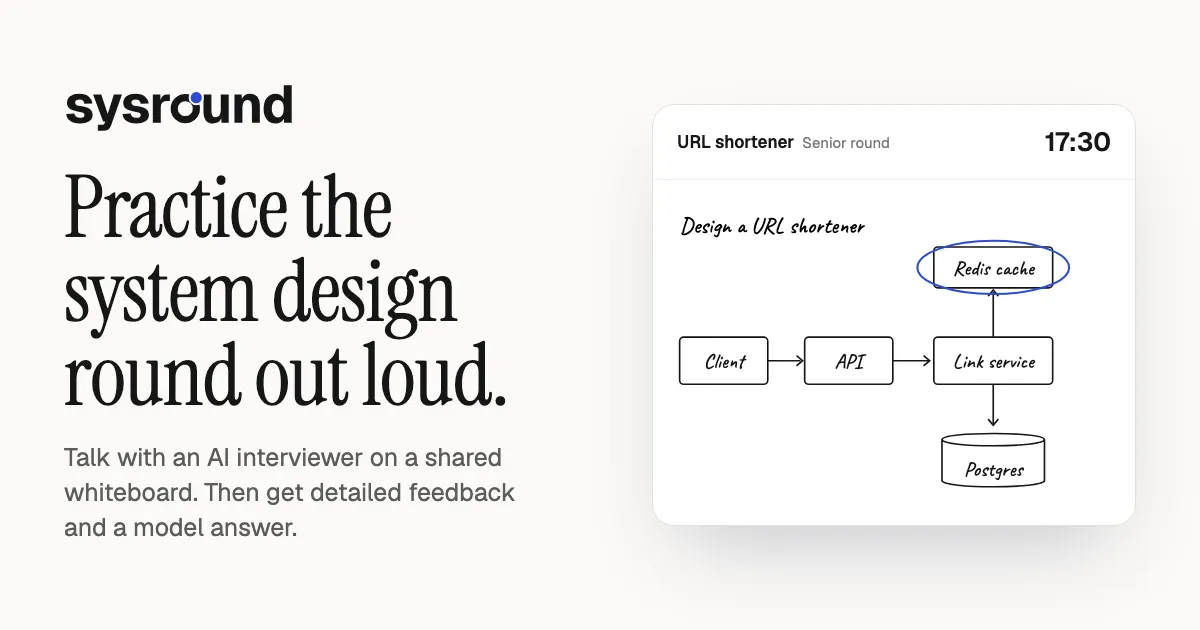
SysRound is a tech interview preparation platform that pairs a library of 8,847 reported questions gathered from 489 companies with an AI voice interviewer named Alex that conducts full system design mock rounds on a shared whiteboard. The product addresses a specific gap in interview preparation: coding drills are abundant, but system design rounds are conversational and diagram driven, and very few tools let an engineer rehearse speaking a design out loud under a ticking clock. SysRound bundles the whole loop into one workspace, covering coding, system design, machine learning and behavioral rounds rather than treating design as an afterthought to a coding judge.
Its audience is mid level, senior and staff software engineers aiming at employers such as Meta, Amazon, Google, OpenAI, Microsoft and Anthropic. Where competing products sell human mock interviews or static question lists, SysRound positions itself around an always available interviewer, a fixed round agenda that mirrors an onsite, and a scorecard that quotes the candidate's own words and drawings back at them. The commercial model is deliberately narrow: the study material is free and the paid inventory is mock interview credit, sold in packs without a subscription.
Key Features
A reported question library spanning 489 companies. The catalog holds 8,847 interview questions, split into 4,878 coding questions, 1,593 system design questions, 965 machine learning questions and 594 behavioral questions, with additional collections for object oriented design, practical engineering and product rounds. The SysRound company directory lists question volume by employer, led by Meta at 834, Amazon at 738 and Google at 671, and each individual question carries its sources alongside the dates on which those reports surfaced. The platform is careful to state that a company tag is a signal rather than a guarantee.
Alex, a voice first AI interviewer. Alex listens, interrupts, challenges a design and draws alongside the candidate on a shared whiteboard. The interviewer deliberately withholds answers, applies pressure with questions such as what happens to a single hot Redis key at a million clicks an hour, and writes the figures agreed during estimation into the candidate's notes automatically. Conversation is genuinely bidirectional, so a candidate can cut in, think out loud and steer the discussion the way an onsite allows.
A practice workspace for every question. Each question opens with a code editor for Python, JavaScript and TypeScript, a notes pane that supports headings, lists and checklists, a box and arrow whiteboard, and AI hints that return either a nudge, a review or an explanation instead of the finished solution. The Two Sum example on the home page shows the layout: statement and worked example on one side, editor and hint on the other.
Structured coding study plans. Two ordered plans organize problems into pattern groups. Coding Patterns 150 spans 18 groups and is pitched at candidates with six weeks or more, while Coding Core 75 spans 22 groups for a two to four week sprint. Progress is tracked per group, and 205 of the coding problems ship with full statements plus examples verified against a reference solution.
Interviewer briefs behind every design question. The 267 system design questions each carry a private brief covering scope, expected numbers, deep dive territory and the hiring bar for the selected level. That brief is what allows a single question to be pitched differently for L4, L5 and L6 candidates, changing both the follow ups and how much the interviewer leads.
Scorecards with seven skill ratings. Feedback grades problem framing and requirements, navigation and ownership, high level architecture, technical depth, trade offs and judgment, scale and operational reliability, and communication and collaboration. Each score quotes the specific sentence or diagram that produced it, and the grader runs three passes and keeps the median result to reduce noise.
Inside the Question Library
The library is organized less like a challenge archive and more like a research dossier. Company pages aggregate reported questions per employer, and the landing page surfaces twelve of the most requested names from Meta and Amazon through Oracle and Airbnb. A search field at the top of the page accepts a company name and routes directly to the matching employer page, and a short list of popular companies sits underneath for candidates who are still shortlisting.
The design question set is curated rather than scraped. Listed titles include URL shortener, distributed rate limiter, notification system, news feed, chat and messaging, and ticket booking, each tagged with the levels it suits and a difficulty rating. The accompanying summaries read as engineering outlines, mentioning at least once delivery with idempotency, outbox patterns, fan out on write versus read and seat holds with TTL, which suggests the underlying briefs are substantive rather than placeholder text.
Coding content is split between browse and drill. All 4,878 coding questions are browsable, but the study plans impose order, and the platform explicitly advises against jumping between groups because later patterns reuse earlier ones. Behavioral coverage is thinner at 594 questions but framed around the stories candidates actually get asked for: conflict, failure, leadership and project narratives.
How It Works
A candidate begins on the landing page with a company search field, types an employer name such as Google, and lands on a company page listing reported questions for that organization. From there a question opens inside the practice workspace, where statement, examples, editor and whiteboard sit side by side on one screen. Free accounts sign in with an email code and no password, keeping the onboarding step to a few seconds.
For coding preparation the path is plan driven. A candidate opens a study plan, works through problems in the order the pattern groups dictate, marks each problem complete and watches group level progress accumulate. The plans are opinionated about cadence, recommending two or three problems a day for the shorter Core 75 sequence and treating the longer Patterns 150 list as the default for anyone with a comfortable runway.
For system design the path is a scheduled mock round. A candidate picks a question, chooses a level from mid level through staff, selects 45 or 60 minutes, and enters an interview room containing notes on one side, a whiteboard in the middle and the interviewer on the other. The round follows a fixed agenda: requirements from minutes zero to eight, back of the envelope estimation from eight to twelve, API and data model from twelve to eighteen, high level design from eighteen to twenty eight, deep dives from twenty eight to forty, and wrap up with scorecard from forty to forty five. Alex keeps the clock and prompts movement between phases.
After the round the candidate receives a scorecard, a model answer constructed from their own notes, a minute by minute whiteboard replay and a practice plan aimed at the weakest skills. Rounds are deducted only when they actually start, so an abandoned session does not consume credit. The whole loop, from search to scorecard, stays inside a single browser tab.
Use Cases
A senior engineer with a Meta onsite three weeks out. The candidate works the Coding Core 75 plan at two or three problems a day, then books three mock rounds on feed and fan out design, the pattern Meta favors. The scorecard's scale and reliability line flags weak hot key handling, and the practice plan routes back to caching questions.
A staff candidate interviewing at an AI lab. Machine learning and ML system design question sets cover models, data, metrics and ML systems, and the staff tier unlocks harder deep dives. Because the interviewer brief changes the bar by level, the same notification system question produces staff level follow ups on idempotency and outbox patterns instead of mid level basics.
A bootcamp graduate preparing for a first loop. The free tier carries the entire question library, company pages, study plans and workspace, so a candidate with no budget can drill all 205 verified coding problems and rehearse behavioral stories without paying anything. The AI rounds become an optional upgrade once a first onsite appears.
An engineer who freezes when speaking. Plenty of candidates can design on paper but stumble when asked to narrate a decision. Working through 45 minute rounds with an interviewer that interrupts and challenges builds the verbal stamina that a written course cannot supply.
Pricing & Value
The split is unusually clean. Questions, company pages, study plans and the practice workspace are free permanently, and during the beta every account receives two free 45 minute rounds. Paid inventory is mock interview credit rather than a subscription: one round for $29, five rounds for $99 at $19.80 each, or twelve rounds for $199 at $16.58 each. Credits do not expire and a round is deducted only when it begins. Compared with human mock interview marketplaces that commonly charge $100 to $250 per session, the twelve round pack undercuts them by roughly an order of magnitude, though an AI interviewer cannot fully replicate the judgment of an engineer who has sat on a hiring committee. Full tier details live on the SysRound pricing page.
Value hinges on volume. A candidate who books a single round gets a reasonable diagnostic, but the discount curve rewards the twelve pack, and the absence of a subscription means no recurring charge for material that is already free elsewhere on the site.
Frequently Asked Questions
Is SysRound free to use? The question library, company pages, coding study plans and practice workspace cost nothing. Paid credits apply only to AI mock interviews, and beta accounts receive two free 45 minute rounds.
How much does a mock interview cost? Twenty nine dollars for a single round, or $99 for five and $199 for twelve, which works out to $19.80 and $16.58 per round respectively. There is no subscription and credits never expire.
Which interview rounds does SysRound cover? Coding, system design, machine learning, ML system design and behavioral rounds, plus smaller sets for object oriented design, practical engineering and product questions. The AI interviewer currently runs system design rounds only.
Does the AI interviewer give away the answer? No. Alex asks one question at a time, pushes back on weak reasoning and refuses to supply the solution, mirroring how a real interviewer behaves. Model answers appear only in the post round scorecard.
How does it compare with human mock interview services? SysRound is far cheaper and available on demand at any hour, but it lacks the hiring committee context a senior engineer brings. The sensible pattern is heavy AI volume for reps with one or two human sessions for final calibration. The order of study sequences is catalogued on the SysRound coding study plans page.
Final Verdict
SysRound's strongest asset is scope coherence: one workspace, one question library and one feedback format across the entire loop, rather than four disconnected tools stitched together. The AI interviewer is genuinely conversational, the scorecard quoting a candidate's own words is a meaningful step beyond generic rubric output, and free access to the full question bank makes the value proposition easy to test before spending anything. Honest limitations exist. Mock interviews are confined to system design, so coding rounds get questions and a workspace but no spoken rehearsal, the AI grader can still be wrong, and voice plus whiteboard work is awkward on a phone even though a typed round works fine.
Engineers facing a design heavy onsite in the next month will find the twelve round pack the most efficient spend in this category, while candidates who only need coding reps can stay on the free tier indefinitely and lose very little. It is a focused tool rather than a complete career platform, and it is honest about that boundary in its own copy.
Pros & Cons
Pros
- Free permanent access to the full library of 8,847 questions from 489 companies, including coding study plans and the multi-pane practice workspace.
- Alex, the AI interviewer, holds a real spoken conversation, interrupts with pointed follow ups and annotates the shared whiteboard instead of delivering a scripted quiz.
- Scorecards grade seven distinct skills with quotes pulled directly from the candidate's own speech and diagrams, and the grader keeps the median of three passes.
- Round credits never expire and are deducted only when a session starts, with a twelve round pack driving the per-session price down to $16.58.
- The round follows a timed agenda from requirements through deep dives to wrap up, matching the pacing of an actual 45 minute onsite.
Cons
- AI mock interviews are limited to system design rounds, so coding, machine learning and behavioral practice remain static question drilling.
- Voice and whiteboard sessions are poorly suited to phones, which restricts serious practice to a laptop or tablet.
- The AI grader and interviewer can be wrong, a caveat the site itself acknowledges, so feedback should not be treated as a hiring signal.