Papaya Chat is an upcoming AI companion platform where users chat with eight fruit-inspired characters, join group chats, and secure early access.
Papaya Chat enters a crowded AI chat market with an unusually specific proposition: conversation should feel like meeting a character, not querying a tool. The platform is still in waitlist mode, but its public site already outlines a cast of eight fruit personalities, a character selection mechanic, and a group chat concept called the fruit bowl. This review examines the product as described on its landing page, focusing on positioning, user experience, feature clarity, pricing transparency, and the questions prospects should ask before joining early access.
What is Papaya Chat?
Papaya Chat is an upcoming AI companion chat platform that assigns distinct personalities to eight fruit-themed characters, then lets users choose one character or gather several into a shared conversation. The product addresses a familiar weakness in mainstream AI chat: most assistants are built for utility, speed, and neutral tone, which can make repeated conversations feel interchangeable. Papaya Chat instead leans on character design, humor, and point of view. The cast includes Pip the Papaya as a sunny host, Lola Lemon as an honest critic, Bash the Banana as comic relief, Duke Durian as a theatrical poet, Mango Mae as a laid-back philosopher, Kiki Kiwi as a tiny scientist, Cher and Ry as a twin hype squad, and Coco Coconut as a calm listener. The service is aimed at consumers who want casual companionship, encouragement, creative banter, or a low-pressure space to think out loud. It also positions itself against generic AI chatbots by treating conversation as a social experience rather than a single assistant session. The fruit bowl concept is the clearest example: multiple characters can respond in one thread, creating the possibility of debate, running jokes, and group morale. Papaya Chat is not yet generally available. The site presents a waitlist, an early access promise, and a playful explanation of how the product should work. Prospects can inspect the Papaya Chat homepage to see the current character lineup and the early access message.
Key Features
Eight distinct fruit characters with authored personalities. The roster is the core of the product. Each character has a name, a short descriptor, a set of tags, and a sample line that establishes voice. Pip is sunny, curious, and kind. Lola is honest, sharp, and zesty. Bash is goofy, upbeat, and slippery in the pun sense. Duke is theatrical, deep, and bold. Mae is chill, wise, and mellow. Kiki is nerdy, precise, and fuzzy. Cher and Ry are loud, loyal, and pumped. Coco is calm, patient, and warm. This is more than cosmetic branding. The site presents personality as the main reason to choose one character over another, and the tags give users a quick way to match mood to companion.
Meet first selection workflow. Each character card includes a button that lets a visitor mark one fruit as the preferred first contact. The button text changes from an invitation such as Meet Pip first to a confirmation such as Pip's up first, and the card receives a selected state. The interface uses an aria-pressed attribute, which suggests attention to accessible state changes. For a pre launch product, this is a smart low-friction personalization step. It gives the team a signal about demand for each character before the full product opens.
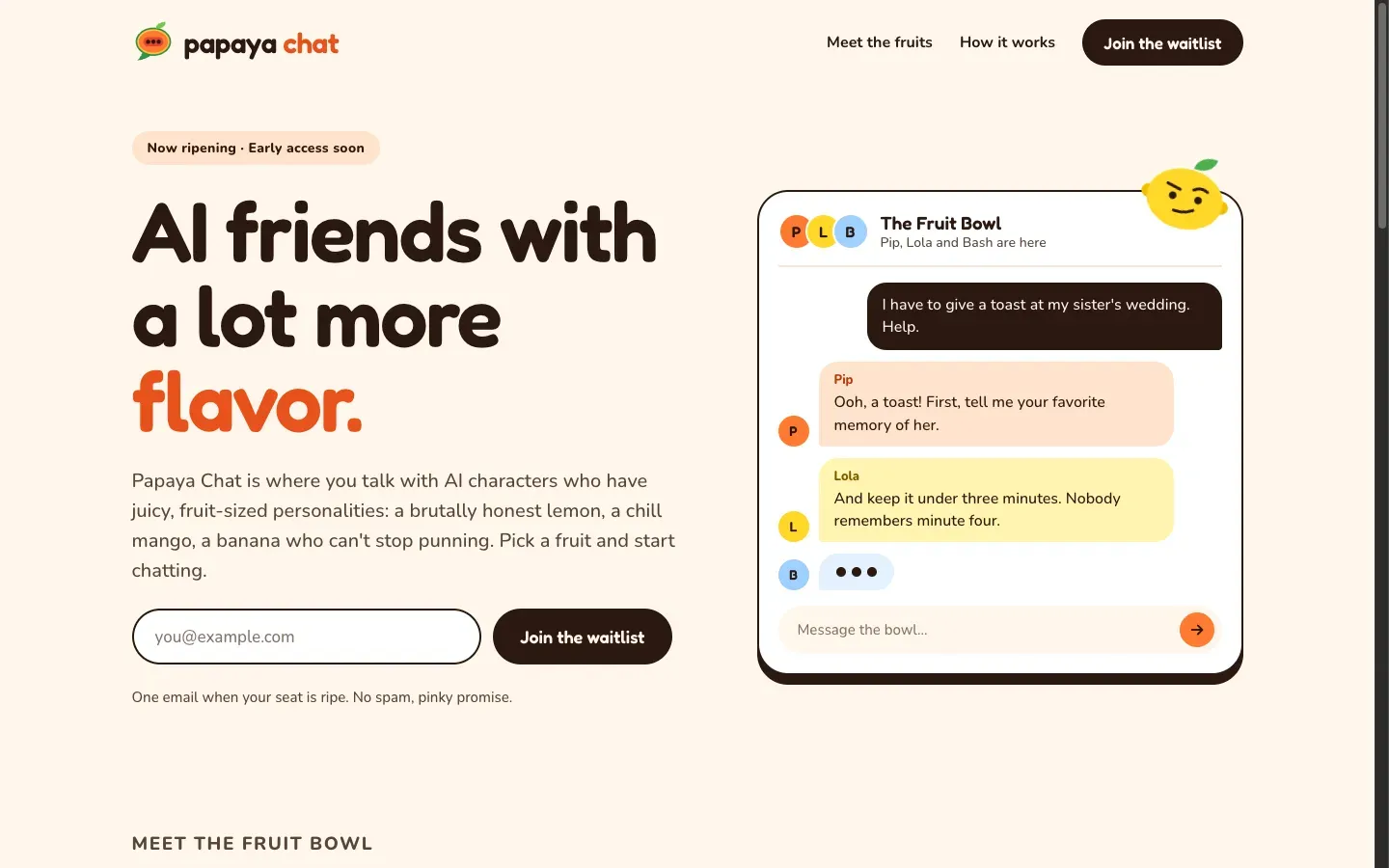
Fruit Bowl group chat. Papaya Chat does not stop at one-to-one character chat. The site describes a fruit bowl where several fruits can be dropped into one group chat so they can riff, debate, and hype the user up together. The hero mockup shows Pip, Lola, and Bash responding to the same prompt in sequence, with a third character showing a typing indicator. This group dynamic is the most distinctive feature in the concept. It turns the assistant from a single voice into a small cast with competing perspectives, which could be useful for brainstorming, morale, or entertainment.
Personality-led conversation design. The characters are not presented as neutral helpers. They have opinions, quirks, and running jokes. Lola is positioned as someone who will challenge a weak introduction. Mae offers calm perspective about deadlines. Coco promises patience. Kiki explains large ideas with playful analogies. This design choice gives Papaya Chat a clearer emotional texture than a general-purpose chatbot. It also raises expectations: users will notice quickly if the live conversations fail to match the sample lines and tag descriptions.
Waitlist and early access flow. The site uses email capture forms in the hero and in a closing join section. Both forms include a hidden honeypot field, a visible error area, and a success panel. The copy promises one email when a seat is ripe and states that there will be no spam. The join section also reminds visitors that tapping Meet first on any fruit can influence who greets them. This is a coherent pre launch funnel: build interest, collect a preference signal, and promise a controlled rollout.
Playful and accessible interface. The visual system uses warm cream, orange, and fruit colors, rounded cards, oversized headings, and chat bubbles. The layout is responsive, with flexible grids and wrapping navigation. Accessibility details include focus-visible outlines, screen-reader labels, reduced-motion handling for typing indicators, and semantic article elements for character cards. These are small signals, but they matter for a consumer chat product that aims to feel friendly rather than technical.
How It Works
The current journey starts on the landing page, where a visitor sees the central promise, a chat mockup, and an email form. The mockup is not a live demo. It is a staged conversation that shows how multiple fruit characters might respond inside one thread. From there, the visitor scrolls to the character section and reviews eight cards. Each card includes a name, a subtitle, tags, a sample line, and a Meet first button. Selecting a fruit marks that character as the preferred first contact and changes the button label to confirm the choice. This step does not create an account. It is a lightweight preference signal.
Next, the visitor joins the waitlist by entering an email address. The form includes basic validation and a hidden field intended to catch automated submissions. On success, the page shows a confirmation panel. The site states that one email will arrive when a seat is available. Because the product is not live, there is no visible onboarding dashboard, character management screen, or conversation history in the public materials. The next stage is therefore promised rather than demonstrated: the user receives an invite, enters the chat environment, and begins a conversation with the chosen fruit. According to the how it works section, daily use should involve picking a fruit based on mood, chatting about anything from homework to holiday plans, and optionally mixing several fruits into one group chat. Users who want a specific character to greet them can use the Papaya Chat early access waitlist and select a favorite before submitting an email.
Use Cases
A maid of honor preparing a wedding toast could use Pip for warm memory prompts and Lola for structural criticism. The site mockup uses exactly this scenario: one character asks for a favorite memory, while another warns that a speech should stay under three minutes. The outcome is a faster first draft and a more honest edit, with the playful format lowering the stress of public speaking.
A student tackling a complex science topic could turn to Kiki Kiwi for precise explanations and playful analogies. The sample line about explaining black holes with a smoothie suggests a teaching style that favors vivid comparison over jargon. The same student might switch to Mae for calm perspective when a deadline feels overwhelming. The value here is not a replacement for a tutor. It is a low-pressure way to rehearse questions and reduce anxiety before seeking authoritative help.
A small friend group or remote team could use the fruit bowl for morale and brainstorming. Cher and Ry are positioned as a hype squad, while Duke Durian offers dramatic commentary and Coco Coconut provides a patient ear. A group could drop several fruits into one chat to generate debate, inside jokes, or encouragement after a shared milestone. The Papaya Chat fruit bowl preview shows how a multi-character thread could feel more like a room than a single assistant.
A late-night user who wants to decompress could choose Coco Coconut for a calm, patient presence. The character promise is simple: take your time, there is no rush. That use case matters because many AI chat products optimize for fast answers, while some users need a slower, warmer tone. Papaya Chat positions that kind of listening as a legitimate reason to open the app, not a productivity failure.
Market Context and Competitive Position
Papaya Chat sits at the intersection of consumer AI chat, character-driven entertainment, and light companionship. The market already includes general assistants, role-play chatbots, journaling tools, and wellness apps. Papaya Chat does not compete on model benchmarks, enterprise integrations, or workflow automation. Its bet is that character design and group chemistry can create a more memorable experience than another neutral assistant. The fruit theme gives the brand a clear visual language and a built-in cast structure. It also limits the addressable audience. Users who want serious professional advice or deep technical work may find the playful framing distracting. Users who want emotional companionship may appreciate the warmth, but they may also demand stronger safety, memory, and moderation features than a landing page can demonstrate. The waitlist strategy is sensible for a pre launch consumer product. It creates scarcity, collects demand signals, and allows the team to tune each character before a wider release. The risk is that the gap between a charming landing page and a reliable chat product is large. Character consistency, memory, moderation, and group chat orchestration are difficult engineering and editorial problems. Papaya Chat will need to prove that the eight personalities remain distinct over many sessions, not just in sample lines.
Pricing & Value
Papaya Chat does not publish pricing tiers, subscription details, or a free plan description on the reviewed page. The only current action is joining the waitlist, which appears to be free. There is no evidence of paid plans, credits, usage limits, or premium characters. This makes a value assessment premature. The product concept has clear potential for a consumer subscription because character selection, group chat, and ongoing memory could support recurring use. However, without public pricing, users cannot compare cost against general AI chat tools or entertainment apps. The honest conclusion is that Papaya Chat is an early access bet, not a purchasable product with a known value proposition. Prospects should treat the waitlist as a way to follow development and evaluate the first release before committing money. The site also does not explain whether the waitlist guarantees access, how seats are allocated, or whether character preferences affect admission. Those details matter for expectation setting. Until pricing and access terms are published, the strongest value signal is the distinct character roster and the fruit bowl concept, not a transparent commercial offer.
Trust, Safety and Transparency
The page says little about data handling, moderation, age limits, or safety policies. That is understandable for a pre launch waitlist, but it is also a gap that prospective users should note. AI companion products invite personal disclosures, and the quality of a product depends as much on trust as on personality. Papaya Chat does not state whether conversations will be private, whether data will train models, or how harmful content will be handled. The site also does not describe account controls, deletion options, or parental safeguards. These omissions do not prove a problem. They simply mean the public materials are not sufficient for a full trust review. A future launch page should address privacy, safety, and support in plain language. The playful brand can coexist with serious disclosure. In fact, a warm consumer product benefits from clear boundaries, especially when characters are designed to listen and encourage.
Frequently Asked Questions
Is Papaya Chat available now? No. The site presents Papaya Chat as a waitlist product with early access planned for a small group first. Visitors can join the email list, but there is no live chat product shown on the page.
How much will Papaya Chat cost? Pricing is not disclosed. The reviewed page contains no subscription tiers, free plan details, or credit system, so cost cannot be assessed until the company publishes commercial terms.
What characters are included in Papaya Chat? The current roster includes Pip the Papaya, Lola Lemon, Bash the Banana, Duke Durian, Mango Mae, Kiki Kiwi, Cher and Ry, and Coco Coconut. Each character has a distinct tone, tag set, and sample line.
Can users chat with more than one fruit at once? Yes, according to the site. The fruit bowl feature lets users place several characters in one group chat so they can respond, debate, and riff together. The hero mockup demonstrates a multi-character thread.
Does Papaya Chat replace a therapist or professional adviser? The site does not make that claim. Papaya Chat is presented as a set of AI companions for conversation, encouragement, and entertainment. Users should not treat fictional fruit characters as licensed professionals.
Final Verdict
Papaya Chat has a sharper concept than most waitlist pages in the AI chat space. The eight-character roster is easy to understand, the fruit bowl group chat is a genuine differentiator, and the Meet first selection mechanic gives the pre launch funnel a useful personalization step. The visual design is cohesive, playful, and accessible enough to suggest a team that cares about the consumer experience. The main limitations are not flaws in the concept but gaps in evidence. The product is not live, pricing is undisclosed, and the site says little about memory, moderation, privacy, or group chat mechanics. Those are critical details for any AI companion service. The recommendation is clear. Consumers who enjoy character-driven chat, light companionship, or playful brainstorming should join the waitlist and watch the first release closely. Buyers who need productivity integrations, enterprise controls, or proven safety policies should wait for a fuller launch and a public pricing page. Papaya Chat is promising, but it remains a concept with a well-designed front door.
Pros & Cons
Pros
- Eight clearly differentiated fruit characters give the product a memorable cast and a strong personality-driven hook.
- The Meet first selection mechanic adds low-friction personalization and gives the team a useful demand signal before launch.
- The Fruit Bowl group chat concept supports multi-character conversations, debate, and morale in a way that stands out from single-assistant chat tools.
- The landing page uses a cohesive playful visual system with responsive cards, accessible focus states, and reduced-motion support.
- The waitlist flow is simple, includes a honeypot field, and sets clear expectations with a one-email promise.
Cons
- Papaya Chat is still pre launch, so conversation quality, character consistency, and group chat reliability cannot be evaluated.
- No public pricing, subscription details, or free plan information is available on the reviewed page.
- The site provides little information about privacy, moderation, memory, account controls, or integrations.