IndieShipped is a weekly launch platform where indie hackers submit projects every Monday, compete for upvotes, and earn search optimised project pages.
IndieShipped positions itself as a launchpad for indie hackers, the solo builders and small teams who create software on the internet and need an audience to find it. Rather than mimicking the constant, always-on stream that defines most product directories, the platform compresses discovery into a weekly ritual. New projects drop every Monday, the community upvotes what resonates, and the cycle repeats. The site's own framing is blunt about the trade-off it is making: a slower, more deliberate cadence in exchange for attention that is not instantly buried. For makers who have watched a launch slide off a homepage in under an hour, the promise of a curated weekly slot is genuinely appealing. This review examines what IndieShipped actually offers, how the submission and voting mechanics work, what the pricing model looks like, and where the platform still has room to mature.
What is IndieShipped?
IndieShipped is a weekly launch platform and product directory where independent founders submit newly built software, compete for upvotes, and gain visibility among an audience of makers and early adopters. The core problem it addresses is distribution. Building a product has become dramatically cheaper, but getting the first hundred sets of eyes on it has not, and general purpose social feeds reward volume over novelty. IndieShipped narrows that gap by wrapping discovery in a schedule. Every Monday a fresh batch of projects appears, each one occupying a dedicated page designed to rank in search engines, and the community decides which entries rise.
The audience is squarely indie: solo developers, two person SaaS teams, no code builders, and side project authors who want feedback, referred traffic, and a stamp of legitimacy rather than a mass market audience. Its positioning sits between a niche community forum and a full fledged launch directory, with a heavier editorial and promotional layer than a plain link list, and a much tighter scope than platforms that accept every category of product.
Key Features
Weekly drop schedule with a live countdown. The homepage runs a countdown to the next launch window, breaking the wait into days, hours, minutes, and seconds. That single design decision converts an open ended directory into an appointment, and it gives every submission a defined moment of maximum exposure rather than an arbitrary posting time.
Upvoting and ranked listings. Every project card carries an upvote control and a running score. The Shipping This Week board orders entries, and the platform surfaces winners through dedicated pages, including weekly and monthly ranges and a hall of fame style archive of past launches.
Dedicated project pages engineered for search. IndieShipped states plainly that each startup ships on a page built to rank. Individual project routes such as /projects/capture-studio and /projects/reel-motion carry their own titles, descriptions, outbound links, and category tags, giving makers a permanent, indexable landing page that outlives the launch window itself.
Spotlight and boosted placement. The In The Spotlight module at the top of the homepage mixes editorial picks labelled Top Pick with an explicitly commercial Open Slot that reads Claim this slot. A separate Partners block in the sidebar offers site wide placement with a stated limit of three slots. Boosted badges also appear on individual listings, so paid visibility is marked rather than disguised.
Category, maker, and alternative directories. Browse By Category aggregates everything from Productivity and Content to HR, Education, Mobile Apps, and Health, while a footer level Category Directory organises those same buckets under groupings such as Work & Life. Additional routes cover Makers, Alternatives, and a randomised Surprise me option for browsers without a specific target in mind.
Accounts, search, and a Monday newsletter. The header exposes Discover, Ship a Project, Pricing, Winners, Blog, and About, alongside a search field with a command palette shortcut, sign in and sign up flows, and a newsletter that promises one email each Monday containing the week's best new startups.
How It Works
The journey starts with an account. A maker signs up, opens the submission route, and files a project with the details that will populate its permanent page: a name, a short pitch, a logo, an external link, and one or more categories drawn from the platform's taxonomy. Because the site notes that each launch gets a page engineered for search, submissions are effectively small landing pages rather than throwaway posts, and the description written at submission time is the copy that search visitors will read months later.
From there the project waits for the weekly window. The countdown on the homepage tells every visitor exactly when the next drop lands, and the queue feeds the Shipping This Week board once the clock expires. When live, the listing competes for upvotes, and the ordering of that board becomes the primary signal of momentum. Makers typically pair the listing with their own audience, directing traffic from social channels and newsletters into the page to accumulate votes during the active window.
Consumption is equally structured. Visitors arrive at the homepage, scan the spotlight module, drop into the weekly board, and click through to individual project pages where they can read the pitch, follow the outbound link to the product itself, or upvote directly from the card. Browsers who want a different lens can jump to categories, winners, trending, makers, or the random surprise route. The final loop is the newsletter, which recaptures the audience that missed the Monday window and pushes the week's best entries into inboxes.
Use Cases
A solo developer launching a first commercial product. A single maker finishes a utility after months of evening work and needs an initial audience plus a permanent page that search engines can crawl. Submitting to the weekly drop provides a scheduled moment of attention, and the resulting project page keeps generating referred traffic long after the Monday window closes, which matters enormously for a founder with no marketing budget.
A two person SaaS team testing positioning. A small team weighing several possible taglines can treat the launch listing as a live test. The pitch that earns upvotes and click throughs on IndieShipped becomes the copy carried into the company's own site, and the low noise environment keeps the signal reasonably clean.
A hobbyist publication seeking readers. Listings such as a home maintenance answer resource show that the platform is not restricted to software. Publishers with a niche audience can use the directory to reach early adopters who are already in the habit of clicking outbound links.
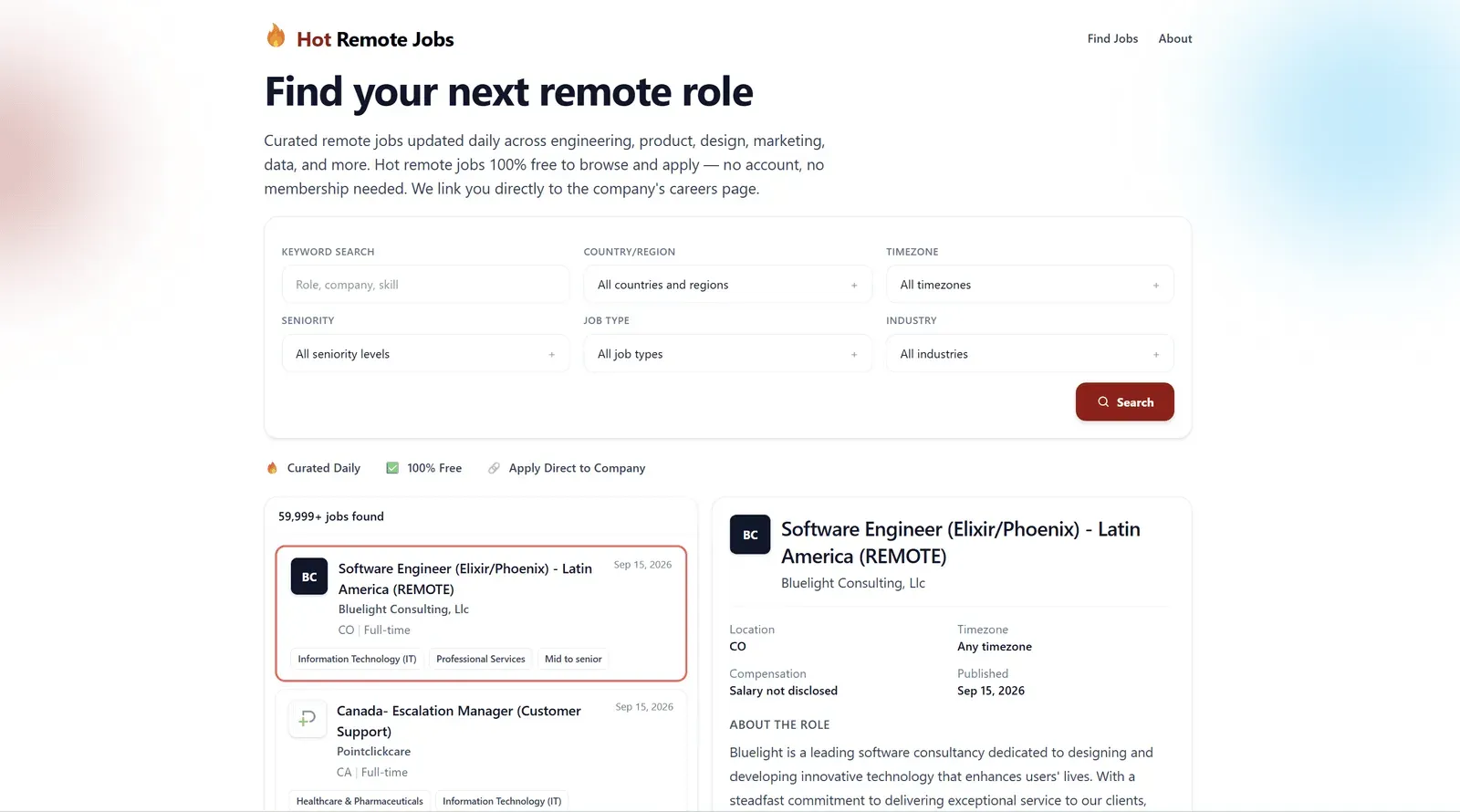
A remote job board or marketplace building supply. A project that aggregates tens of thousands of listings competes less on novelty than on usefulness, and placement on a directory read by founders and freelancers is a natural fit for tools aimed at independent workers.
A sponsor buying visibility rather than launching. Companies rather than makers can approach the platform commercially through the pricing route, taking either the front page spotlight slot or one of the three site wide partner positions to reach an audience that is by definition interested in new software.
Pricing & Value
IndieShipped publishes a dedicated pricing page, and the visible commercial mechanics on the homepage fall into two buckets. The first is the Open Slot inside In The Spotlight, described as a quiet, well seen spot on the front page. The second is the Partners block in the sidebar, which states that placement is shown site wide and that only three slots exist, with an Advertise here link pointing to the same pricing route. Boosted badges on weekly listings indicate a third, smaller promotional tier attached to individual projects.
There is no evidence on the homepage of a mandatory fee for basic participation. Submission, upvoting, browsing, and the Monday newsletter are all presented as open actions, and discovery is not gated behind a login wall. The realistic assessment is that IndieShipped runs on a freemium logic: the directory itself is free to use and to appear in, while visibility upgrades are sold to makers and sponsors who want guaranteed placement rather than a shot at the weekly ranking. For a solo builder the free path is genuinely viable, but the paid tiers matter for anyone whose launch timing cannot tolerate a low vote count.
How IndieShipped Compares to Established Launch Platforms
The obvious comparison is the large, general purpose launch sites that dominate the category. Those platforms offer enormous traffic spikes, but volume is also their weakness: a listing can be pushed off the front page within hours, and the audience skews toward people who read launches professionally rather than people who might buy. IndieShipped trades peak scale for a scheduled weekly cadence and a permanent, search optimised project page. That trade is defensible for products with a narrow niche, where a smaller but more relevant audience outperforms a large indifferent one.
A second comparison is the community forum or subreddit dedicated to showing off projects. Those venues are free and conversational, but the content is ephemeral, the formatting is minimal, and there is no ranking archive or winners page to point to later. IndieShipped adds structure: categories, maker profiles, an alternatives route, and a hall of fame style record of past winners.
The third comparison is paid product listing services and review aggregators, where placement is essentially advertising. IndieShipped does sell placement, and the Open Slot and boosted badges make that clear, yet the editorial Top Pick labels sit alongside the commercial slots rather than being replaced by them. That mixture is honest, but it also means readers should treat the spotlight area as a blend of curation and inventory.
Where the platform is genuinely differentiated is its single day rhythm. Weekly drops reduce noise, give makers a deadline to work toward, and give readers a reason to return on a predictable schedule instead of grazing all week.
Frequently Asked Questions
Is IndieShipped free to use? Browsing, upvoting, and the Monday newsletter are all presented as open, and there is no visible paywall on the homepage. Paid options exist for guaranteed placement, but basic participation and discovery appear to be free.
How often do new projects appear? New projects drop every Monday, and a live countdown on the homepage tracks the days, hours, minutes, and seconds until the next release. The archive is then split into Last Week's Best and Best Of The Month views.
What kinds of products can be submitted? Listings range from desktop recording tools and SaaS hiring suites to fitness apps, remote job boards, and content publications. The category list covers Productivity, Content, HR, Education, Mobile Apps, and Health, so the scope is broad within the indie software and small web business world.
Does each launch get its own page for SEO? Yes. IndieShipped markets the platform on the claim that every startup ships on a page built to rank, and project routes carry their own titles, descriptions, external links, and category tags. That makes a listing a lasting asset rather than a temporary post.
Are there advertising options for companies rather than makers? The site sells a front page spotlight slot and three site wide partner positions, both routed through the pricing page. Smaller boosted badges are also attached to individual weekly listings.
Final Verdict
IndieShipped is a well defined answer to a real problem: independent software makers have an abundance of products and a shortage of places where a launch is not instantly swallowed. The weekly cadence, the permanent project pages, the category directory, and the Monday newsletter form a coherent loop that respects both the maker's need for attention and the reader's need for signal. The platform is also refreshingly transparent about its commercial side, labelling boosted listings and open slots instead of hiding them.
The limitations are equally clear. The numbers published on the homepage are small, with three startups shipped by nine makers at the time of writing, and sections such as Last Week's Best and Best Of The Month still display placeholder copy. A marketplace lives or dies on volume, and IndieShipped has not yet reached the scale where a launch guarantees meaningful traffic on its own. Anyone expecting a single submission to produce a viral spike will be disappointed.
For solo developers, tiny SaaS teams, and niche publishers who want a scheduled launch moment, a durable indexed page, and an audience of fellow builders, IndieShipped is worth submitting a project to. Founders chasing maximum reach in a single day should treat it as one channel among several rather than the whole strategy, and can start by browsing the category directory to see where a submission would fit.
Pros & Cons
Pros
- A fixed Monday drop schedule with a live countdown turns discovery into a predictable appointment instead of an easily buried, always-on feed.
- Every accepted project receives a permanent, individually titled page with its own URL, description, logo, and category tags, explicitly built to rank in search.
- Browsing, upvoting, and the Monday newsletter are all open and free, while paid visibility is disclosed through boosted badges and clearly labelled open slots.
- Structured discovery layers include Spotlight picks, category directories, weekly and monthly winner archives, maker profiles, an alternatives route, and a randomised surprise option.
- Category coverage spans Productivity, Content, HR, Education, Mobile Apps, and Health, which gives non software publishers and niche content sites a place in the directory.
Cons
- Published traction remains modest, with the homepage citing only three startups shipped by nine makers, so a launch may not generate substantial traffic on its own.
- Several homepage modules, including Last Week's Best and Best Of The Month, still display empty placeholder copy rather than live listings.
- Actual price points for the front page spotlight slot, boosted listings, and the three partner positions are not shown in the page content, so advertisers must visit the pricing route to learn the cost.