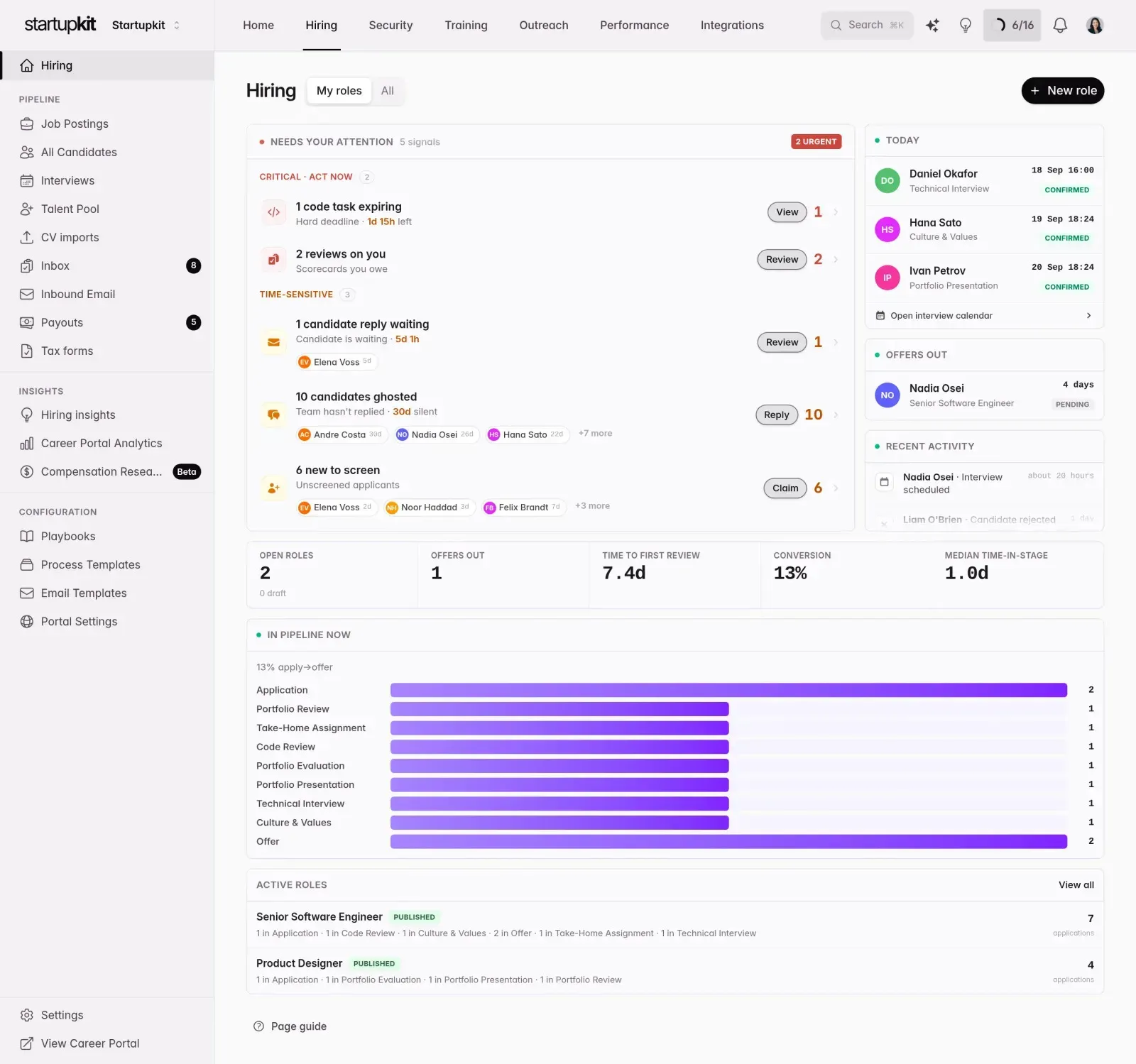
erecruit maps open Australian government ICT opportunities to the agency job ads behind them, giving recruiters contract-level intelligence.
erecruit is a specialised opportunity intelligence platform for the Australian government ICT labour hire market, built to answer a question that recruitment agencies in that sector have wrestled with for years: which advertised role sits behind which open panel contract. BuyICT publishes labour hire opportunities the moment they open, while tender panel agencies simultaneously advertise their own versions of the same work. Those two streams rarely speak to one another. erecruit fuses them by matching role, security clearance, location and timing, so a recruiter can trace a Canberra data engineering advertisement back to a named government opportunity. The platform targets recruitment agencies, talent suppliers and business development leads chasing federal and state ICT work. Against generalist job aggregators it trades breadth for depth: fewer listings, substantially more context attached to each one.
Key Features
Opportunity intelligence. Every open government ICT opportunity is held with a link to the agency advertisement running behind it, so the commercial picture and the talent advertising picture arrive as one record instead of two browser tabs. This is the capability that separates erecruit from a conventional tender alert service.
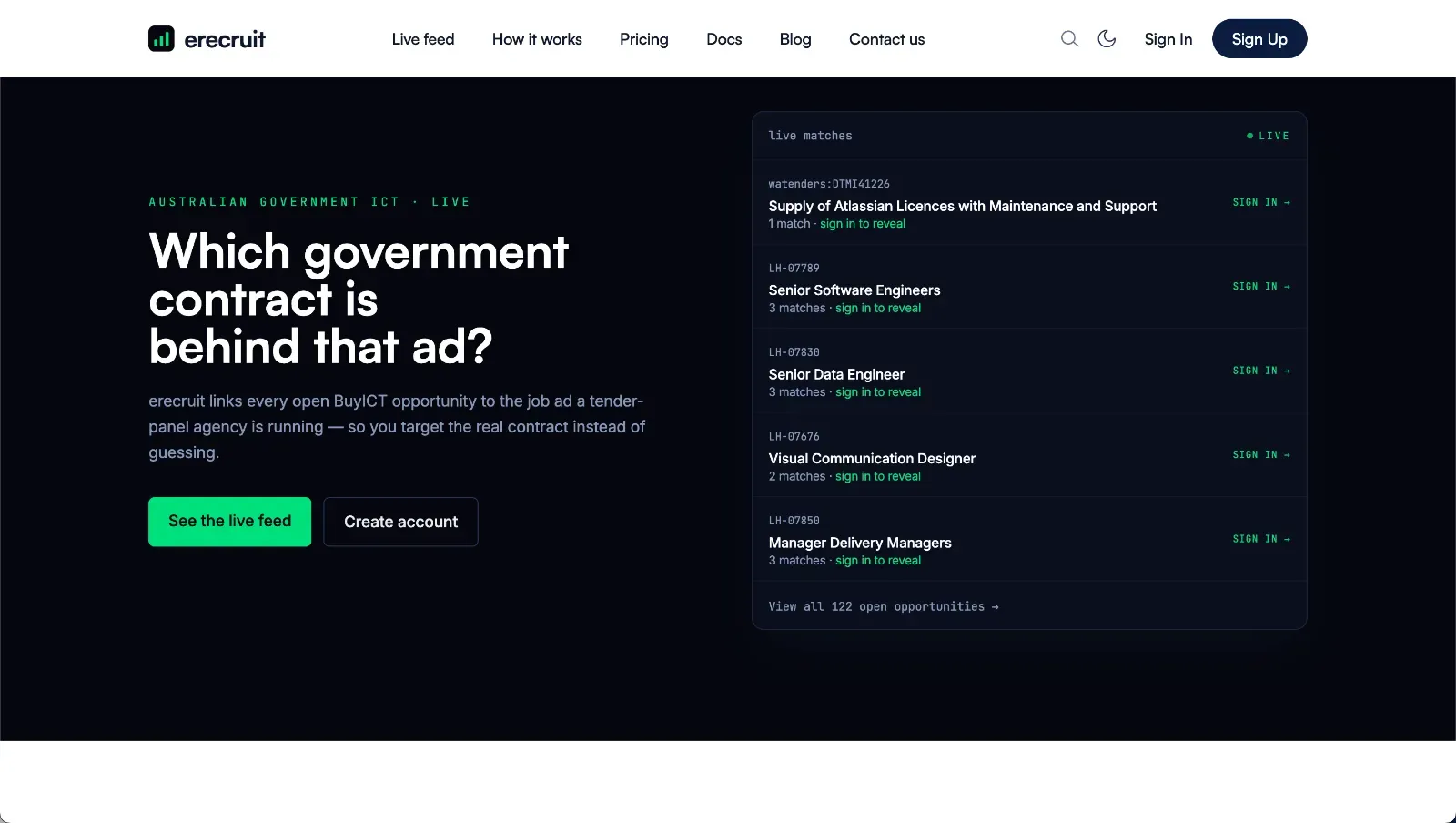
A live feed with match counts. The home page streams current openings such as LH-07789 for Senior Software Engineers, LH-07830 for a Senior Data Engineer and watenders:DTMI41226 for Atlassian licence supply, each labelled with the number of advertisements matched to it. At the time of writing the feed reported 122 open opportunities. The match count doubles as a heat signal, showing where several agencies are already crowding the same contract.
CV matching with visible evidence. Recruiters upload candidate CVs and receive a score against each role together with the reasons behind that score. The evidence framing matters. The product does not merely rank files, it explains the fit using role requirements, clearance, location and timing, which makes the output defensible in front of a hiring manager.
Candidate search and workspace import. Candidates can be discovered from external sources and imported into a cached workspace, keeping sourcing and evaluation inside one environment rather than spread across spreadsheets and inboxes. The workspace model also means repeat lookups are fast.
Pipeline kanban. Profiles move through drag and drop stages and can be filtered by opportunity, producing a per contract view of talent supply instead of one undifferentiated funnel. For agencies juggling several panel responses at once this is the difference between a shared mental model and a spreadsheet nobody trusts.
Consent gate. Representation consent is requested before a candidate is submitted, which reduces the risk of a profile being marketed without authorisation and creates an auditable trail for compliance reviews.
Recruiter dashboard. KPIs, CV matches, a needs review queue and recent activity sit on one screen, which is where a team lead would naturally start the day. Needs review exists precisely because automated scoring should never be the final word.
How It Works
The journey starts with account creation, after which the live feed becomes the working surface. Open opportunities are listed with their identifiers, titles and match counts, and the detail behind each match is revealed once a user signs in. That gating is deliberate: the intelligence sits behind authentication rather than in public view, and the call to action on every row points toward a sign in rather than an open view.
Once inside, the practical loop is straightforward. A recruiter scans the feed for opportunities that fit the agency's panel coverage, opens an opportunity to inspect the linked advertisement and the evidence behind the match, then uploads candidate CVs relevant to that role. The scoring engine returns ranked candidates with reasoning attached. Shortlisted profiles are dragged through the kanban stages, filtered by the opportunity in question, and a consent request is issued before any submission goes out. The dashboard aggregates the resulting activity so that matches, items needing review and pipeline health remain visible without manual reporting.
The model assumes a workflow built around discrete government opportunities rather than continuous generalist hiring. Teams that live inside tender cycles will recognise the shape immediately; teams that hire mostly in the private sector will find the structure unfamiliar at first.
What the Matching Evidence Actually Covers
erecruit does not treat a match as a binary flag. The platform describes matching on role, security clearance, location and timing, which are the four variables that determine whether a candidate can realistically be submitted against an Australian government ICT opportunity. Clearance is frequently the disqualifier in this market: a strong engineer without a current baseline cannot be placed on many contracts at all. Location matters because remote arrangements are applied unevenly across agencies. Timing matters because panel opportunities open and close quickly, and an advertisement that lags the procurement record is a poor lead. By exposing these dimensions alongside the match, erecruit lets a recruiter judge quality instead of trusting an opaque score. That transparency is the most defensible part of the design, and it is also what makes the product difficult to replicate without deep familiarity with the procurement calendar.
Use Cases
A boutique Canberra agency chasing a single panel. A three person agency spots LH-07850 for Manager Delivery Managers on the feed, sees three competing advertisements already matched to the contract, and uses CV matching to decide within an hour whether it holds a genuinely competitive profile. The alternative is days of manual cross referencing across BuyICT and public job boards.
A contract recruiter rebuilding a shortlist overnight. A recruiter receives a late request for a cleared Senior Data Engineer, imports candidates from an external source into the workspace, and lets the scoring engine surface the two profiles with the strongest evidence behind them. The needs review queue catches borderline matches that deserve a second look before submission.
A business development lead mapping competitive intensity. Rather than guessing which agencies are active on which contract, the business development lead reads match counts across the feed to see where competition is thin. Opportunities showing a single match become priority conversations, while heavily contested contracts are deprioritised until capacity allows.
A delivery manager protecting compliance. Before any profile leaves the building, the consent gate records authorisation. If a candidate later questions how a submission was handled, the trail already exists and the conversation becomes factual rather than defensive.
Who erecruit Is Built For
The product is unambiguously niche. It suits recruitment agencies with existing Australian government panel arrangements, independent contract recruiters who specialise in ICT placements, and supplier organisations that maintain bid and delivery teams for public sector work. It is less obviously useful for internal talent acquisition teams at large enterprises, for agencies operating outside Australia, or for recruiters whose work is primarily commercial and private sector. The narrowness is arguably a feature rather than a flaw. The matching logic depends on the specific structure of government tenders and labour hire panels, and generalising that logic across other markets would dilute the signal that makes the feed worth reading.
Pricing & Value
Pricing is published on the pricing page rather than on the landing page. What can be observed from the public site is that the live feed exposes opportunity titles, identifiers and match counts without authentication, while the identity of matched advertisements and the CV scoring engine sit behind an account. That structure points to a free tier or subscription model in which discovery is open and depth is paid. For an agency placing a single contract at typical government ICT day rates, the arithmetic favours almost any reasonable subscription, because one additional placement covers years of tooling. Agencies with no government panel coverage will find little to justify the spend, and there is no advertised free trial path beyond browsing the open feed.
How erecruit Compares to Traditional Recruitment Data Tools
Conventional tender alert services notify subscribers that an opportunity exists. Job aggregators list advertisements without knowing which contract sits behind them. erecruit occupies the gap between the two by asserting a relationship between a procurement record and a private sector advertisement, then attaching evidence to that claim. That is a harder technical problem than either alternative, and it is also the reason the product cannot be evaluated on listing volume alone. A competitor with ten thousand advertisements and no linkage offers less actionable information than a feed of 122 matched opportunities. The trade off is scale. erecruit will never match the raw reach of a generalist board, and it does not appear to try.
Frequently Asked Questions
Is there a free plan? The public feed can be browsed without an account, and the pricing page is the authoritative source for plan structure. Anything involving revealed matches or CV scoring requires signing in first.
How much does erecruit cost? Tier details live on the dedicated pricing page. Value depends heavily on whether an agency already holds government panels, since the platform's worth is measured in placements rather than in seats.
Does erecruit integrate with an ATS? The site documents CV matching and candidate import into a cached workspace. No applicant tracking system integrations are advertised on the public pages, so connectivity expectations should be confirmed before committing to an annual plan.
Who should use erecruit? Australian recruitment agencies, independent ICT contract recruiters and public sector suppliers. Generalist agencies and non Australian recruiters will find the matching logic largely irrelevant to their daily work.
How does it differ from a government tender alert? Tender alerts report that a contract exists. erecruit additionally identifies the agency advertisement behind that contract, with role, clearance, location and timing evidence attached, which is the information actually needed to act on the opportunity.
Final Verdict
erecruit solves a genuinely specific problem with an unusually direct method. The linkage between BuyICT opportunities and the private advertisements chasing them is the kind of intelligence agencies previously assembled by hand over several days, and the evidence based CV scoring and consent gate show a real understanding of how public sector recruitment compliance works in practice. The limitations are equally clear. The addressable market is small, the geography is effectively one country, and no integrations with mainstream applicant tracking systems are advertised. Social links in the footer resolve to placeholders, which suggests a young product still finishing its edges. For an Australian agency already competing for government ICT panels, erecruit is a focused tool worth evaluating against the cost of manual research. For everyone else, the niche is simply too narrow to justify attention.
Pros & Cons
Pros
- It links each open BuyICT labour hire opportunity to the specific tender panel agency advertisement behind it, replacing manual cross referencing with a single matched record.
- The live feed surfaces match counts for every opportunity, giving recruiters an immediate read on how crowded a contract already is before committing time to it.
- CV matching returns scores with the stated reasons behind them, so shortlists can be defended to hiring managers rather than presented as an opaque ranking.
- A consent gate requests representation authorisation before any candidate is submitted, creating an auditable compliance trail for public sector work.
- The recruiter dashboard consolidates KPIs, CV matches, a needs review queue and recent activity, which keeps team leads oriented without manual reporting.
Cons
- The addressable market is extremely narrow, covering Australian government ICT labour hire only, so agencies without existing panel arrangements gain little.
- The most valuable detail, the identity of matched advertisements and the CV scoring output, sits behind a sign in, making evaluation difficult before an account is created.
- The footer social links resolve to placeholder anchors and no applicant tracking system integrations or public API are advertised on the site.