1 Beat: Hit Music Game is a free four-lane rhythm game for iPhone and Android, adding per-device audio offset and no-fail scoring to the Beatstar formula.
What is 1 Beat: Hit Music Game?
1 Beat: Hit Music Game is an in-development rhythm game for iPhone and Android that sends chart-topping songs down four note lanes instead of the three lanes popularized by Beatstar. The project exists to answer a specific gap in the mobile market. Beatstar's servers were shut down permanently on 31 October 2025, which stranded a sizeable community of players who had spent years chasing perfect scores on licensed pop tracks. Rather than rebuild that game exactly, the small team behind 1 Beat has taken the three note types players already understand and widened the playfield. The result is a title that reads as familiar on first contact and considerably denser once the charts speed up.
The target audience is narrow and clearly stated. Lapsed Beatstar players are the primary constituency, followed by mobile rhythm players arriving from adjacent titles such as Magic Tiles 3. The pitch is unapologetically comparative: same portrait orientation, same tap, hold and swipe vocabulary, one extra lane, and free to play. The studio argues that one additional lane changes the combinatorics meaningfully rather than cosmetically. Three lanes offer six ways to hit one or two notes simultaneously; four lanes offer ten. That gap is where the entire design argument lives.
Positioning against alternatives is honest rather than aggressive. The site explicitly names Beatstar and Magic Tiles 3 as reference points and states plainly that it is affiliated with neither. For a product that does not yet have a downloadable build, that restraint is a sensible way to build credibility with an audience that has already been disappointed once.
Key Features
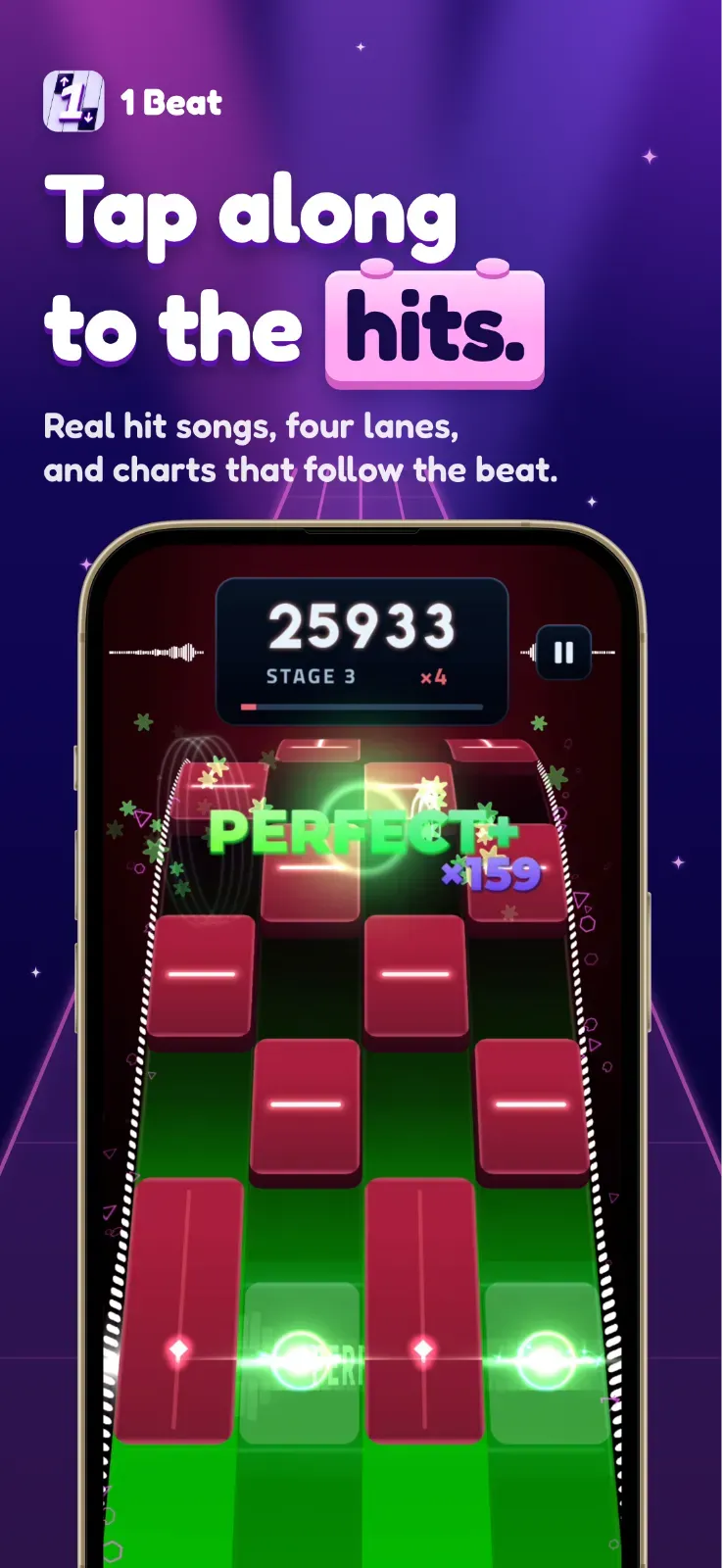
Four-lane portrait note highway. The core playfield runs vertically with four lanes and notes descending toward a white judgement line. Tapping, holding and swiping are the only three inputs, so any player who has read a Beatstar chart can read a 1 Beat chart without learning a new vocabulary. The studio frames the extra lane as additional headroom for chart design rather than additional complexity for its own sake.
Tap pads positioned below the judgement line. Rather than placing thumbs directly on the reading area, the input pads sit beneath the line. That arrangement keeps fingers from covering incoming notes on smaller screens, a small layout decision with outsized effect on readability during dense sections.
Touch-event-based timing. Judgement is calculated from the touch event itself rather than waiting for the next rendered frame. In practical terms, a dropped frame on older hardware does not silently convert into a missed note, which makes the scoring feel fairer on mid-range Android devices where frame pacing is inconsistent.
No-fail scoring by default. A poor run ends as a poor score, not as a prompt to watch an advertisement in order to continue. The studio positions this as a statement about how the game regards player time, and it separates 1 Beat from the monetization conventions of the free-to-play rhythm category.
Per-device audio offset calibration. Timing offset is stored individually for every pair of headphones used, so a player switching between wired earbuds, a Bluetooth set and a phone speaker does not need to recalibrate each session. A public audio offset calculator already exists on the site and works before the game ships.
Reduced-flashing mode. A single switch gates every visual effect rather than a subset of them. The site describes it as complete rather than partial, which matters for players sensitive to strobe-style note hits.
Weekly leaderboards. Store screenshots show a weekly leaderboard tied to friend scores, suggesting a light competitive layer built around recurring resets rather than permanent global rankings.
How It Works
The entry point at present is not an app download. Both the App Store and Google Play badges are marked as coming soon, and the only active call to action is a waitlist form that asks for an email address and promises a single notification when a build is ready. The site is explicit that nothing else will be sent, and there is no account system, no profile, and no onboarding flow to evaluate yet.
Once a build exists, the intended loop is conventional for the genre. A player opens the game in portrait, selects a track, and taps, holds or swipes notes as they cross the judgement line. Four lanes are arranged so that each thumb owns two of them, which allows patterns to split, cross and stack in configurations that three lanes cannot express. A run concludes with a score, and scores feed a weekly leaderboard.
The calibration step is the one element with a documented workflow already. Before serious play, a player measures device latency, either through the in-game offset screen or through the browser tool, then stores the resulting figure against that specific output device. The offset persists per pair of headphones, so the tedious part happens once rather than every session.
Use Cases
The displaced Beatstar veteran. A player who spent two years grinding three-lane charts and lost access when servers closed needs a successor that does not demand a new skill set. 1 Beat offers the same three note types and the same portrait frame, so the transition is a matter of relearning density rather than relearning the interface. The Beatstar shutdown guide on the site exists precisely for this reader.
The commuter on Bluetooth earbuds. Rhythm players on public transport frequently report that timing feels slightly off on wireless audio. Because the offset is stored per output device, a commuter can carry one calibration for earbuds and another for a home speaker and never touch the setting again.
The player on mid-range hardware. Frame drops on budget Android phones are a common source of unfair misses in timing games. Touch-event judgement means a stuttering frame does not invalidate an otherwise accurate tap, which is a meaningful fairness gain for anyone not carrying flagship hardware.
The photosensitive player. A single reduced-flashing toggle that gates every effect makes the game usable for players who avoid strobe-heavy interfaces, a group the genre has historically underserved.
The Beatstar Inheritance and the Competitive Field
The site is unusually candid about its lineage. A dedicated section credits Beatstar with establishing that licensed hit songs, not generic instrumental loops, are what make a three-minute run feel like the song rather than an exercise. It also credits the three-input vocabulary as sufficient, and acknowledges that perceived timing problems on wireless earbuds were an audio routing issue rather than player error. Each of those lessons is mapped to a specific decision in 1 Beat.
The competitive field is described without bravado. Beatstar is gone and the site says so directly. Magic Tiles 3 is treated as a neighbouring audience rather than a rival to be dismissed. Comparisons against SuperStar, Hi Beatz and Beat Tiles are handled on a separate page rather than in the main pitch. For a pre-launch product, the willingness to publish the comparison rather than avoid it is a reasonable trust signal.
What the site does not do is overclaim. Screenshots in the comparison section are labelled as Beatstar captures used as placeholders until 1 Beat has its own, a disclosure that most pre-launch marketing pages quietly omit.
Roadmap and Open Questions
The largest open question is the song catalogue. Licensed music is the single most expensive and most consequential input for a game of this type, and the site states plainly that there is nothing to announce. Everything else, including the four-lane design, the calibration system and the no-fail policy, is scaffolding around a music library that does not yet exist in public form.
Chart authoring is the second gap. The studio describes charts as hand-made and mentions that the charting work is still being built. The distinction between harder to master and harder to read appears repeatedly, and the stated aim is escalation in density rather than in visual noise.
Bluetooth drift is acknowledged as unsolved. A stored offset corrects a fixed latency, not a latency that shifts during playback, and the site says as much instead of pretending the problem is closed.
Pricing & Value
No pricing page exists, and there is nothing to purchase. The game is described consistently as free to play, and the no-fail-by-default policy implies an intent to avoid the watch-an-ad-to-continue loop that defines monetization in much of the free mobile rhythm category. How the studio intends to fund licensed music remains unstated, and that is the most legitimate value question a prospective player can ask. Until a build and a monetization model are published, value cannot be assessed in any meaningful sense. The free browser calibration tool is available now and costs nothing.
Frequently Asked Questions
Is 1 Beat free to play? Yes. The site describes the game as free to play in its opening paragraph. No pricing tiers, subscriptions or in-app purchase details have been published, and no store listing is live.
When can the game be downloaded? There is no release date. Both store badges are marked coming soon, and the only way to register interest is the waitlist, which promises a single email when a build is available.
What makes four lanes different from three? The studio argues that three lanes permit six combinations for hitting one or two notes at once, while four lanes permit ten. The extra lane also gives each thumb two lanes of its own, so note patterns can split and stack in ways a three-lane layout cannot accommodate.
Does it work with Bluetooth headphones? Partially. A stored offset per output device corrects fixed latency, and the site is upfront that Bluetooth drift, which changes during playback, is not fully solved by a static calibration value.
Is 1 Beat connected to Beatstar? No. The site states clearly that 1 Beat is not affiliated with Beatstar or with Magic Tiles 3, and those names belong to their respective owners. Beatstar is referenced only as a design influence.
Final Verdict
The strongest thing about 1 Beat: Hit Music Game right now is its reasoning. Every design decision on the site is tied to a stated problem: thumb occlusion, frame-dependent judgement, repeated calibration, punitive monetization, and photosensitivity. The four-lane argument is substantiated rather than asserted, and the honesty about Bluetooth drift and about placeholder screenshots is rare at this stage.
The limitation is equally clear. There is no game to play. No build, no store listing, no announced song catalogue, and no release window. For a rhythm title, the licensed music library is not a detail, it is the product, and that piece is explicitly unresolved.
Players who lost Beatstar and want a four-lane successor should join the waitlist and treat the calibration tool as a preview of the studio's approach. Anyone seeking a finished game to play this week should look elsewhere for now.
Pros & Cons
Pros
- The four-lane layout raises simultaneous note combinations from six to ten, letting charts escalate in density without introducing any new note type.
- Timing is judged from the touch event rather than the next rendered frame, so dropped frames on mid-range hardware do not register as missed notes.
- Audio offset is stored separately for every output device, so switching between wired earbuds, Bluetooth sets and speakers requires calibration only once per pair.
- No-fail scoring is the default, which means a weak run ends as a weak score instead of a prompt to watch an advertisement to continue.
- A single reduced-flashing switch gates every visual effect, and a working audio offset calculator is already public ahead of launch.
Cons
- No downloadable build exists, with both App Store and Google Play listings marked as coming soon, so none of the design claims can be verified hands-on.
- The licensed song catalogue, the single most important element for a Beatstar successor, has not been announced in any form.
- Bluetooth audio drift is openly acknowledged as unsolved, and a stored static offset cannot correct latency that shifts during playback.