RemindHer helps moms offload mental load with a shared family calendar, voice-to-task entry, and Google Calendar sync. Read the full review.
What is RemindHer?
RemindHer is a family calendar and organizer app designed specifically for moms, couples, and households who are overwhelmed by the mental load of managing kids, chores, and schedules. It combines a shared family calendar with voice-to-task entry and Google Calendar synchronization to turn scattered reminders into a single, collaborative system. The product directly targets the phenomenon where one partner, often the mother, becomes the default memory for every appointment, school form, and grocery list. Instead of relying on group chats and sticky notes, RemindHer lets families capture tasks the moment they think of them, assign owners, and view everything on a unified timeline. The app positions itself not just as a productivity tool, but as a way to redistribute invisible labor and create more equitable partnerships. What sets it apart from generic to-do apps is its family-first architecture: every feature from voice input to calendar sharing is built around the idea that household coordination is a shared responsibility, not one person's job. The website presents it as a practical solution for the modern family, with an emphasis on reducing stress and making daily life easier. The homepage opens with a bold statement: "Stop remembering everything alone." That message is echoed throughout the site, which also lists impressive figures like 20+ years of experience, 350+ happy customers, and a 98% satisfaction rate. The founder, Adi Ben Elyahu, appears to be the face of the brand, with an author image and bio on the homepage. For parents who have ever texted their partner "don't forget to pick up milk" and still ended up doing it themselves, RemindHer offers a structured alternative that externalizes memory and makes shared responsibility tangible. The product feels like a response to a very specific complaint: why do I have to remember everything? RemindHer answers by turning the family calendar into a living agreement. The app's branding is warm and approachable, with a magenta color scheme and personal messaging. The site also offers a Hebrew version, suggesting an international ambition.
Key Features
RemindHer bundles several distinct capabilities that work together to reduce the burden of family coordination. The features are not just isolated tools; they are integrated into a single workflow that mirrors how a family actually operates. Here is a closer look at the core features.
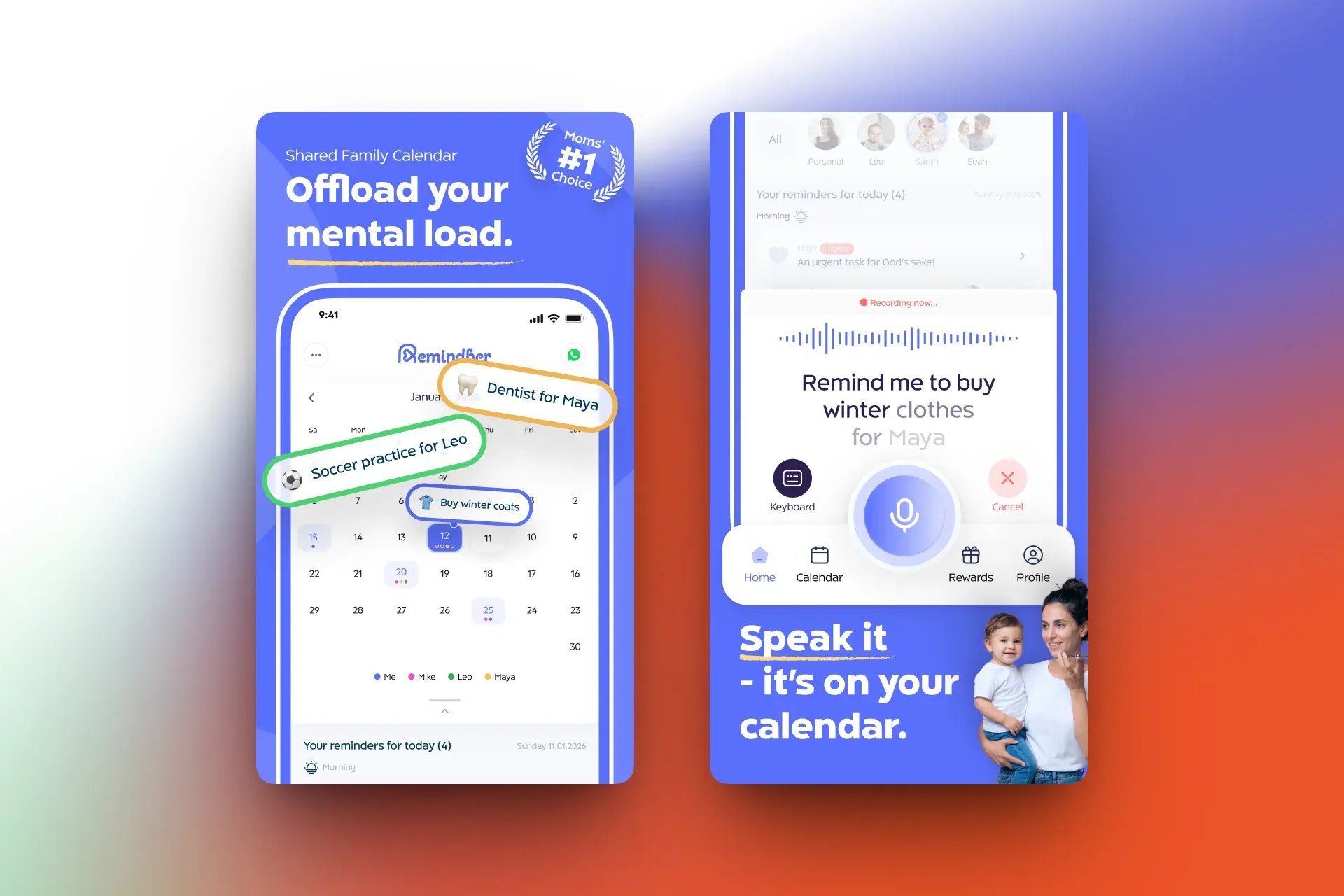
Voice-to-Task Magic is the most prominent feature on the homepage. Instead of typing out tasks, users can speak naturally, such as "Soccer practice on Wednesday at 4 PM," and the app converts the audio into a structured calendar entry. This is particularly valuable for parents with their hands full, whether they are cooking, holding a child, or driving. The voice input is described as "magic" because it removes the friction of opening an app and typing, making task capture nearly instantaneous. The screenshots on the site show a simple interface with a microphone prompt, suggesting that the voice recognition is designed to handle casual, conversational phrasing rather than rigid commands.
Shared Family Calendar sits at the center of the experience. It is a single, always-visible schedule that every family member can access. The calendar shows not only events but also tasks, with each item assigned to a specific person. This visibility is key to solving the mental load problem: when responsibilities are visible, they are harder to ignore. The design encourages partners to distribute household responsibilities rather than letting one person silently manage everything. The calendar is designed to handle recurring events, color coding, and reminders, which are essential for family life. It replaces the chaotic patchwork of individual calendars, paper notes, and group chats.
Organize Kids & Tasks Easily refers to the app's ability to handle family-specific scheduling. Users can manage school runs, extracurricular activities, and children's appointments without mixing them up with work obligations. The app supports recurring entries, so a weekly dance class or a monthly dental check-up automatically repopulates on the calendar. This reduces the cognitive effort of remembering standing commitments. The website's gallery shows multiple screens dedicated to child-related entries, reinforcing that this is not a generic task manager but one tuned to parenting.
Smart Calendar Sync integrates with Google Calendar, which is likely a dealbreaker for many users. Once connected, RemindHer sends tasks and family events to Google Calendar and pulls existing events back, creating a unified schedule. The sync is designed to maintain privacy, meaning personal work events are not exposed to the family group. This integration means users do not have to transplant their lives into a closed ecosystem; RemindHer works alongside the calendar they already use. It is a pragmatic choice that lowers the barrier to adoption.
Mental Load Offloading is not a single button but a design philosophy that pervades the product. The homepage explicitly invites users to "stop remembering everything alone." By capturing tasks externally, the app frees users from the constant effort of maintaining a mental to-do list. It turns abstract worry into concrete dates, owners, and checkboxes. The site's "Who We Are" section says RemindHer was created to support moms in their daily lives, transforming the overwhelming mental load into manageable tasks and shared responsibility. This mission-driven framing is rare in productivity software and gives the product a clear emotional appeal.
Shared Responsibility Tools go beyond a simple list. The website emphasizes distributing tasks among family members, ensuring that no one person is overwhelmed. This likely includes assigning roles, setting deadlines, and maybe even tracking completion, though detailed documentation is not fully public. The emphasis is on creating accountability and cooperation. The "What Makes Us Unique" section highlights shared responsibility as a key differentiator, arguing that the app distributes the mental load among family members.
Taken together, these features form a coherent system. The voice capture feeds directly into the shared calendar, the calendar syncs with Google, and the assignment tools make responsibilities visible. This is what distinguishes RemindHer from a collection of separate utilities.
For a more detailed breakdown, visit the RemindHer features page.
How It Works
The onboarding journey begins with creating a family profile and inviting other members. The user signs up, names the household, and then sends invitations by email or a shareable link. Once the family unit is established, the shared calendar becomes the main dashboard. The interface provides daily, weekly, and monthly views, along with a task list that shows who is responsible for what. Adding an item is extremely fast: the user taps the voice button and speaks something like "Dentist appointment for Maya, Thursday at 10 a.m." The app parses the sentence, extracts the date, time, and optional assignee, and creates an entry. If needed, the user can edit the details manually or set a recurring pattern. Google Calendar sync is a one-time connection; after linking accounts, events flow both ways. Existing Google events appear in RemindHer, and new family tasks appear in Google Calendar. This means both partners see everything without constantly cross-checking two separate apps. During the day, the user can check the calendar to see what is coming up, mark tasks as done, and receive push notifications when a family member updates an entry. The result is a low-friction workflow: speak a task, see it appear, and trust that everyone else is on the same page. The product effectively turns the smartphone into a family operations dashboard.
The app appears to be mobile-first, with multiple screenshots showing a phone interface. There is also a Hebrew version of the site, indicating the team is thinking about multilingual households. The voice-to-task feature is likely integrated with the phone's speech recognition, which means it works offline or in real time depending on the operating system. The overall user journey is designed to be as short as possible: from "I need to remember this" to "It's on the calendar" should take less than five seconds. For recurring tasks, the app eliminates the need to re-enter the same information, and the visual design uses warm, friendly colors that feel comforting rather than corporate. The mobile app seems to be designed with touch-first gestures, including swipe actions to complete or postpone tasks. The screenshots also show a "Today" view that aggregates all family members' activities, which is useful for a morning glance.
Use Cases
RemindHer is built for families of all shapes, and the website highlights several common scenarios. The use cases range from the classic nuclear family to more complex support networks.
The working mother with three kids is the archetypal user. She is juggling a career, school drop-offs, and extracurricular activities. With RemindHer, she can record a reminder for "swim class gala" while walking to the car, and her partner can see it immediately. The app reduces her job of being the family's memory bank and gives her more capacity for work and personal time. The outcome is less resentment and fewer arguments about forgotten details.
The dual-income couple without children also benefits. They manage a home, pets, and elderly parents. RemindHer helps split errands such as vet appointments, home repairs, and medical visits. The shared calendar prevents scheduling conflicts, and the visibility of assigned tasks encourages a fair division of labor. For this persona, the app functions more like a household operations tool than a parenting app, and the voice entry is just as useful for capturing a quick thought about a leaky faucet.
The single parent with a support network uses RemindHer to coordinate with grandparents, babysitters, or an ex-partner. By adding trusted people to the family group, the single parent can share school events, pick-up times, and health appointments without endless group texts. The app acts as a neutral, always-updated source of truth. It reduces the pressure of being the only one who knows the schedule, and it prevents miscommunications when a grandparent is scheduled to look after the kids.
The blended family coordinator faces the most complex scheduling challenges: custody handovers, events in two households, and multiple children with different schools. RemindHer helps harmonize these schedules, with privacy controls ensuring each household only sees what is relevant. It turns a chaotic patchwork of dates into a structured plan. While the website does not explicitly mention privacy controls in depth, the presence of a shared calendar implies that different members can be given different levels of access.
The empty-nester couple caring for aging parents also fits the product's scope. They can manage medication reminders, doctor visits, and home care helpers in a single shared space, coordinating with siblings who live elsewhere. RemindHer turns a stressful caregiving situation into a coordinated team effort.
The about page provides more context on the company's mission to support moms and transform the mental load into shared responsibility.
Pricing & Value
One of the obvious gaps in RemindHer's public communication is the absence of a transparent pricing page. The website uses a "Get Started" button that leads to a contact form, which strongly suggests the product may not have a self-serve signup or open pricing. This could mean RemindHer is currently invite-only, in beta, or sold via a subscription that requires a sales conversation. For a consumer app aimed at families, the lack of explicit pricing is a friction point; competitors like Cozi and OurHome clearly list free and premium tiers. That said, the value proposition is clear. If RemindHer saves even one hour of mental energy per week, the cost is likely justified. Families that already rely on Google Calendar will find the integration particularly valuable.
The freemium model seems plausible, given that the site is built on WordPress and uses a contact-based CTA rather than an app store link. It is possible that the product is still in pre-launch or early access, and the pricing is being decided based on subscriber feedback. For now, prospective users should contact the team directly to learn about pricing, trials, or early access. The lack of a public pricing page might be intentional, to allow the team to gauge interest and tailor offers. However, it also creates uncertainty for families who want to do quick research before committing. The website's footer shows a copyright only, without any links to a privacy policy or terms of service, which might be because the product is in early development.
Until RemindHer publishes its pricing structure, the product remains something to explore through direct outreach rather than self-service. The value for money, once a price is known, will depend heavily on whether the app can actually replace the patchwork of tools most families use today.
Frequently Asked Questions
Is RemindHer free to use?
The website does not explicitly state whether RemindHer is free or paid. Visitors are directed to the contact page, which implies that access may involve a trial or a paid plan. Reaching out to the team is the best way to get a clear answer.
Does RemindHer sync with Google Calendar?
Yes, RemindHer integrates with Google Calendar. The sync is two-way, meaning events added in either system appear in both, and it respects user privacy by keeping personal events separate from family ones.
Who is RemindHer designed for?
RemindHer is designed for moms, couples, and families who want to share household responsibilities and reduce the mental load. It is particularly useful for parents with children, but it also works for any household that needs better coordination.
Can tasks be created with voice commands?
Absolutely. The signature "Voice-to-Task Magic" feature lets users speak a task or appointment, and the app converts it into a calendar entry. This eliminates typing and makes task capture much faster.
How does RemindHer compare to a generic to-do list app?
Generic to-do apps focus on individual productivity. RemindHer is built around shared family coordination, offering a family-wide calendar, task assignment, Google Calendar sync, and a voice interface that fits parenting on the go. It treats the household as a team, not a solo user.
Is there a mobile app for iOS and Android?
The website does not explicitly list platform availability, but the many phone screenshots and the mobile-first design strongly suggest that RemindHer is a mobile application. Since the CTAs point to a contact form rather than an app store, it may be in a testing phase before a wider release.
Does RemindHer handle multiple children and stakeholders?
Yes, the app's structure allows multiple family members and multiple children's schedules to be managed together. The shared calendar and assignment tools are designed to scale across different family configurations, from a two-parent household to a broader support network.
The team also shares updates and insights on their blog, which is worth reading for anyone considering the app. The blog could provide deeper insight into the development roadmap and the founders' thinking.
Final Verdict
RemindHer tackles a real and often unacknowledged problem: the mental load that weighs on the person who remembers everything for everyone. Its voice-to-task capture, shared family calendar, and Google Calendar integration are genuinely practical features that could bring immediate relief to busy parents. The app is thoughtfully designed around cooperation rather than individual to-do lists. The emotional mission, backed by the founder's visible presence, gives it a human touch that resonates with its target audience.
However, the product is not without limitations. The lack of transparent pricing makes it hard to evaluate whether it is a better value than existent competitors. The public website is light on technical details, such as platform availability, data security, and the inner workings of the voice recognition. And while the site claims 350+ happy customers and 98% satisfaction, those numbers are anecdotal and not independently verifiable.
Still, for families who are constantly overwhelmed by scheduling chaos, RemindHer is worth a serious look. It is not a perfect product, but its focus on shared responsibility and mental load reduction fills a meaningful niche. The recommendation is to reach out for a demo or trial and see whether it fits the family's rhythm. There is also an opportunity for the company to add more social proof, such as user reviews or ratings, which would strengthen its credibility.
Pros & Cons
Pros
- Voice-to-Task Magic lets parents capture tasks hands-free, turning natural speech into calendar entries in seconds.
- A shared family calendar makes household responsibilities visible, ensuring no single partner carries the entire mental load.
- Google Calendar integration provides two-way sync while preserving privacy, so family and personal events stay separated.
- The mobile-first design is purpose-built for family life, with recurring entries and child-specific scheduling built in.
- The mission-driven branding and founder-led story, backed by a 98% satisfaction claim, resonate emotionally with the target audience.
Cons
- Pricing is not publicly listed, forcing prospective users to contact the company before they can evaluate cost.
- Public documentation lacks details on platform availability, security practices, and advanced feature configuration.
- With only 350+ happy customers and no independent reviews, social proof is limited compared to established competitors.