Matcha curates remote startup roles from 10k+ under-the-radar companies, delivering a zero-noise email of handpicked opportunities daily.
Matcha is a zero-noise job search platform that scans thousands of remote, well-funded startups each day and delivers a curated selection of roles directly to the inbox. Designed for professionals frustrated by endless job boards and irrelevant alerts, Matcha focuses on quality over quantity by leveraging algorithmic filtering and human-like curation. The platform claims to surface roles that are often missing from LinkedIn, with an average advertised salary of $175,000 and a strong emphasis on venture-backed companies. This review takes a deep dive into Matcha's features, workflow, and overall value for remote job seekers.
What is Matcha?
Matcha is an email-based job discovery service that aggregates openings from more than 10,000 remote startups and sends a single, tightly curated email each day. The service targets tech professionals—engineers, designers, product managers, and marketers—who want to avoid the noise of traditional job boards. Rather than letting users scroll through endless listings, Matcha applies a matching algorithm based on a short text description of the user's ideal role, then surfaces only the handful of positions that align closely with that profile. This positions Matcha as a middle ground between automated job alerts (like Indeed) and human-curated newsletters (like whoishiring.io), promising the efficiency of automation with the discretion of a personal recruiter.
Key Features
Curated Daily Email – The core delivery mechanism is a single email per day containing a shortlist of matching roles. The email eliminates clutter by showing only job titles, company names, salary ranges, and a brief description, with a link to apply. This forces users to engage intentionally rather than passively scroll.
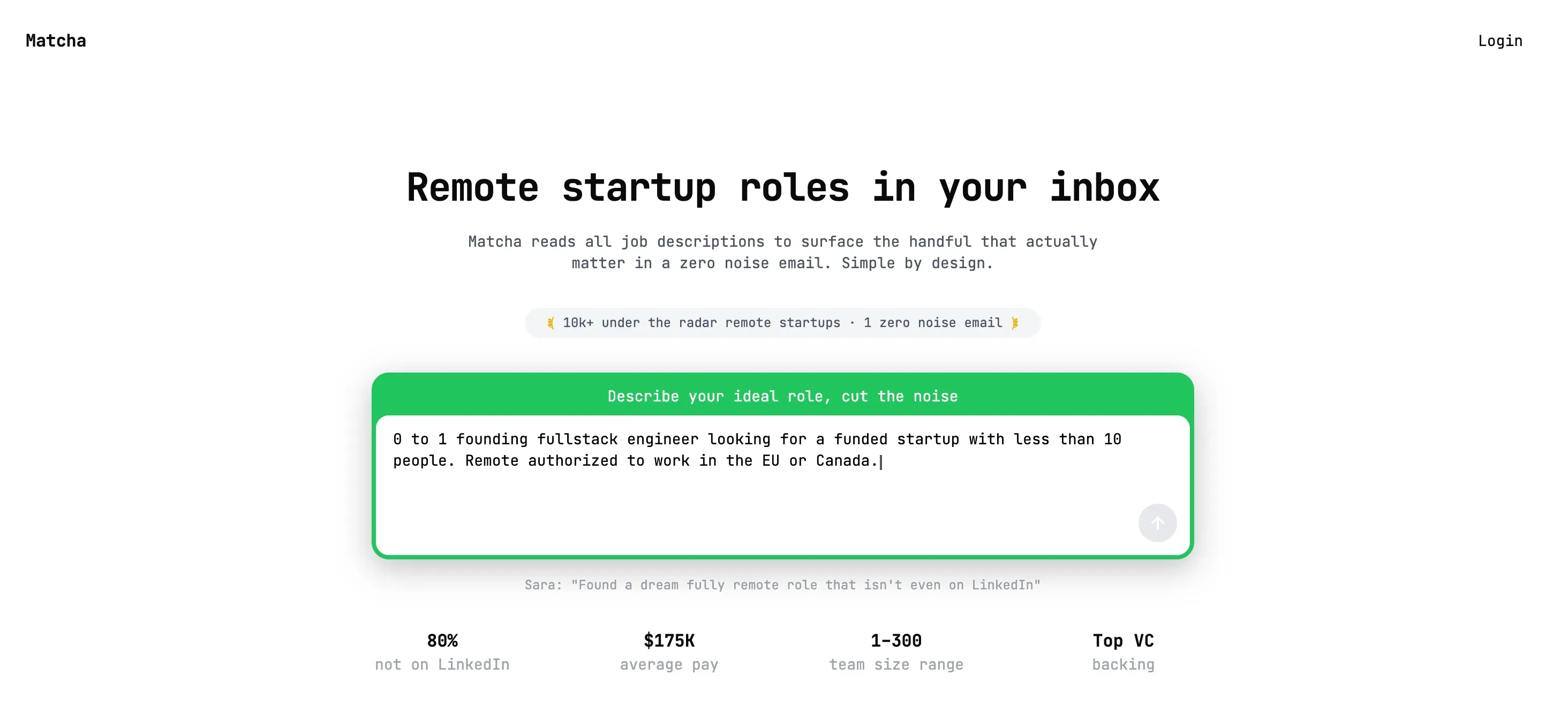
Natural Language Profile Matching – Users describe their ideal role in natural language via a textarea on the homepage. Matcha's algorithm parses this description (e.g., “senior backend engineer at a seed-stage fintech startup”) and cross-references it against the daily scan of 10k+ startups. The system adapts over time, learning from clicks and applications to refine future selections.
Exclusive Access to Off-Market Roles – Matcha highlights that 80% of the roles it surfaces are not listed on LinkedIn. This appeals to candidates who feel oversaturated on major platforms and want access to younger, venture-backed companies that favor direct applications or niche channels.
Transparent Company Data – Each job listing includes the company’s funding status (e.g., “Top VC backed”), team size (1–300 employees), and average pay ($175K). This allows candidates to filter by stage and compensation before applying, reducing time wasted on mismatches.
Simple No-Code Onboarding – There is no signup form or account creation barrier. Users write their role description and hit a button (currently disabled in the scraped version, but presumably for demo). The service likely requires only an email address to begin receiving curated matches.
Focus on Remote-First Startups – Every company in the database is remote or remote-friendly, meaning no hybrid or on-site listings clutter the feed. This makes Matcha particularly valuable for location-independent professionals.
How It Works
The user journey begins on the Matcha homepage. Instead of creating a profile or filling out a form with checkboxes, the user types a plain-English description of their ideal job into a textarea—for example, “mid-level frontend developer at a B2B SaaS startup with 20+ employees.” The algorithm behind the scenes scans the latest job postings from over 10,000 remote startups. Within 24 hours, the user receives a single email containing a ranked list of matching openings. Each listing shows company name, role title, salary range, and funding stage. The user can click to apply directly on the company’s site or career page. Over time, as the user clicks or ignores certain roles, the algorithm refines its matches. If the user wants to pause or change criteria, they can submit a new description. This workflow minimizes friction: no dashboard, no filters, no endless searching. Everything revolves around the daily email, which acts as a decision moment rather than a passive feed.
Use Cases
Senior Engineer Seeking Series A Startup – A senior software engineer looking for high-agency roles at early-stage companies can describe their preference for Series A startups with 10–50 employees. Matcha surfaces roles from companies like those backed by Sequoia or a16z, often with equity offers not advertised on LinkedIn.
Career Changer Exploring Remote Roles – A marketer transitioning into product management can describe “junior PM role at a remote-first, VC-backed startup.” Matcha filters for entry-level openings and provides salary transparency to gauge realistic expectations.
Overwhelmed Job Seeker Reducing Noise – A product designer tired of 50+ daily alerts from LinkedIn can rely on Matcha to condense opportunities into one email with the 5–10 most relevant roles, saving hours of manual browsing.
Passive Candidate Testing the Market – Even someone not actively looking can subscribe with a vague description (e.g., “interesting AI startup roles”) and receive a low-commitment weekly digest, discovering opportunities without the pressure of a full search.
Pricing & Value
The Matcha website does not explicitly display pricing tiers. The homepage emphasizes a free experience: “10k+ under the radar remote startups · 1 zero noise email.” There are no mentions of a paid plan, upgrade prompts, or feature limits. This suggests that the current version is entirely free, likely supported by venture funding or future premium features (e.g., priority matching, analytics). Assuming the service remains free, the value is significant for job seekers who would otherwise spend hours curating their own search. If a paid plan is introduced, a reasonable price point would be $10–$20 per month for additional personalization or unlimited daily updates. For now, the zero-cost entry makes it a no-brainer for remote job seekers.
Frequently Asked Questions
Is Matcha free to use? Based on the website, there is no mention of payment. Users can describe their ideal role and receive a curated email without a credit card. It is currently free.
How many jobs will I receive per email? Matcha does not specify a number, but typical curators send between 3 and 15 roles per email. The focus is on quality, so users should expect a handful of highly relevant matches.
Can I browse jobs on the website instead of email? The site includes a /jobs page that shows aggregated statistics (80% not on LinkedIn, $175K average pay, team size, VC backing), but it redirects to a promotional page rather than a searchable board. Active browsing is not supported; the service is email-centric.
Who is Matcha for? Matcha is designed for professionals seeking remote roles at venture-backed startups, particularly those who want to avoid large job boards and discover lesser-known companies. It is best suited for tech roles (engineering, product, design, marketing) where salary transparency and startup culture matter.
How does Matcha differ from other job search tools? Unlike LinkedIn or Indeed, Matcha does not have a user-facing job board or apply filters. It uses a natural language description to generate matches behind the scenes and delivers them via email. This reduces screen time and decision fatigue. Competitors like Hacker News’ Who Is Hiring or Remote OK offer similar curation but require manual effort to filter.
Final Verdict
Matcha excels at reducing job search overload for remote professionals, especially those targeting well-funded startups. Its single-email-per-day model is a refreshing departure from notification-driven platforms. The transparency on salary and funding stage adds trust. However, the lack of an interactive job board and the reliance on email-only delivery may frustrate users who want to browse or compare listings visually. Additionally, the algorithm’s quality depends entirely on the user’s written description, which can be ambiguous. Overall, Matcha is a valuable tool for passive and active job seekers alike who value curation over volume. Anyone tired of spammy alerts and willing to trust an algorithm’s picks should give it a try.
For a closer look at how Matcha presents its value proposition, visit their jobs overview page. If you're curious about the company's origin and team, you can explore the main site for more context.
Pros & Cons
Pros
- Culls roles from over 10,000 remote startups daily, many of which are not listed on LinkedIn, expanding the candidate's pool.
- Delivers a single curated email per day instead of a feed, drastically reducing the noise and time spent on job searching.
- Provides salary transparency upfront with an average advertised pay of $175,000, helping candidates assess fit quickly.
- Uses natural language descriptions for matching rather than rigid filters, allowing more nuanced role alignment.
- Highlights venture capital backing and team size, giving insight into company stage and stability before applying.
Cons
- Lacks an interactive job board or dashboard, forcing users to rely solely on email for discovery and review.
- No visible pricing information or commitment to a free tier long-term, creating uncertainty about future costs.
- The matching algorithm depends heavily on the quality of the user's written description, which can lead to irrelevant matches if input is vague.