SnitchFeed is an AI social listening platform that helps B2B startups surface high-intent leads and competitor mentions across LinkedIn, X, and Reddit.
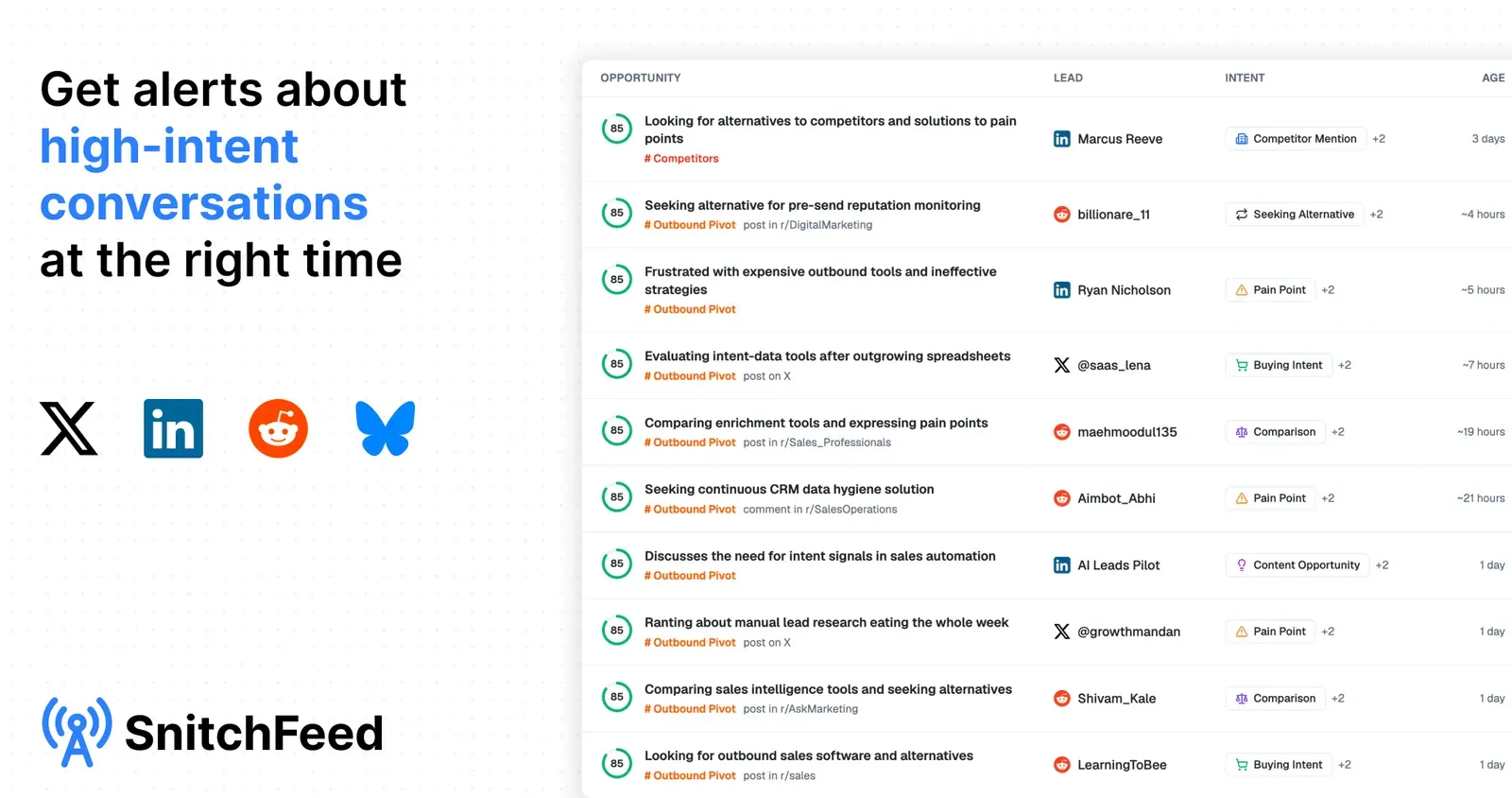
SnitchFeed is an intent-based social listening platform designed for go-to-market teams at startups and small to midsize businesses. Rather than mining static contact databases for cold prospects, the product monitors public conversations across LinkedIn, X, Reddit, Bluesky, and Hacker News to identify people who are actively describing a problem that a given company can solve. The platform's central argument is that the most valuable prospects announce themselves in public long before they ever fill out a demo form, and the company that responds first wins the conversation. It targets founders, sales leaders, marketers, and growth operators who want real-time signal instead of a steadily decaying list.
What is SnitchFeed?
SnitchFeed is an AI-powered social listening tool that turns public posts and comments into qualified pipeline for B2B SaaS and startup teams. The core problem it addresses is the gap between cold outreach and genuine buying intent, because most prospecting tools surface contacts who happen to match a filter, while SnitchFeed surfaces people who have literally asked for a solution. It is built for startups, SMBs, and lean GTM teams that cannot afford a dedicated sales development function but still need a steady flow of warm conversations. Users describe their ideal customer in plain language, and the platform handles the rest, scanning the supported networks around the clock and pushing qualified matches into the tools the team already relies on.
Key Features
-
AI Scoring and Tagging: Every mention that reaches a feed has already been evaluated by AI for relevance, buying intent, and sentiment. Keyword hits that do not represent a genuine signal are discarded, which keeps the dashboard focused on actionable posts instead of raw volume.
-
Boolean Search: Users can combine keywords with AND, OR, and NOT operators to describe exactly the conversations they want and precisely the ones they do not. Job postings, promotional content, and off-topic threads are excluded automatically, reducing the manual triage that plagues simpler monitoring products.
-
Real-Time Alerts: Matches can be delivered through Slack, Discord, email, or a webhook. Teams choose between instant pings for high-priority signals and digest summaries for everything else, so the notification stream fits existing workflows rather than competing with them.
-
Instant Historical Results: Instead of waiting days for new posts to accumulate, SnitchFeed streams historical data in real time, meaning a first session can surface leads that already exist on the open web. That shortens the distance between signup and the first booked conversation considerably.
-
Webhook Integrations: The platform fires a webhook the moment a match lands, allowing routing into HubSpot, Salesforce, Notion, Zapier, Make, or a custom internal pipeline. If a system accepts a webhook, it can receive SnitchFeed leads without bespoke development work.
-
Noise Controls: Users can block entire domains, exclude specific authors, filter by engagement thresholds, and mute recurring false positives. Rules are configured once and then run quietly in the background.
-
Multi-Platform Coverage: LinkedIn, X, Reddit, Bluesky, and Hacker News are monitored live, with GitHub, dev.to, YouTube, and newsletters listed as forthcoming additions to the coverage map.
How It Works
Onboarding begins with a natural language description of the ideal customer. A user might type a sentence about the job titles, industries, and problems that define a good fit, and SnitchFeed translates that description into listeners that run continuously in the background. Setup is advertised as taking roughly five minutes, and the company claims first matches arrive within sixty seconds because historical data is streamed immediately rather than waiting for new posts to trickle in.
From there, the workflow is largely passive. The system scans the supported networks around the clock, applies AI scoring and sentiment tagging, and routes the strongest matches to whichever channels a team has configured. A typical daily routine involves opening the SnitchFeed dashboard or a dedicated Slack channel, reviewing scored mentions, replying to the highest-intent posts, and letting webhooks push the remainder into a CRM or an outreach sequence. Listeners can be tuned over time by adjusting keywords, adding exclusions, or raising engagement thresholds whenever a feed starts to feel noisy.
Use Cases
The solo founder hunting first customers. An early-stage founder cannot justify a sales team but can monitor Reddit and LinkedIn for people asking for recommendations. Using plain-language intent descriptions paired with real-time alerts, the founder receives a Slack ping the moment a relevant post appears and replies before larger competitors notice the thread at all.
The competitive displacement play. A marketing lead at a B2B SaaS company sets up listeners around competitor brand names and complaint language. When a frustrated user publicly describes a missing feature or a billing problem, SnitchFeed flags the post within minutes, giving the team a narrow window to offer a better solution and convert a dissatisfied customer.
The brand monitoring war room. When a negative mention or product complaint appears, speed determines whether it becomes a crisis. By catching complaints in minutes rather than days and responding publicly, a support or community team can resolve issues before sentiment spreads and often convert an angry user into a visible advocate.
The product research loop. Product managers use SnitchFeed to listen for users describing needs in their own words, which is a far more honest signal than a survey response. Those conversations feed directly into roadmap prioritization and messaging tests.
Frequently Asked Questions
Is there a free trial? Yes. SnitchFeed offers a seven-day free trial with no credit card required, and the company advertises that first matches appear within sixty seconds of onboarding.
Which platforms does SnitchFeed monitor? LinkedIn, X, Reddit, Bluesky, and Hacker News are supported live. GitHub, dev.to, YouTube, and newsletters are listed as coming soon.
How much does SnitchFeed cost? The Starter plan runs $47 per month when billed yearly, or $59 monthly, with 7,000 credits, 10 tracked terms, and three Listeners. The Pro plan is $95 per month annually, or $119 monthly, with 21,000 credits, 30 tracked terms, 10 Listeners, webhooks, CSV exports, and support for five users. A custom tier starts at $399 per month.
Does SnitchFeed integrate with CRMs and automation tools? The platform fires webhooks on every match, which allows routing into HubSpot, Salesforce, Notion, Zapier, or Make. Native Slack and Discord alerting is included on all paid tiers, though webhook automations are restricted to Pro and above.
Who is SnitchFeed built for? It is aimed at B2B SaaS founders, sales leaders, marketers, and community or product teams at startups and SMBs. It is a weaker fit for large enterprises that already operate a complex social listening stack.
Pros & Cons
Pros
- AI scoring evaluates relevance, buying intent, and sentiment on every match, so promotional posts and spam never reach the inbox.
- Instant historical data streaming means new accounts surface existing leads within the first minute instead of waiting days for fresh posts.
- Webhook-driven delivery routes matches into HubSpot, Salesforce, Notion, Zapier, or Make without custom engineering effort.
- Transparent tiered pricing starting at $47 per month undercuts most enterprise-grade social listening suites.
- A seven-day free trial with no credit card required lowers the barrier to evaluating the platform.
Cons
- Only five platforms are live, with GitHub, dev.to, YouTube, and newsletters still marked as coming soon.
- Webhook automations and CSV exports are locked behind the Pro tier, which limits the entry plan for automation-heavy teams.
- Data retention is capped at three months on Starter and six months on Pro, constraining long-term historical analysis.