Alternative.tools is an independent discovery platform for new websites, tools, and products, featuring curated lists, unbiased reviews, and practical alternatives.
What is Alternative.tools?
Alternative.tools is a curated discovery platform that helps founders, makers, and product enthusiasts find the best newly launched websites, tools, and SaaS products while also exploring viable alternatives. Instead of relying on community upvotes or algorithm-driven feeds, this directory focuses on editorial judgment: each listing is manually reviewed, categorized, and often accompanied by an in-depth article that examines features, pricing, and real-world utility. The platform positions itself as an independent resource for anyone who wants to cut through the noise of daily product launches and evaluate software based on substance rather than hype.
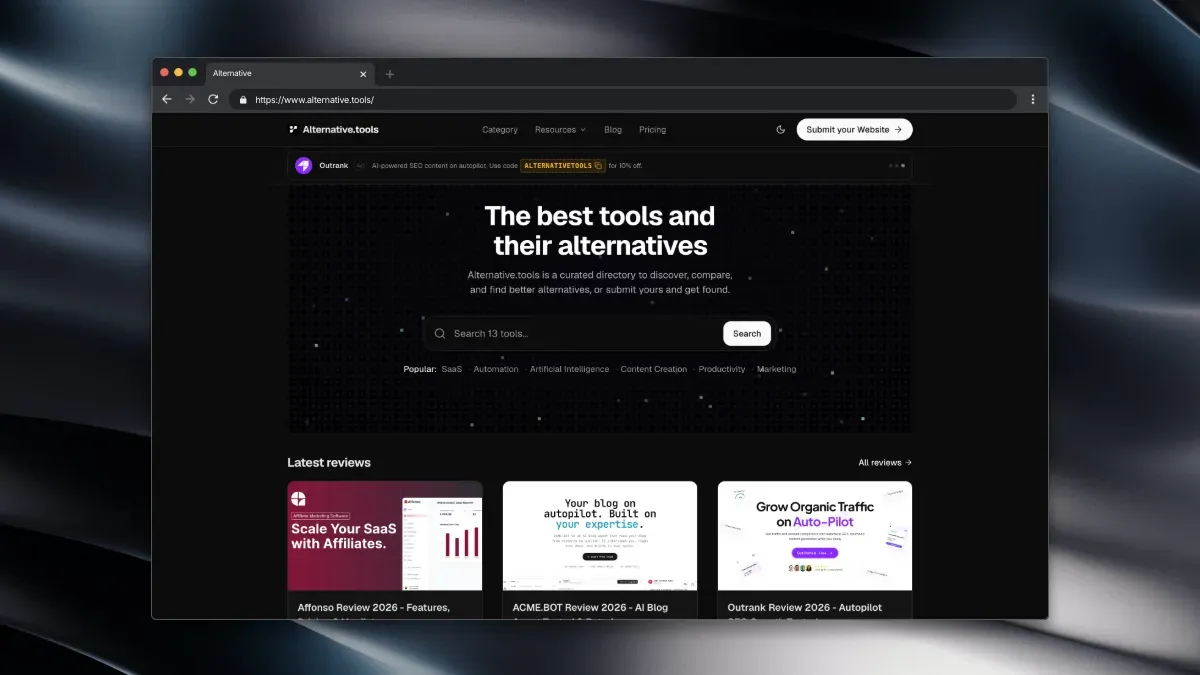
Unlike mainstream directories such as Product Hunt, where popularity often overshadows quality, Alternative.tools emphasizes structured organization and thoughtful analysis. The homepage presents a searchable database, a list of top products, recently added tools, and a blog filled with detailed reviews. For users, the value proposition is simple: discover what is genuinely useful, understand its strengths and limitations, and compare it against other solutions in the same category. The site also offers guides, how-to playbooks, a glossary of SEO and directory terms, and a "Best for" section that recommends tools for specific use cases, making it a comprehensive resource beyond mere listing.
Given its current size, with only a handful of tools indexed, the platform appears to be in its early stages. However, the quality of the editorial content and the thoughtful categorization suggest that the team behind Alternative.tools is building something that could become a trusted reference point for evaluating new software. This review explores the platform's core features, user experience, pricing model, and overall value proposition, providing an analytical look at what it currently offers and where it might be headed.
Key Features
Alternative.tools packs a surprising number of features into a modestly sized directory. Each element is designed to assist in tool discovery, comparison, and educational depth. Below are the most notable capabilities visible on the public homepage and its immediate subpages.
-
Curated Directory Listings – The heart of the platform is its curated directory, which classifies products into categories such as SaaS, Artificial Intelligence, SEO, Analytics, Design, and Social Media. Categories are displayed with counts, making it easy to gauge the depth of each niche. Top products are featured with rank numbers, logos, and one-line descriptions, while a "Recently Listed" section surfaces the newest additions. This curation ensures that every tool listed has passed some level of editorial review, reducing the noise common on community-driven sites.
-
In-depth Blog Reviews – The blog is one of the most valuable parts of Alternative.tools. Each review follows a structured format: a title that includes the year, a thumbnail image, and a descriptive snippet that summarizes the product. For example, reviews like "Affonso Review 2026 – Features, Pricing & Verdict" and "ACME.BOT Review 2026 – AI Blog Agent Tested & Rated" give immediate insight into what the tool does and how it was evaluated. The reviews are written in a journalistic style and typically cover features, pricing, and a verdict, providing actionable information for prospective buyers.
-
Educational Resources – Beyond reviews, the platform offers a dedicated resources section with Guides, How-to playbooks, and a Glossary. The Guides are in-depth comparisons of the best tools in specific categories, such as SEO software. How-to articles are step-by-step playbooks for founders, covering topics like directory submission services and SaaS payments. The Glossary explains key SEO and directory terms, making the site a useful reference for newcomers to the software space.
-
Submission System – For product owners, the "Submit your Website" button on the header leads to a submission page where new tools can be added. The footer links to a dedicated "Submission Guidelines" page, indicating that there are criteria for acceptance. While the current homepage does not expose detailed pricing for submissions, the existence of a pricing page suggests that featured placements may involve a fee. This system is essential for growing the directory and giving new products a chance to gain exposure.
-
Search and Filtering – The homepage features a prominent search bar with a placeholder that reads "Search 13 tools…" This reveals the current database size, but the functionality is not limited to a single box. Users can browse by category, sort by featured or newest, and navigate through curated sections like "Top Products" and "Recently Listed." The search is fast and responsive, making it easy to find a specific product or explore a category.
-
Additional Sections – The footer and sidebar reveal further depth: a "Google Graveyard" page tracks discontinued Google services, a "Best for" section recommends tools by use case, and there are links to an About page, Contact page, and legal documents. The sidebar also displays a "Featured Guide" and "Newest Software" widgets, keeping the most relevant content accessible. Moreover, an LLMs.txt file is available for AI crawlers, indicating a forward-thinking approach to discoverability.
How It Works
The typical user journey on Alternative.tools begins with visiting the homepage, where a large hero section asks, "The best tools and their alternatives." Below that, a search bar invites users to type a query, and popular categories are listed as quick links. A first-time user might start by browsing a category, such as "Artificial Intelligence," which displays all listed tools with their logos, descriptions, and categories. Each tool name links to a dedicated detail page (though those individual pages are not part of this analysis, they are clearly linked from the listing cards).
After discovering a tool, the user may click through to a detailed blog review. These reviews are accessible both from the "Latest reviews" carousel on the homepage and from the blog section. Each review provides a deep dive into the product's features, pricing, and overall verdict. The user can then compare multiple reviews to understand how different tools stack up. Alternatively, the user can explore the resources section, which includes guides that compare categories like SEO tools side by side, offering a more structured comparison.
For product owners, the workflow is different. To get listed, the owner navigates to the "Submit your Website" page, presumably fills out a form with details about the product, and submits it for review. The exact process is not detailed on the homepage, but the presence of submission guidelines suggests that there is a vetting process. After approval, the product may appear in the "Recently Listed" section, and potentially later in categories or the featured "Top Products" list. Given the editorial nature, approval is likely selective, which maintains quality but also introduces a bottleneck.
Daily users of the platform, whether they are searching for a new CRM, an AI writing tool, or a social media scheduler, will find the experience straightforward: landing on the site, using the search or category navigation, reading a review or guide, and then visiting the external product website via the provided links. The site also supports dark mode? A theme toggle is visible in the header, allowing users to switch between light and dark interfaces, which is a nice touch for extended reading sessions.
Use Cases
Alternative.tools serves a diverse set of users, each with distinct needs. Here are three concrete scenarios where the platform shines.
-
A founder researching tools for a new startup – Early-stage founders often need to assemble a stack of efficient, affordable SaaS products. By browsing categories like SaaS, Automation, and Productivity, a founder can quickly see what tools are new, what alternatives exist, and how they are priced. For instance, the review of DataFast, a revenue analytics tool, highlights its focus on driving paying customers rather than vanity metrics, which is exactly the kind of insight a founder needs when choosing analytics software. The guides, such as the SEO Tools comparison, also help founders make budget-conscious decisions.
-
A marketer comparing products for a client campaign – Marketing teams are always evaluating new tools for content creation, social media management, and SEO. On Alternative.tools, a marketer could land on the Postiz review to learn about an all-in-one social media scheduling tool with AI agents, then compare it with other marketing tools listed under the Marketing category. The "Best for" section adds another layer, offering curated picks for specific use cases. The editorial tone and inclusion of pricing tiers in reviews make it easier to present a business case to a client.
-
A product creator looking to get discovered – An indie hacker who just launched a new AI tool can submit it to Alternative.tools to gain visibility. The submission process is straightforward, and if accepted, the tool is listed in the directory. Unlike larger directories where new products get buried within hours, the curated nature here offers a better chance of being seen. The platform also provides a blog review if the product catches the editor’s attention, which can serve as an authoritative backlink and social proof. For a maker looking to build an audience, that kind of exposure is invaluable.
Pricing & Value
Alternative.tools appears to operate on a freemium model for its users. The directory itself is completely free to browse: there is no paywall for reading reviews, accessing guides, or searching the database. The site generates revenue likely through paid submissions or featured placements, as indicated by the existence of a Pricing page separate from the free submission process. However, the exact pricing tiers and what they include are not displayed on the public homepage, which creates a degree of opacity.
From a user perspective, the value is clear: access to high-quality editorial content and a curated list of tools without spending a dime. For product owners, the value proposition depends on the cost and reach. If the pricing is reasonable and the directory continues to grow, a paid placement could be a worthwhile investment for early-stage products seeking backlinks and targeted traffic. As the database is currently small, the immediate value for submitters may be limited, but the potential for future growth is there. In comparison to alternatives like Product Hunt (which offers free and paid options), Alternative.tools differentiates itself through editorial quality rather than community size.
Frequently Asked Questions
Is Alternative.tools free to use?
Yes, browsing the directory, reading blog reviews, and accessing guides is completely free. The site is supported by submissions and possibly featured listings, but users do not need to pay to discover tools.
How do I get my website listed on Alternative.tools?
To get listed, go to the "Submit" page, which is linked from the header. The platform has submission guidelines, and after review, your website will appear in the directory if approved. The exact requirements are detailed on the submission page itself.
Does Alternative.tools publish reviews of every tool?
No, not every tool gets a dedicated blog review. The blog reviews appear to be reserved for select products that the editorial team finds noteworthy. However, all accepted tools are listed in the directory with a category tag and description.
What kinds of products are featured on the site?
The directory includes a wide range of software categories: SaaS, AI tools, SEO platforms, marketing software, analytics, design tools, developer tools, fintech, and more. The category list on the homepage gives a snapshot of the current coverage.
How does Alternative.tools compare to other directories like Product Hunt?
Unlike Product Hunt, which depends on community upvotes and has a massive volume of launches, Alternative.tools is a curated directory with a smaller database and editorial oversight. This results in higher quality listings but less traffic. It is better suited for users who want thorough reviews rather than a fleeting 'upvote and move on' culture.
Final Verdict
Alternative.tools is a promising niche directory that fills a gap left by mainstream platforms. Its focus on editorial quality, in-depth reviews, and structured resources sets it apart from the noise of daily launches. The main strengths are evident: a clean user interface, thoughtful categorization, and valuable content that goes beyond simple listings. The platform also supports discoverability through its guides, glossary, and how-to articles, making it a one-stop resource for tool research.
However, the current limitations are hard to ignore. The database is incredibly small, with only 13 tools indexed at the time of analysis, which severely limits its usefulness for users seeking a broad range of options. Additionally, the lack of transparent pricing information for submissions could deter potential submitters, and the editorial process may become a bottleneck as the site grows. Despite these drawbacks, for founders and early adopters who value depth over breadth, Alternative.tools is worth watching. As the directory expands and the team continues publishing high-quality reviews, it has the potential to become a trusted alternative to the giants in the space. For now, it is a well-intentioned but underequipped contender, best used as a supplementary research tool alongside larger directories.
For a deeper look at how the platform organizes its offerings, visit the category directory to see the full scope of listed tools. The latest reviews on the blog provide a taste of the editorial depth. And if there is a product that deserves a place, the submission page is where the journey begins.
Pros & Cons
Pros
- Curated directory with hand-picked listings across multiple categories, ensuring quality over quantity.
- In-depth editorial reviews on the blog provide detailed analysis of each tool, aiding decision-making.
- Additional resources like guides, how-to playbooks, glossary, and best-for pages offer substantial educational content.
- Simple submission process for new products, making it easy for founders to get discovered.
- Clean, searchable interface with featured and recently listed sections for efficient discovery.
Cons
- Limited database size, currently only 13 tools indexed, which may not cover enough ground for broad discovery.
- No visible pricing details for submissions on the homepage, creating uncertainty for potential submitters.
- The site lacks social login or community features, so interaction is one-way between editors and users.